 Add to Chrome
 Add to Firefox
 Add to Edge
From Core to Detail: Unsupervised Disentanglement with Entropy-Ordered Flows
Feb 06, 2026
Learning unsupervised representations that are both semantically meaningful and stable across runs remains a central challenge in modern representation learning. We introduce entropy-ordered flows (EOFlows), a normalizing-flow framework that orders latent dimensions by their explained entropy, analogously to PCA's explained variance. This ordering enables adaptive injective flows: after training, one may retain only the top C latent variables to form a compact core representation while the remaining variables capture fine-grained detail and noise, with C chosen flexibly at inference time rather than fixed during training. EOFlows build on insights from Independent Mechanism Analysis, Principal Component Flows and Manifold Entropic Metrics. We combine likelihood-based training with local Jacobian regularization and noise augmentation into a method that scales well to high-dimensional data such as images. Experiments on the CelebA dataset show that our method uncovers a rich set of semantically interpretable features, allowing for high compression and strong denoising.

Analyzing Generative Models by Manifold Entropic Metrics
Oct 25, 2024
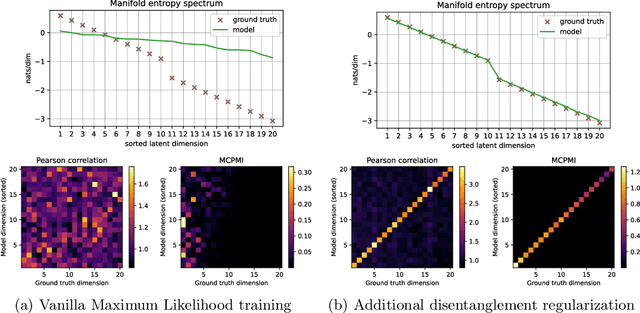

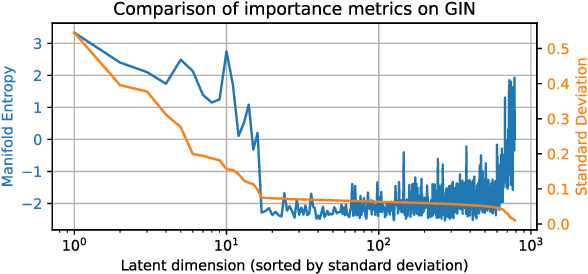
Good generative models should not only synthesize high quality data, but also utilize interpretable representations that aid human understanding of their behavior. However, it is difficult to measure objectively if and to what degree desirable properties of disentangled representations have been achieved. Inspired by the principle of independent mechanisms, we address this difficulty by introducing a novel set of tractable information-theoretic evaluation metrics. We demonstrate the usefulness of our metrics on illustrative toy examples and conduct an in-depth comparison of various normalizing flow architectures and $\beta$-VAEs on the EMNIST dataset. Our method allows to sort latent features by importance and assess the amount of residual correlations of the resulting concepts. The most interesting finding of our experiments is a ranking of model architectures and training procedures in terms of their inductive bias to converge to aligned and disentangled representations during training.