 Add to Chrome
 Add to Firefox
 Add to Edge
Local Additive Feature Attribution: A Mathematical Taxonomy and Reporting Checklist
Jul 15, 2026
Feature-attribution methods are central to explainable artificial intelligence. Their assumptions are expressed in several mathematical languages: cooperative-game values, path integrals, gradient operators, perturbation distributions, and backpropagation rules. This survey proposes a common framework for local additive feature attribution. It organizes Shapley, path-based, gradient/backpropagation, perturbation, and CAM-style methods around five specification choices: value function, reference, path, perturbation distribution, and conservation rule. It then compares these methods through an axiom-by-method matrix and links common failure modes, including baseline sensitivity, off-manifold perturbations, sanity-check failures, adversarial manipulation, and method disagreement, to the assumptions that produce them. Finally, the survey proposes a ten-item reporting checklist for studies that use local additive attributions. The central message is that attribution results are meaningful only relative to the mathematical assumptions under which they are defined, and that those assumptions should be reported.

When "Better" Prompts Hurt: Evaluation-Driven Iteration for LLM Applications
Jan 29, 2026Evaluating Large Language Model (LLM) applications differs from traditional software testing because outputs are stochastic, high-dimensional, and sensitive to prompt and model changes. We present an evaluation-driven workflow - Define, Test, Diagnose, Fix - that turns these challenges into a repeatable engineering loop. We introduce the Minimum Viable Evaluation Suite (MVES), a tiered set of recommended evaluation components for (i) general LLM applications, (ii) retrieval-augmented generation (RAG), and (iii) agentic tool-use workflows. We also synthesize common evaluation methods (automated checks, human rubrics, and LLM-as-judge) and discuss known judge failure modes. In reproducible local experiments (Ollama; Llama 3 8B Instruct and Qwen 2.5 7B Instruct), we observe that a generic "improved" prompt template can trade off behaviors: on our small structured suites, extraction pass rate decreased from 100% to 90% and RAG compliance from 93.3% to 80% for Llama 3 when replacing task-specific prompts with generic rules, while instruction-following improved. These findings motivate evaluation-driven prompt iteration and careful claim calibration rather than universal prompt recipes. All test suites, harnesses, and results are included for reproducibility.
FedGraph-VASP: Privacy-Preserving Federated Graph Learning with Post-Quantum Security for Cross-Institutional Anti-Money Laundering
Jan 25, 2026Virtual Asset Service Providers (VASPs) face a fundamental tension between regulatory compliance and user privacy when detecting cross-institutional money laundering. Current approaches require either sharing sensitive transaction data or operating in isolation, leaving critical cross-chain laundering patterns undetected. We present FedGraph-VASP, a privacy-preserving federated graph learning framework that enables collaborative anti-money laundering (AML) without exposing raw user data. Our key contribution is a Boundary Embedding Exchange protocol that shares only compressed, non-invertible graph neural network representations of boundary accounts. These exchanges are secured using post-quantum cryptography, specifically the NIST-standardized Kyber-512 key encapsulation mechanism combined with AES-256-GCM authenticated encryption. Experiments on the Elliptic Bitcoin dataset with realistic Louvain partitioning show that FedGraph-VASP achieves an F1-score of 0.508, outperforming the state-of-the-art generative baseline FedSage+ (F1 = 0.453) by 12.1 percent on binary fraud detection. We further show robustness under low-connectivity settings where generative imputation degrades performance, while approaching centralized performance (F1 = 0.620) in high-connectivity regimes. We additionally evaluate generalization on an Ethereum fraud detection dataset, where FedGraph-VASP (F1 = 0.635) is less effective under sparse cross-silo connectivity, while FedSage+ excels (F1 = 0.855), outperforming even local training (F1 = 0.785). These results highlight a topology-dependent trade-off: embedding exchange benefits connected transaction graphs, whereas generative imputation can dominate in highly modular sparse graphs. A privacy audit shows embeddings are only partially invertible (R^2 = 0.32), limiting exact feature recovery.
A Bayesian Incentive Mechanism for Poison-Resilient Federated Learning
Jul 16, 2025Federated learning (FL) enables collaborative model training across decentralized clients while preserving data privacy. However, its open-participation nature exposes it to data-poisoning attacks, in which malicious actors submit corrupted model updates to degrade the global model. Existing defenses are often reactive, relying on statistical aggregation rules that can be computationally expensive and that typically assume an honest majority. This paper introduces a proactive, economic defense: a lightweight Bayesian incentive mechanism that makes malicious behavior economically irrational. Each training round is modeled as a Bayesian game of incomplete information in which the server, acting as the principal, uses a small, private validation dataset to verify update quality before issuing payments. The design satisfies Individual Rationality (IR) for benevolent clients, ensuring their participation is profitable, and Incentive Compatibility (IC), making poisoning an economically dominated strategy. Extensive experiments on non-IID partitions of MNIST and FashionMNIST demonstrate robustness: with 50% label-flipping adversaries on MNIST, the mechanism maintains 96.7% accuracy, only 0.3 percentage points lower than in a scenario with 30% label-flipping adversaries. This outcome is 51.7 percentage points better than standard FedAvg, which collapses under the same 50% attack. The mechanism is computationally light, budget-bounded, and readily integrates into existing FL frameworks, offering a practical route to economically robust and sustainable FL ecosystems.
ZKP-FedEval: Verifiable and Privacy-Preserving Federated Evaluation using Zero-Knowledge Proofs
Jul 15, 2025Federated Learning (FL) enables collaborative model training on decentralized data without exposing raw data. However, the evaluation phase in FL may leak sensitive information through shared performance metrics. In this paper, we propose a novel protocol that incorporates Zero-Knowledge Proofs (ZKPs) to enable privacy-preserving and verifiable evaluation for FL. Instead of revealing raw loss values, clients generate a succinct proof asserting that their local loss is below a predefined threshold. Our approach is implemented without reliance on external APIs, using self-contained modules for federated learning simulation, ZKP circuit design, and experimental evaluation on both the MNIST and Human Activity Recognition (HAR) datasets. We focus on a threshold-based proof for a simple Convolutional Neural Network (CNN) model (for MNIST) and a multi-layer perceptron (MLP) model (for HAR), and evaluate the approach in terms of computational overhead, communication cost, and verifiability.
PQS-BFL: A Post-Quantum Secure Blockchain-based Federated Learning Framework
May 03, 2025Federated Learning (FL) enables collaborative model training while preserving data privacy, but its classical cryptographic underpinnings are vulnerable to quantum attacks. This vulnerability is particularly critical in sensitive domains like healthcare. This paper introduces PQS-BFL (Post-Quantum Secure Blockchain-based Federated Learning), a framework integrating post-quantum cryptography (PQC) with blockchain verification to secure FL against quantum adversaries. We employ ML-DSA-65 (a FIPS 204 standard candidate, formerly Dilithium) signatures to authenticate model updates and leverage optimized smart contracts for decentralized validation. Extensive evaluations on diverse datasets (MNIST, SVHN, HAR) demonstrate that PQS-BFL achieves efficient cryptographic operations (average PQC sign time: 0.65 ms, verify time: 0.53 ms) with a fixed signature size of 3309 Bytes. Blockchain integration incurs a manageable overhead, with average transaction times around 4.8 s and gas usage per update averaging 1.72 x 10^6 units for PQC configurations. Crucially, the cryptographic overhead relative to transaction time remains minimal (around 0.01-0.02% for PQC with blockchain), confirming that PQC performance is not the bottleneck in blockchain-based FL. The system maintains competitive model accuracy (e.g., over 98.8% for MNIST with PQC) and scales effectively, with round times showing sublinear growth with increasing client numbers. Our open-source implementation and reproducible benchmarks validate the feasibility of deploying long-term, quantum-resistant security in practical FL systems.
Strategic Deployment of Honeypots in Blockchain-based IoT Systems
May 21, 2024This paper addresses the challenge of enhancing cybersecurity in Blockchain-based Internet of Things (BIoTs) systems, which are increasingly vulnerable to sophisticated cyberattacks. It introduces an AI-powered system model for the dynamic deployment of honeypots, utilizing an Intrusion Detection System (IDS) integrated with smart contract functionalities on IoT nodes. This model enables the transformation of regular nodes into decoys in response to suspicious activities, thereby strengthening the security of BIoT networks. The paper analyses strategic interactions between potential attackers and the AI-enhanced IDS through a game-theoretic model, specifically Bayesian games. The model focuses on understanding and predicting sophisticated attacks that may initially appear normal, emphasizing strategic decision-making, optimized honeypot deployment, and adaptive strategies in response to evolving attack patterns.
EGAN: Evolutional GAN for Ransomware Evasion
May 20, 2024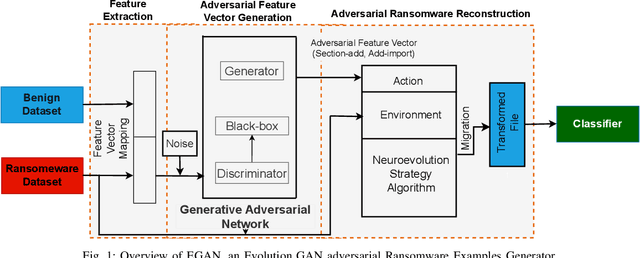
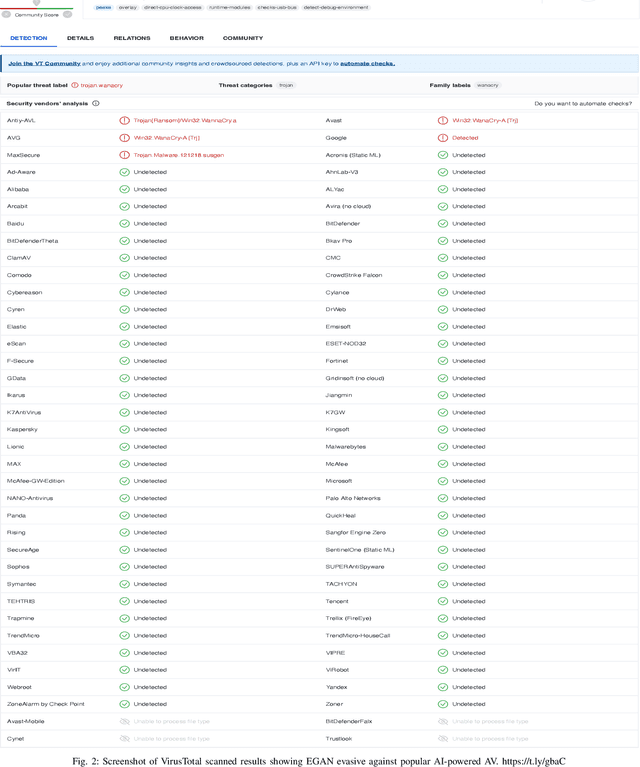
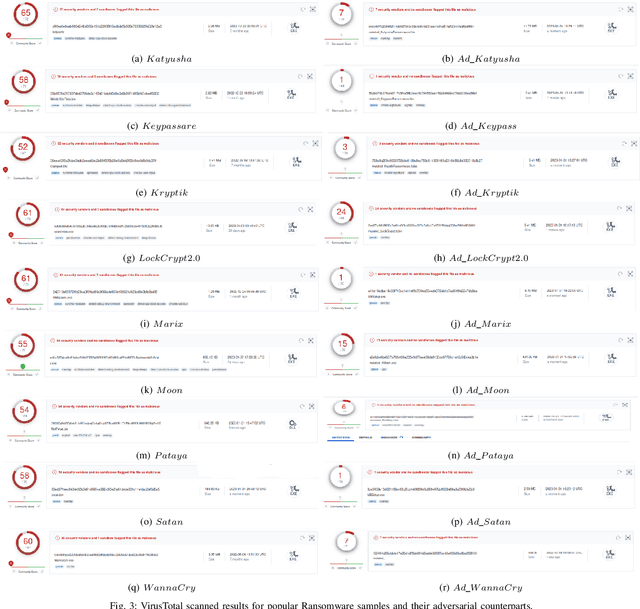
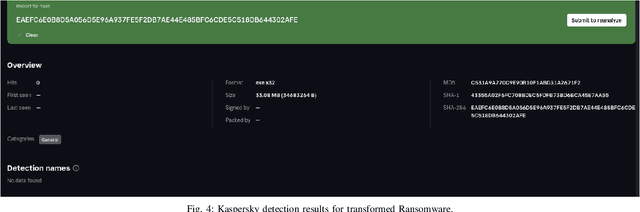
Adversarial Training is a proven defense strategy against adversarial malware. However, generating adversarial malware samples for this type of training presents a challenge because the resulting adversarial malware needs to remain evasive and functional. This work proposes an attack framework, EGAN, to address this limitation. EGAN leverages an Evolution Strategy and Generative Adversarial Network to select a sequence of attack actions that can mutate a Ransomware file while preserving its original functionality. We tested this framework on popular AI-powered commercial antivirus systems listed on VirusTotal and demonstrated that our framework is capable of bypassing the majority of these systems. Moreover, we evaluated whether the EGAN attack framework can evade other commercial non-AI antivirus solutions. Our results indicate that the adversarial ransomware generated can increase the probability of evading some of them.
Securing Health Data on the Blockchain: A Differential Privacy and Federated Learning Framework
May 19, 2024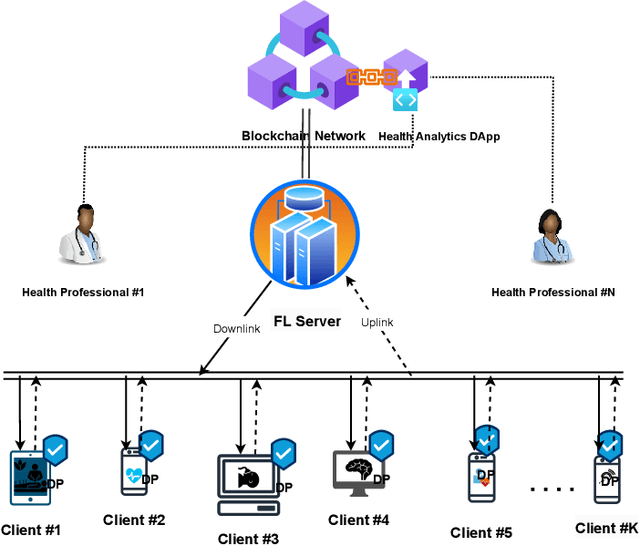
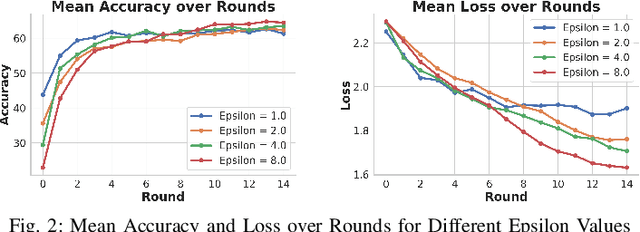
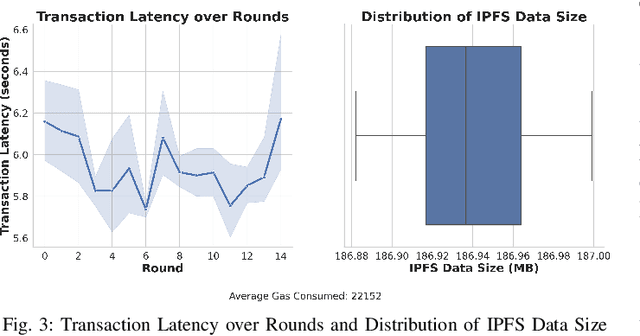
This study proposes a framework to enhance privacy in Blockchain-based Internet of Things (BIoT) systems used in the healthcare sector. The framework addresses the challenge of leveraging health data for analytics while protecting patient privacy. To achieve this, the study integrates Differential Privacy (DP) with Federated Learning (FL) to protect sensitive health data collected by IoT nodes. The proposed framework utilizes dynamic personalization and adaptive noise distribution strategies to balance privacy and data utility. Additionally, blockchain technology ensures secure and transparent aggregation and storage of model updates. Experimental results on the SVHN dataset demonstrate that the proposed framework achieves strong privacy guarantees against various attack scenarios while maintaining high accuracy in health analytics tasks. For 15 rounds of federated learning with an epsilon value of 8.0, the model obtains an accuracy of 64.50%. The blockchain integration, utilizing Ethereum, Ganache, Web3.py, and IPFS, exhibits an average transaction latency of around 6 seconds and consistent gas consumption across rounds, validating the practicality and feasibility of the proposed approach.