 Add to Chrome
 Add to Firefox
 Add to Edge
Behavioral Cloning for Robotic Connector Assembly: An Empirical Study
Feb 25, 2026
Automating the assembly of wire harnesses is challenging in automotive, electrical cabinet, and aircraft production, particularly due to deformable cables and a high variance in connector geometries. In addition, connectors must be inserted with limited force to avoid damage, while their poses can vary significantly. While humans can do this task intuitively by combining visual and haptic feedback, programming an industrial robot for such a task in an adaptable manner remains difficult. This work presents an empirical study investigating the suitability of behavioral cloning for learning an action prediction model for connector insertion that fuses force-torque sensing with a fixed position camera. We compare several network architectures and other design choices using a dataset of up to 300 successful human demonstrations collected via teleoperation of a UR5e robot with a SpaceMouse under varying connector poses. The resulting system is then evaluated against five different connector geometries under varying connector poses, achieving an overall insertion success rate of over 90 %.

Flexible Gear Assembly With Visual Servoing and Force Feedback
Mar 06, 2023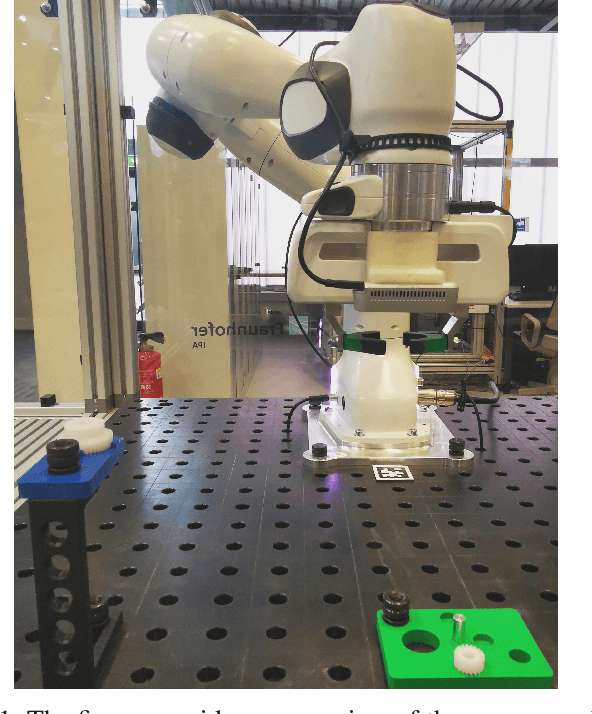
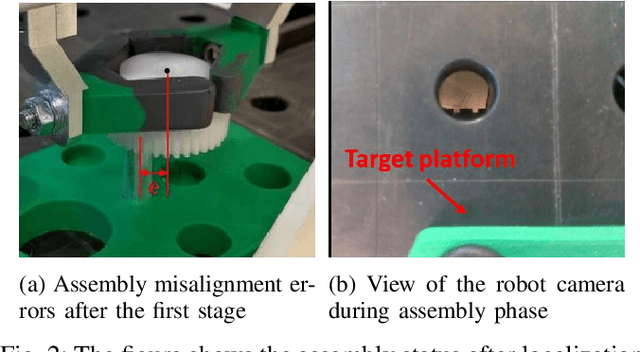

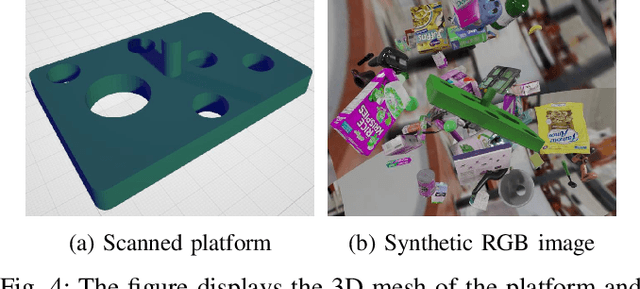
Gear assembly is an essential but challenging task in industrial automation. This paper presents a novel two-stage approach for achieving high-precision and flexible gear assembly. The proposed approach integrates YOLO to coarsely localize the workpiece in a searching phase and deep reinforcement learning (DRL) to complete the insertion. Specifically, DRL addresses the challenge of partial visibility when the on-wrist camera is too close to the workpiece. Additionally, force feedback is used to smoothly transit the process from the first phase to the second phase. To reduce the data collection effort for training deep neural networks, we use synthetic RGB images for training YOLO and construct an offline interaction environment leveraging sampled real-world data for training DRL agents. We evaluate the proposed approach in a gear assembly experiment with a precision tolerance of 0.3mm. The results show that our method can robustly and efficiently complete searching and insertion from arbitrary positions within an average of 15 seconds.