 Add to Chrome
 Add to Firefox
 Add to Edge
Mind the Gap: Disentangling Performance Bottlenecks in Video Instance Segmentation
Jun 05, 2026
In Video Instance Segmentation (VIS), classification, segmentation, and tracking objectives are jointly evaluated, but their individual contributions to performance loss remain opaque. We introduce a diagnostic framework that formulates identity and class assignment as an Integer Linear Program (ILP), yielding a model-agnostic oracle that hierarchically isolates each error source. Applied to seven VIS methods spanning online and offline paradigms across YouTube-VIS 2019/2021 and a diagnostic subset of OVIS, our analysis reveals a consistent picture. Tracking instability is a critical bottleneck for online methods, with gaps exceeding 20 AP under heavy occlusion, and grows sharply with video length and instance density. While semantic classification contributes meaningfully on standard benchmarks, its impact becomes negligible where tracking fails most. Although stronger backbones substantially lift default scores, they leave AP tracking gaps largely intact, confirming that temporal fragility is algorithmic rather than purely representational. To complement the oracle, we introduce TrackLens, a visual tool that translates gap magnitude into observable, query-level failure modes. Together, these tools provide a systematic foundation for targeting VIS's core challenge: robust long-term temporal association.

Snuffy: Efficient Whole Slide Image Classifier
Aug 15, 2024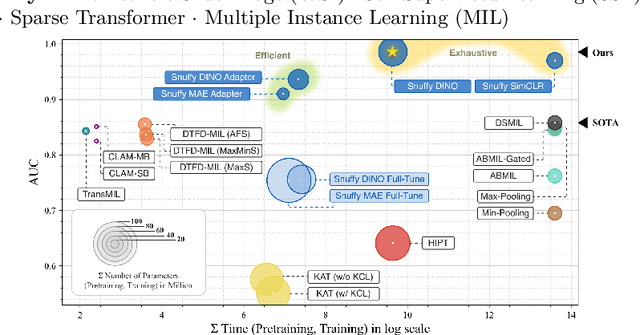
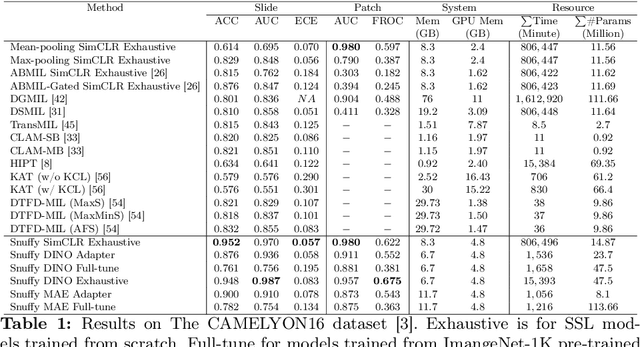
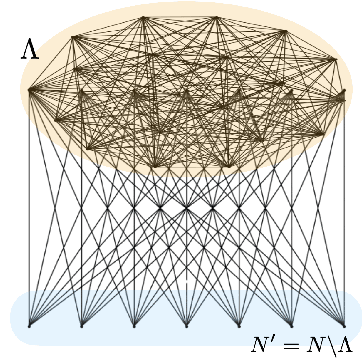
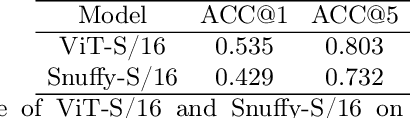
Whole Slide Image (WSI) classification with multiple instance learning (MIL) in digital pathology faces significant computational challenges. Current methods mostly rely on extensive self-supervised learning (SSL) for satisfactory performance, requiring long training periods and considerable computational resources. At the same time, no pre-training affects performance due to domain shifts from natural images to WSIs. We introduce \textbf{\textit{Snuffy}} architecture, a novel MIL-pooling method based on sparse transformers that mitigates performance loss with limited pre-training and enables continual few-shot pre-training as a competitive option. Our sparsity pattern is tailored for pathology and is theoretically proven to be a universal approximator with the tightest probabilistic sharp bound on the number of layers for sparse transformers, to date. We demonstrate Snuffy's effectiveness on CAMELYON16 and TCGA Lung cancer datasets, achieving superior WSI and patch-level accuracies. The code is available on \url{https://github.com/jafarinia/snuffy}.