 Add to Chrome
 Add to Firefox
 Add to Edge
Hierarchical Forecast Reconciliation for Urban Rail Transit Demand Prediction under Operational Disruptions
Jun 05, 2026
Accurate and coherent passenger demand forecasting is essential for Urban Rail Transit (URT) operations. Passenger demand has a hierarchical structure in which origin-destination (OD) flows aggregate to station-level inflows and outflows through conservation constraints. In practice, station-level and OD-level forecasts are often generated independently, producing incoherent predictions that violate these constraints and introduce inconsistencies into operational decision-making. Such issues become more severe during disruptions, when forecasting reliability is most critical. This paper presents the first hierarchical forecast reconciliation framework for joint station-level and OD-level URT demand prediction. A neural Fully Connected Reconciler (FCR) learns a non-linear mapping from incoherent base forecasts to coherent hierarchical predictions while guaranteeing exact structural consistency by construction. The method is benchmarked against OLS, WLS, and Minimum Trace (MinT) variants using Rejsekort smart-card data from the Copenhagen S-train network under one-step, multi-step, and disruption forecasting scenarios. Results show that reconciliation consistently improves OD forecasting accuracy while ensuring hierarchical coherence. Under normal conditions, FCR performs competitively with MinT-based methods. An oracle analysis indicates that perfect station-level forecasts could reduce OD prediction error by up to 34 percent, highlighting the value of improved base forecasts. Under severe disruptions, FCR outperforms classical methods, reducing OD forecasting error by up to 17.45 percent in multi-step destination-side delay scenarios. These findings establish hierarchical reconciliation as an effective mechanism for improving forecast robustness, with the largest benefits occurring under the most challenging operating conditions.

Large-Scale Demand Prediction in Urban Rail using Multi-Graph Inductive Representation Learning
Aug 28, 2024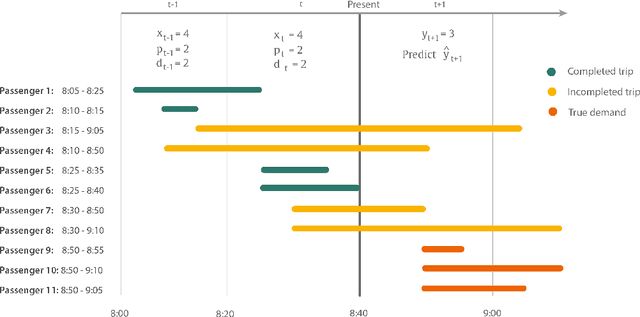
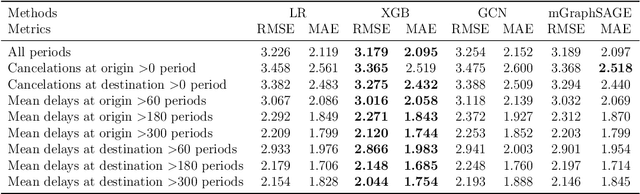
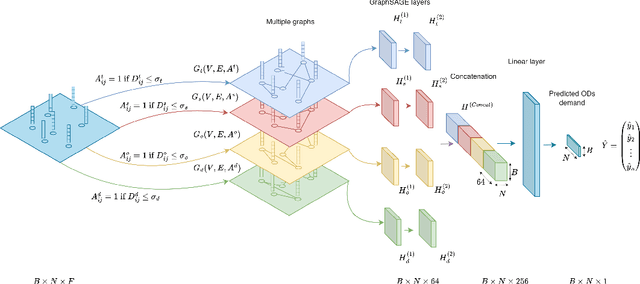
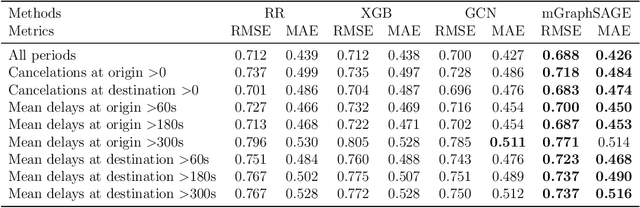
With the expansion of cities over time, URT (Urban Rail Transit) networks have also grown significantly. Demand prediction plays an important role in supporting planning, scheduling, fleet management, and other operational decisions. In this study, we propose an Origin-Destination (OD) demand prediction model called Multi-Graph Inductive Representation Learning (mGraphSAGE) for large-scale URT networks under operational uncertainties. Our main contributions are twofold: we enhance prediction results while ensuring scalability for large networks by relying simultaneously on multiple graphs, where each OD pair is a node on a graph and distinct OD relationships, such as temporal and spatial correlations; we show the importance of including operational uncertainties such as train delays and cancellations as inputs in demand prediction for daily operations. The model is validated on three different scales of the URT network in Copenhagen, Denmark. Experimental results show that by leveraging information from neighboring ODs and learning node representations via sampling and aggregation, mGraphSAGE is particularly suitable for OD demand prediction in large-scale URT networks, outperforming reference machine learning methods. Furthermore, during periods with train cancellations and delays, the performance gap between mGraphSAGE and other methods improves compared to normal operating conditions, demonstrating its ability to leverage system reliability information for predicting OD demand under uncertainty.