 Add to Chrome
 Add to Firefox
 Add to Edge
Unifying Dynamical Systems and Graph Theory to Mechanistically Understand Computation in Neural Networks
May 05, 2026
Understanding how biological and artificial neural networks implement computation from connectivity is a central problem in neuroscience and machine learning. In neural systems, structural and functional connectivity are known to diverge, motivating approaches that move beyond direct connections alone. Here, we show that the spatial and temporal function of recurrent neural networks (RNNs) trained on hierarchically modular tasks can be recovered by modelling the network as a graph and analysing the multi-hop pathways between input and output units. In particular, decomposing these pathways by hop length reveals how the network temporally routes information. This perspective reframes regularisation: if function is implemented through multi-hop communication, then standard penalties such as L1 regularisation, which act only on individual weights, constrain single-hop structure rather than the multi-hop pathways that support computation. Motivated by this view, we introduce resolvent-RNNs (R-RNNs), which constrain multi-hop pathways and thereby induce temporal sparsity beyond that achieved by standard L1 regularisation. Compared with L1 regularisation, R-RNNs achieve improved performance by inducing temporal sparsity that matches the task structure, even when the task signal is sparse. Moreover, R-RNNs exhibit stronger sparsity-function alignment, reflected in their increased robustness under strong regularisation. Together, our results identify multi-hop communication as a key principle linking structure to function in recurrent networks, and suggest that sparsity should be defined over functional pathways rather than individual parameters.

Spiking Network Initialisation and Firing Rate Collapse
May 13, 2023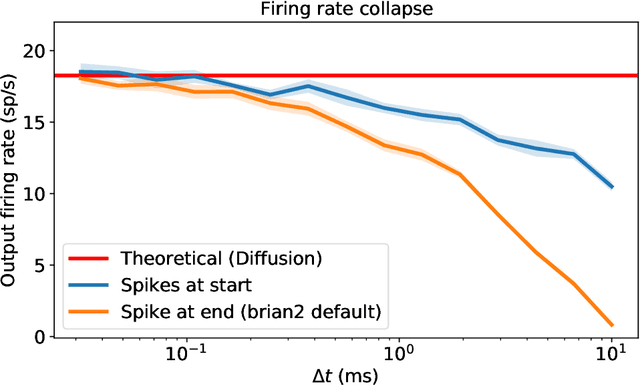
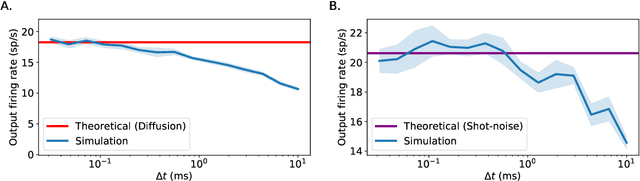
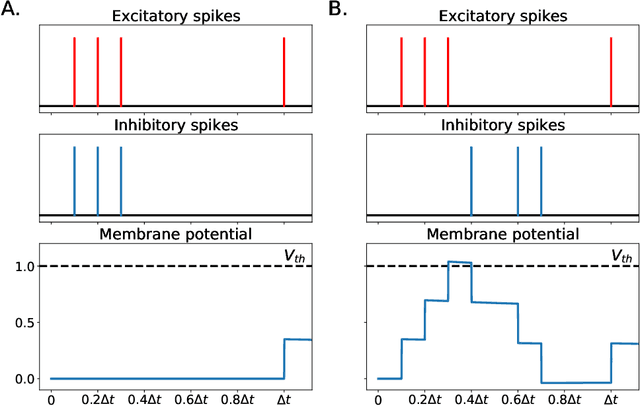
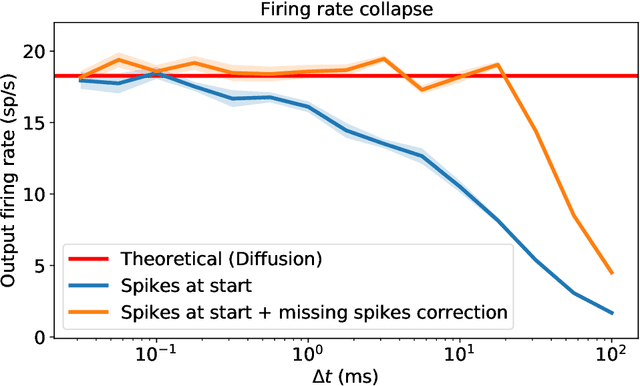
In recent years, newly developed methods to train spiking neural networks (SNNs) have rendered them as a plausible alternative to Artificial Neural Networks (ANNs) in terms of accuracy, while at the same time being much more energy efficient at inference and potentially at training time. However, it is still unclear what constitutes a good initialisation for an SNN. We often use initialisation schemes developed for ANN training which are often inadequate and require manual tuning. In this paper, we attempt to tackle this issue by using techniques from the ANN initialisation literature as well as computational neuroscience results. We show that the problem of weight initialisation for ANNs is a more nuanced problem than it is for ANNs due to the spike-and-reset non-linearity of SNNs and the firing rate collapse problem. We firstly identify and propose several solutions to the firing rate collapse problem under different sets of assumptions which successfully solve the issue by leveraging classical random walk and Wiener processes results. Secondly, we devise a general strategy for SNN initialisation which combines variance propagation techniques from ANNs and different methods to obtain the expected firing rate and membrane potential distribution based on diffusion and shot-noise approximations. Altogether, we obtain theoretical results to solve the SNN initialisation which consider the membrane potential distribution in the presence of a threshold. Yet, to what extent can these methods be successfully applied to SNNs on real datasets remains an open question.