 Add to Chrome
 Add to Firefox
 Add to Edge
Training AI Scientists to Replicate Research
Aug 13, 2026
The replicability of papers is a cornerstone of scientific knowledge, ensuring the reliability of existing results and providing a base for further experiments. The act of replication typically illuminates details that were previously underspecified, and thus requires similar hypothesis-driven exploration to open-ended research. In this work, we develop Replica, a scalable task space for paper replication. To provide reward signal, we introduce an auto-generated rubric-based judge that has low noise and agrees with human assessment of replication quality. We post-train Faraday, a 27B-parameter "AI Scientist" agent that leverages coding agents as tools, surpassing the performance of Claude Opus 4.8 and GPT-5.5 on held-out replication tasks. Qualitative analysis of individual rollouts reveals that Faraday adopts a more scientifically-principled approach. We believe that our results provide a stepping stone towards AI agents capable of long-horizon scientific innovation without requiring complex harnesses.

Trading Off Resource Budgets for Improved Regret Bounds
Oct 11, 2022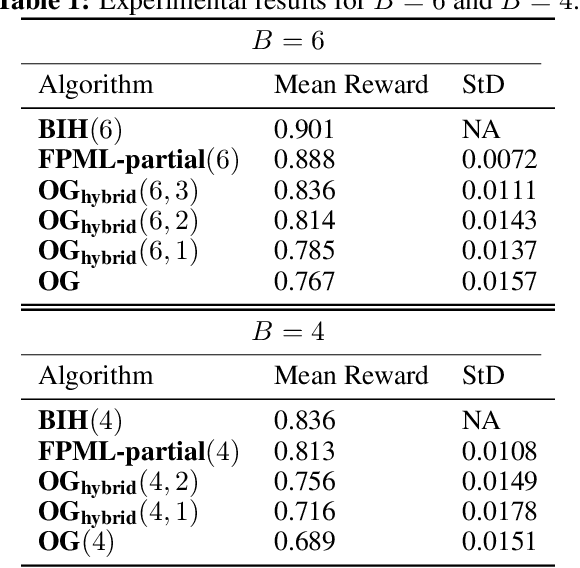
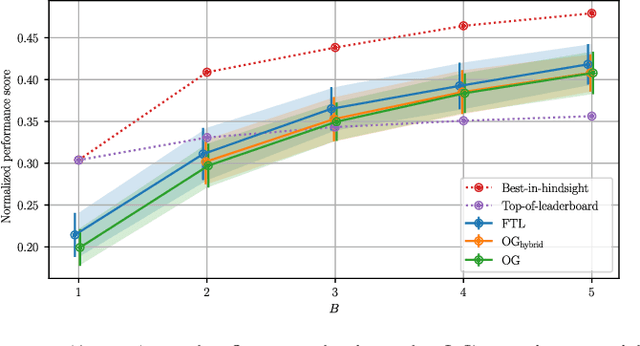
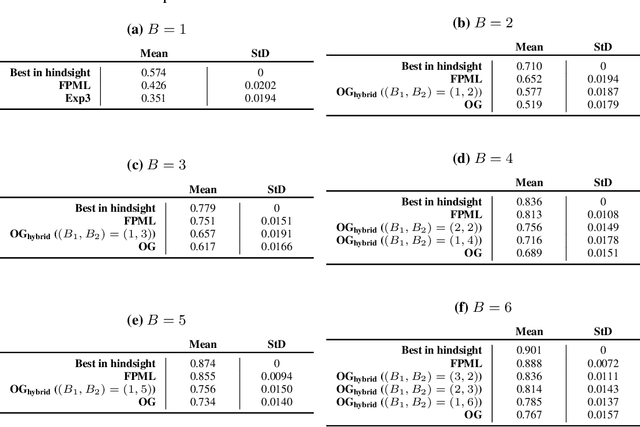
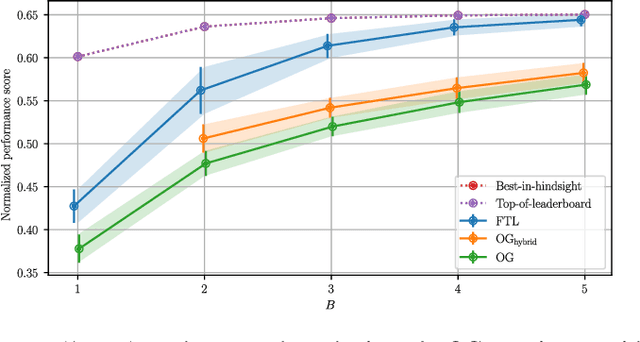
In this work we consider a variant of adversarial online learning where in each round one picks $B$ out of $N$ arms and incurs cost equal to the $\textit{minimum}$ of the costs of each arm chosen. We propose an algorithm called Follow the Perturbed Multiple Leaders (FPML) for this problem, which we show (by adapting the techniques of Kalai and Vempala [2005]) achieves expected regret $\mathcal{O}(T^{\frac{1}{B+1}}\ln(N)^{\frac{B}{B+1}})$ over time horizon $T$ relative to the $\textit{single}$ best arm in hindsight. This introduces a trade-off between the budget $B$ and the single-best-arm regret, and we proceed to investigate several applications of this trade-off. First, we observe that algorithms which use standard regret minimizers as subroutines can sometimes be adapted by replacing these subroutines with FPML, and we use this to generalize existing algorithms for Online Submodular Function Maximization [Streeter and Golovin, 2008] in both the full feedback and semi-bandit feedback settings. Next, we empirically evaluate our new algorithms on an online black-box hyperparameter optimization problem. Finally, we show how FPML can lead to new algorithms for Linear Programming which require stronger oracles at the benefit of fewer oracle calls.