 Add to Chrome
 Add to Firefox
 Add to Edge
Distilling Human-Aligned Privacy Sensitivity Assessment from Large Language Models
Mar 31, 2026
Accurate privacy evaluation of textual data remains a critical challenge in privacy-preserving natural language processing. Recent work has shown that large language models (LLMs) can serve as reliable privacy evaluators, achieving strong agreement with human judgments; however, their computational cost and impracticality for processing sensitive data at scale limit real-world deployment. We address this gap by distilling the privacy assessment capabilities of Mistral Large 3 (675B) into lightweight encoder models with as few as 150M parameters. Leveraging a large-scale dataset of privacy-annotated texts spanning 10 diverse domains, we train efficient classifiers that preserve strong agreement with human annotations while dramatically reducing computational requirements. We validate our approach on human-annotated test data and demonstrate its practical utility as an evaluation metric for de-identification systems.

Adaptive Text Anonymization: Learning Privacy-Utility Trade-offs via Prompt Optimization
Feb 24, 2026Anonymizing textual documents is a highly context-sensitive problem: the appropriate balance between privacy protection and utility preservation varies with the data domain, privacy objectives, and downstream application. However, existing anonymization methods rely on static, manually designed strategies that lack the flexibility to adjust to diverse requirements and often fail to generalize across domains. We introduce adaptive text anonymization, a new task formulation in which anonymization strategies are automatically adapted to specific privacy-utility requirements. We propose a framework for task-specific prompt optimization that automatically constructs anonymization instructions for language models, enabling adaptation to different privacy goals, domains, and downstream usage patterns. To evaluate our approach, we present a benchmark spanning five datasets with diverse domains, privacy constraints, and utility objectives. Across all evaluated settings, our framework consistently achieves a better privacy-utility trade-off than existing baselines, while remaining computationally efficient and effective on open-source language models, with performance comparable to larger closed-source models. Additionally, we show that our method can discover novel anonymization strategies that explore different points along the privacy-utility trade-off frontier.
Tau-Eval: A Unified Evaluation Framework for Useful and Private Text Anonymization
Jun 06, 2025Text anonymization is the process of removing or obfuscating information from textual data to protect the privacy of individuals. This process inherently involves a complex trade-off between privacy protection and information preservation, where stringent anonymization methods can significantly impact the text's utility for downstream applications. Evaluating the effectiveness of text anonymization proves challenging from both privacy and utility perspectives, as there is no universal benchmark that can comprehensively assess anonymization techniques across diverse, and sometimes contradictory contexts. We present Tau-Eval, an open-source framework for benchmarking text anonymization methods through the lens of privacy and utility task sensitivity. A Python library, code, documentation and tutorials are publicly available.
TAROT: Task-Oriented Authorship Obfuscation Using Policy Optimization Methods
Jul 31, 2024
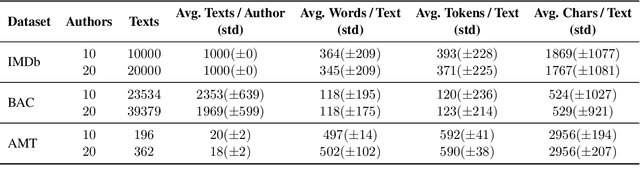


Authorship obfuscation aims to disguise the identity of an author within a text by altering the writing style, vocabulary, syntax, and other linguistic features associated with the text author. This alteration needs to balance privacy and utility. While strong obfuscation techniques can effectively hide the author's identity, they often degrade the quality and usefulness of the text for its intended purpose. Conversely, maintaining high utility tends to provide insufficient privacy, making it easier for an adversary to de-anonymize the author. Thus, achieving an optimal trade-off between these two conflicting objectives is crucial. In this paper, we propose TAROT: Task-Oriented Authorship Obfuscation Using Policy Optimization, a new unsupervised authorship obfuscation method whose goal is to optimize the privacy-utility trade-off by regenerating the entire text considering its downstream utility. Our approach leverages policy optimization as a fine-tuning paradigm over small language models in order to rewrite texts by preserving author identity and downstream task utility. We show that our approach largely reduce the accuracy of attackers while preserving utility. We make our code and models publicly available.