 Add to Chrome
 Add to Firefox
 Add to Edge
RPAM: A Principled Metric for Evaluating Associations in Language Models with High Predictive Validity in Downstream Outputs
Jul 06, 2026
Language models (LMs) exhibit problematic biases, such as stereotypes. Effectively analyzing and mitigating such biases requires accurate and generalizable evaluation methods of the underlying associations. Some existing approaches focus on downstream metrics that analyze associations in generated text. Since generated text content can vary drastically across LMs, such metrics often require specialized evaluation datasets, which limits the generalization of such downstream metrics. In contrast, upstream metrics examine LMs at the fundamental level of embeddings or continuation probabilities, enabling principled association analyses across LMs. Yet, to date, no upstream metric for generative LMs has uncovered a strong relationship with real-world associations, including those measured in generated text. To address this gap, we introduce the Relative Probability Association Metric (RPAM), an association evaluation metric for generative LMs. For three LMs of different quality of language generation and purpose (Mistral-7B-Instruct, Mistral-7B, and GPT-2) and well-studied evaluation datasets (WEAT-WS, Bellezza, WS-353, and SST2), we find a strong relationship between upstream RPAM measurements and corresponding implicit and explicit associations observed in humans, as well as biases measured downstream with LM-specific tasks, outperforming prior record values where applicable.

Epistemic diversity across language models mitigates knowledge collapse
Dec 17, 2025The growing use of artificial intelligence (AI) raises concerns of knowledge collapse, i.e., a reduction to the most dominant and central set of ideas. Prior work has demonstrated single-model collapse, defined as performance decay in an AI model trained on its own output. Inspired by ecology, we ask whether AI ecosystem diversity, that is, diversity among models, can mitigate such a collapse. We build on the single-model approach but focus on ecosystems of models trained on their collective output. To study the effect of diversity on model performance, we segment the training data across language models and evaluate the resulting ecosystems over ten, self-training iterations. We find that increased epistemic diversity mitigates collapse, but, interestingly, only up to an optimal level. Our results suggest that an ecosystem containing only a few diverse models fails to express the rich mixture of the full, true distribution, resulting in rapid performance decay. Yet distributing the data across too many models reduces each model's approximation capacity on the true distribution, leading to poor performance already in the first iteration step. In the context of AI monoculture, our results suggest the need to monitor diversity across AI systems and to develop policies that incentivize more domain- and community-specific models.
Response: Emergent analogical reasoning in large language models
Aug 30, 2023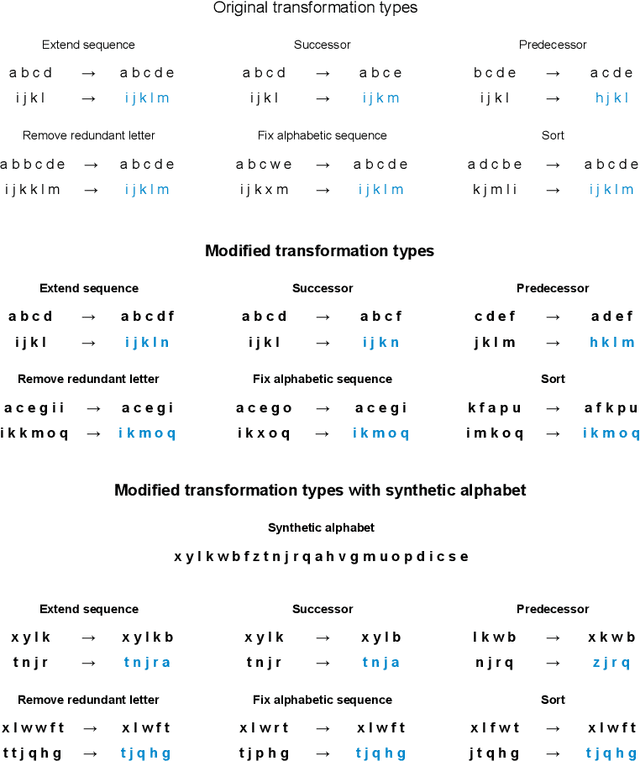
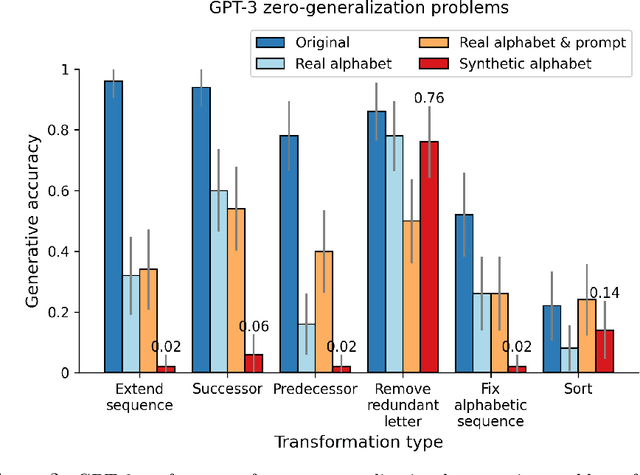
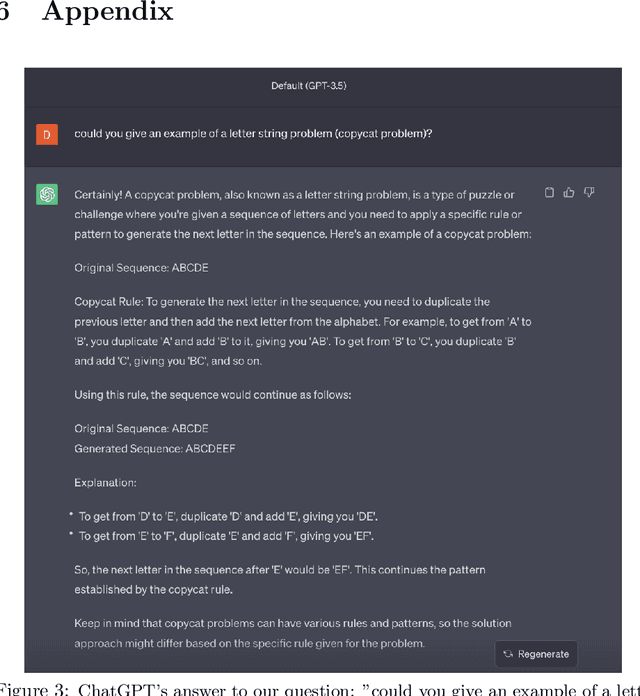
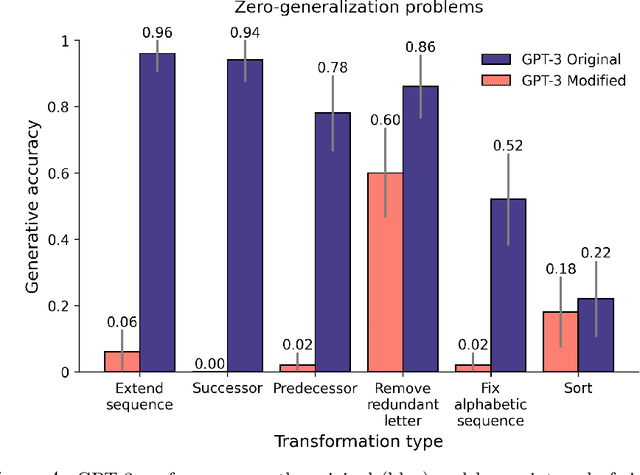
In their recent Nature Human Behaviour paper, "Emergent analogical reasoning in large language models," (Webb, Holyoak, and Lu, 2023) the authors argue that "large language models such as GPT-3 have acquired an emergent ability to find zero-shot solutions to a broad range of analogy problems." In this response, we provide counterexamples of the letter string analogies. In our tests, GPT-3 fails to solve even the easiest variants of the problems presented in the original paper. Zero-shot reasoning is an extraordinary claim that requires extraordinary evidence. We do not see that evidence in our experiments. To strengthen claims of humanlike reasoning such as zero-shot reasoning, it is important that the field develop approaches that rule out data memorization.