 Add to Chrome
 Add to Firefox
 Add to Edge
WeightCLIP: Aligning Datasets and Models for Weight Space Learning
Jul 03, 2026
Weight space learning aims to learn representations of neural network (NN) weights, enabling different downstream tasks. Existing approaches show promising performance, but lacking a way to shape these weight-space representations using information about the datasets the models were trained on, thus limiting downstream applications. We propose WeightCLIP, a method for learning a dataset-aligned latent space for neural networks, where datasets information is induced during training. The NNs are encoded as latent representations using an autoencoder, while dataset samples are encoded using a dataset encoder. The two representations are aligned using a contrastive objective, effectively reshaping the weight-space representations according to the datasets. We demonstrate that such representations can be used for different downstream tasks, including mapping dataset information to a weight-space representation that decode to strong models. In addition, we introduce a latent refinement process for generating models that outperforms standard fine-tuning. Overall, our results demonstrate that explicitly incorporating dataset information improves what can be achieved with weight-space representations across retrieval, generation, and refinement. Code will be available at https://github.com/HSG-AIML/WeightCLIP.

GeoSANE: Learning Geospatial Representations from Models, Not Data
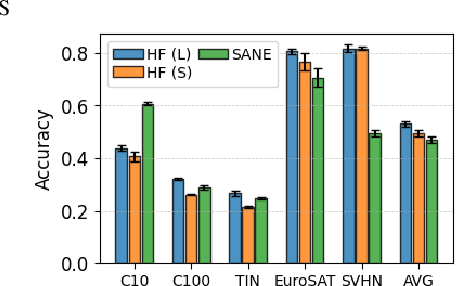
Mar 24, 2026Recent advances in remote sensing have led to an increase in the number of available foundation models; each trained on different modalities, datasets, and objectives, yet capturing only part of the vast geospatial knowledge landscape. While these models show strong results within their respective domains, their capabilities remain complementary rather than unified. Therefore, instead of choosing one model over another, we aim to combine their strengths into a single shared representation. We introduce GeoSANE, a geospatial model foundry that learns a unified neural representation from the weights of existing foundation models and task-specific models, able to generate novel neural networks weights on-demand. Given a target architecture, GeoSANE generates weights ready for finetuning for classification, segmentation, and detection tasks across multiple modalities. Models generated by GeoSANE consistently outperform their counterparts trained from scratch, match or surpass state-of-the-art remote sensing foundation models, and outperform models obtained through pruning or knowledge distillation when generating lightweight networks. Evaluations across ten diverse datasets and on GEO-Bench confirm its strong generalization capabilities. By shifting from pre-training to weight generation, GeoSANE introduces a new framework for unifying and transferring geospatial knowledge across models and tasks. Code is available at \href{https://hsg-aiml.github.io/GeoSANE/}{hsg-aiml.github.io/GeoSANE/}.
Learning Model Representations Using Publicly Available Model Hubs
Oct 02, 2025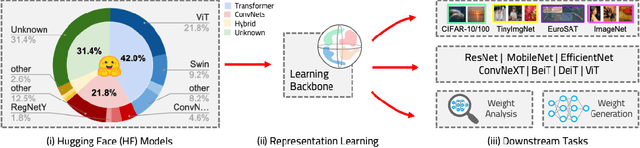

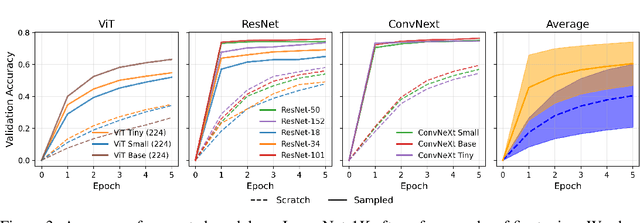
The weights of neural networks have emerged as a novel data modality, giving rise to the field of weight space learning. A central challenge in this area is that learning meaningful representations of weights typically requires large, carefully constructed collections of trained models, typically referred to as model zoos. These model zoos are often trained ad-hoc, requiring large computational resources, constraining the learned weight space representations in scale and flexibility. In this work, we drop this requirement by training a weight space learning backbone on arbitrary models downloaded from large, unstructured model repositories such as Hugging Face. Unlike curated model zoos, these repositories contain highly heterogeneous models: they vary in architecture and dataset, and are largely undocumented. To address the methodological challenges posed by such heterogeneity, we propose a new weight space backbone designed to handle unstructured model populations. We demonstrate that weight space representations trained on models from Hugging Face achieve strong performance, often outperforming backbones trained on laboratory-generated model zoos. Finally, we show that the diversity of the model weights in our training set allows our weight space model to generalize to unseen data modalities. By demonstrating that high-quality weight space representations can be learned in the wild, we show that curated model zoos are not indispensable, thereby overcoming a strong limitation currently faced by the weight space learning community.
The Impact of Model Zoo Size and Composition on Weight Space Learning
Apr 14, 2025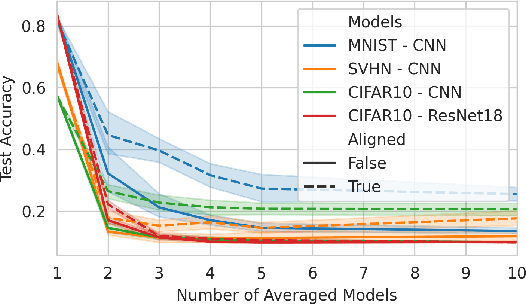
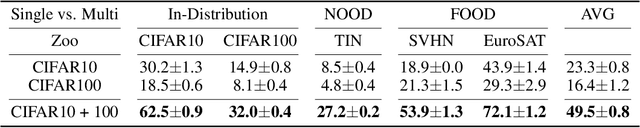
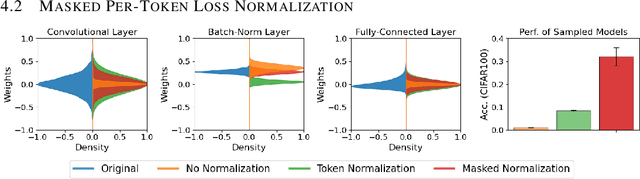
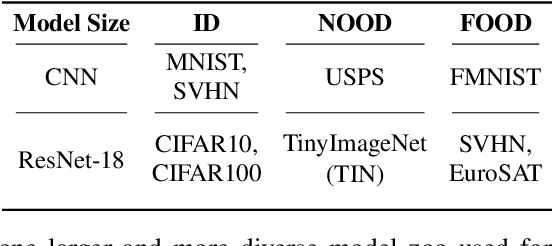
Re-using trained neural network models is a common strategy to reduce training cost and transfer knowledge. Weight space learning - using the weights of trained models as data modality - is a promising new field to re-use populations of pre-trained models for future tasks. Approaches in this field have demonstrated high performance both on model analysis and weight generation tasks. However, until now their learning setup requires homogeneous model zoos where all models share the same exact architecture, limiting their capability to generalize beyond the population of models they saw during training. In this work, we remove this constraint and propose a modification to a common weight space learning method to accommodate training on heterogeneous populations of models. We further investigate the resulting impact of model diversity on generating unseen neural network model weights for zero-shot knowledge transfer. Our extensive experimental evaluation shows that including models with varying underlying image datasets has a high impact on performance and generalization, for both in- and out-of-distribution settings. Code is available on github.com/HSG-AIML/MultiZoo-SANE.
A Model Zoo of Vision Transformers
Apr 14, 2025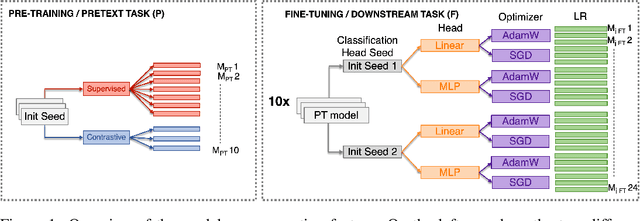

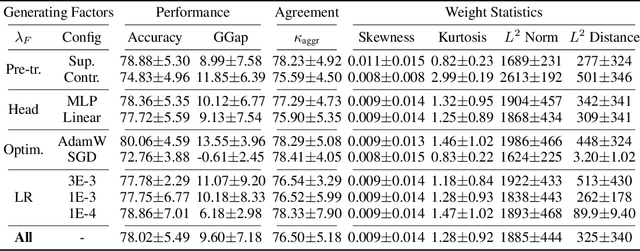
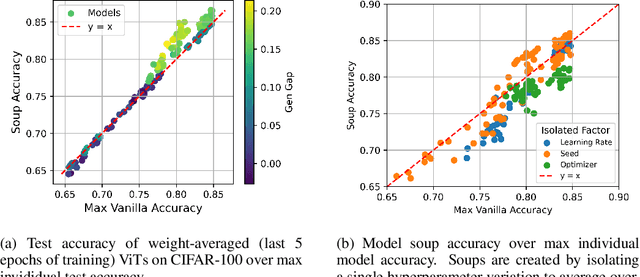
The availability of large, structured populations of neural networks - called 'model zoos' - has led to the development of a multitude of downstream tasks ranging from model analysis, to representation learning on model weights or generative modeling of neural network parameters. However, existing model zoos are limited in size and architecture and neglect the transformer, which is among the currently most successful neural network architectures. We address this gap by introducing the first model zoo of vision transformers (ViT). To better represent recent training approaches, we develop a new blueprint for model zoo generation that encompasses both pre-training and fine-tuning steps, and publish 250 unique models. They are carefully generated with a large span of generating factors, and their diversity is validated using a thorough choice of weight-space and behavioral metrics. To further motivate the utility of our proposed dataset, we suggest multiple possible applications grounded in both extensive exploratory experiments and a number of examples from the existing literature. By extending previous lines of similar work, our model zoo allows researchers to push their model population-based methods from the small model regime to state-of-the-art architectures. We make our model zoo available at github.com/ModelZoos/ViTModelZoo.