 Add to Chrome
 Add to Firefox
 Add to Edge
RAGe: A Retrieval-Augmented Generation Evaluation Framework
May 23, 2026
Deploying Large Language Model (LLM) applications, particularly those relying on Retrieval-Augmented Generation (RAG), remains challenging due to high computational demands, outdated knowledge bases, and the need to manually select optimal pipeline components. In this work, we propose a modular framework for benchmarking and guiding the efficient development of RAG applications by focusing on resource telemetry and component recommendation, suggesting the best components for a domain-specific dataset. Our approach leverages core techniques in LLM applications, including document chunking, vector databases, embedding models, and retrievers, to evaluate trade-offs among accuracy, efficiency, and scalability. By directly correlating retrieval and generation quality with underlying hardware constraints, RAGe supports researchers to identify the most effective, domain-specific RAG setups for their specific operational needs, facilitating rapid prototyping even on consumer-grade hardware.

Automated Planning for Optimal Data Pipeline Instantiation
Mar 16, 2025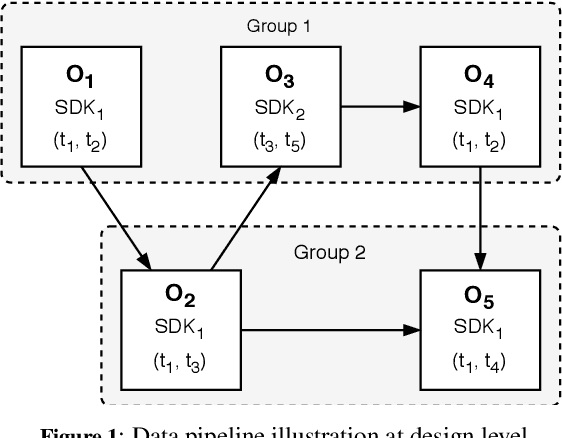
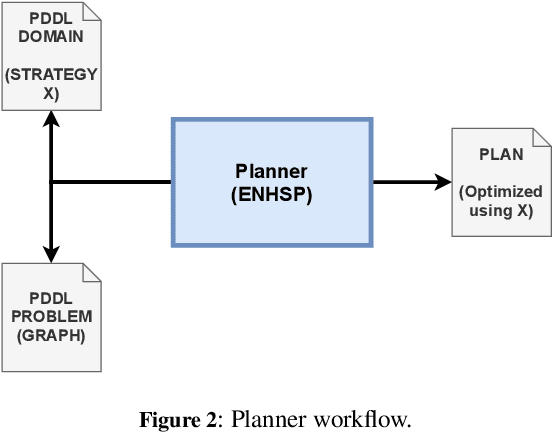
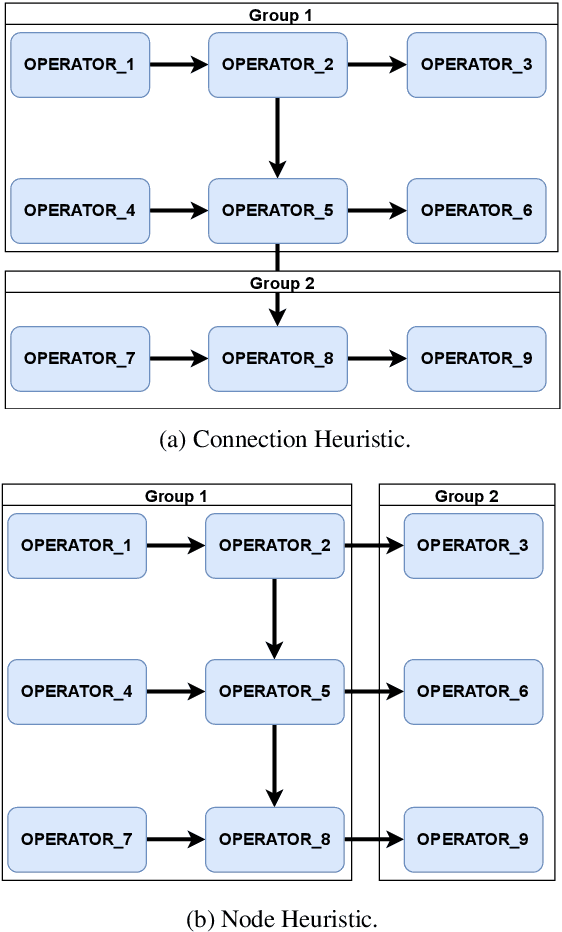
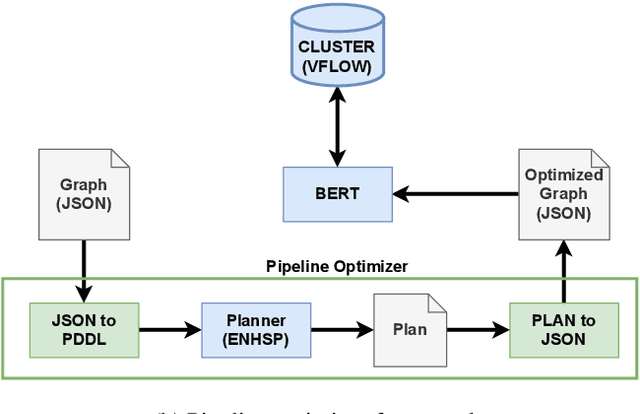
Data pipeline frameworks provide abstractions for implementing sequences of data-intensive transformation operators, automating the deployment and execution of such transformations in a cluster. Deploying a data pipeline, however, requires computing resources to be allocated in a data center, ideally minimizing the overhead for communicating data and executing operators in the pipeline while considering each operator's execution requirements. In this paper, we model the problem of optimal data pipeline deployment as planning with action costs, where we propose heuristics aiming to minimize total execution time. Experimental results indicate that the heuristics can outperform the baseline deployment and that a heuristic based on connections outperforms other strategies.