 Add to Chrome
 Add to Firefox
 Add to Edge
Creating a Hybrid Rule and Neural Network Based Semantic Tagger using Silver Standard Data: the PyMUSAS framework for Multilingual Semantic Annotation
Jan 14, 2026
Word Sense Disambiguation (WSD) has been widely evaluated using the semantic frameworks of WordNet, BabelNet, and the Oxford Dictionary of English. However, for the UCREL Semantic Analysis System (USAS) framework, no open extensive evaluation has been performed beyond lexical coverage or single language evaluation. In this work, we perform the largest semantic tagging evaluation of the rule based system that uses the lexical resources in the USAS framework covering five different languages using four existing datasets and one novel Chinese dataset. We create a new silver labelled English dataset, to overcome the lack of manually tagged training data, that we train and evaluate various mono and multilingual neural models in both mono and cross-lingual evaluation setups with comparisons to their rule based counterparts, and show how a rule based system can be enhanced with a neural network model. The resulting neural network models, including the data they were trained on, the Chinese evaluation dataset, and all of the code have been released as open resources.

The IgboAPI Dataset: Empowering Igbo Language Technologies through Multi-dialectal Enrichment
May 02, 2024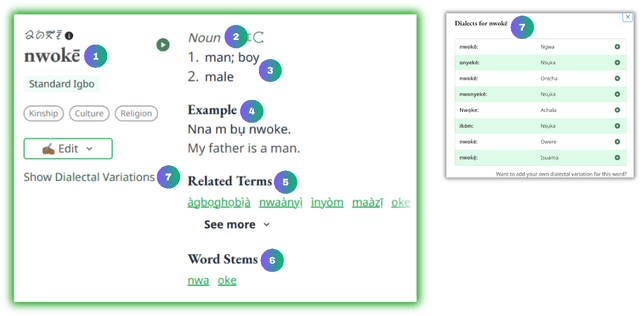
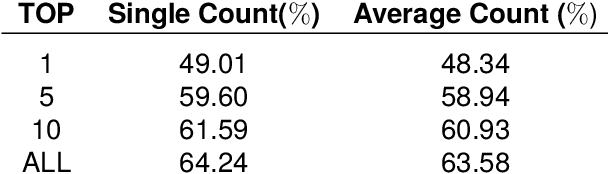
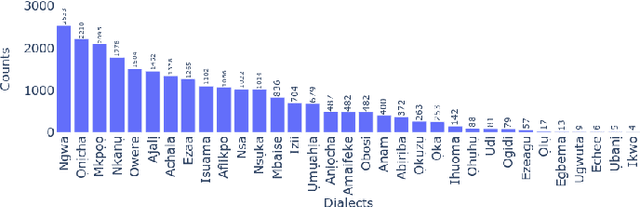
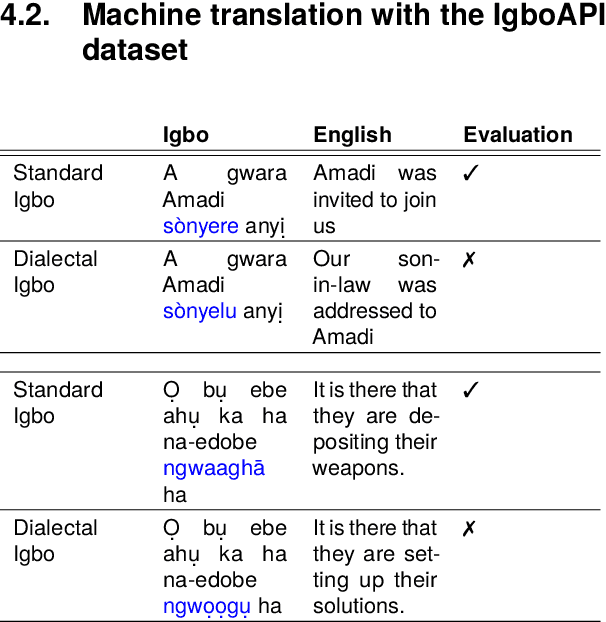
The Igbo language is facing a risk of becoming endangered, as indicated by a 2025 UNESCO study. This highlights the need to develop language technologies for Igbo to foster communication, learning and preservation. To create robust, impactful, and widely adopted language technologies for Igbo, it is essential to incorporate the multi-dialectal nature of the language. The primary obstacle in achieving dialectal-aware language technologies is the lack of comprehensive dialectal datasets. In response, we present the IgboAPI dataset, a multi-dialectal Igbo-English dictionary dataset, developed with the aim of enhancing the representation of Igbo dialects. Furthermore, we illustrate the practicality of the IgboAPI dataset through two distinct studies: one focusing on Igbo semantic lexicon and the other on machine translation. In the semantic lexicon project, we successfully establish an initial Igbo semantic lexicon for the Igbo semantic tagger, while in the machine translation study, we demonstrate that by finetuning existing machine translation systems using the IgboAPI dataset, we significantly improve their ability to handle dialectal variations in sentences.