 Add to Chrome
 Add to Firefox
 Add to Edge
PLaMo 2.1-VL Technical Report
Apr 21, 2026
We introduce PLaMo 2.1-VL, a lightweight Vision Language Model (VLM) for autonomous devices, available in 8B and 2B variants and designed for local and edge deployment with Japanese-language operation. Focusing on Visual Question Answering (VQA) and Visual Grounding as its core capabilities, we develop and evaluate the models for two real-world application scenarios: factory task analysis via tool recognition, and infrastructure anomaly detection. We also develop a large-scale synthetic data generation pipeline and comprehensive Japanese training and evaluation resources. PLaMo 2.1-VL outperforms comparable open models on Japanese and English benchmarks, achieving 61.5 ROUGE-L on JA-VG-VQA-500 and 85.2% accuracy on Japanese Ref-L4. For the two application scenarios, it achieves 53.9% zero-shot accuracy on factory task analysis, and fine-tuning on power plant data improves anomaly detection bbox + label F1-score from 39.7 to 64.9.

PLaMo 2 Technical Report
Sep 05, 2025In this report, we introduce PLaMo 2, a series of Japanese-focused large language models featuring a hybrid Samba-based architecture that transitions to full attention via continual pre-training to support 32K token contexts. Training leverages extensive synthetic corpora to overcome data scarcity, while computational efficiency is achieved through weight reuse and structured pruning. This efficient pruning methodology produces an 8B model that achieves performance comparable to our previous 100B model. Post-training further refines the models using a pipeline of supervised fine-tuning (SFT) and direct preference optimization (DPO), enhanced by synthetic Japanese instruction data and model merging techniques. Optimized for inference using vLLM and quantization with minimal accuracy loss, the PLaMo 2 models achieve state-of-the-art results on Japanese benchmarks, outperforming similarly-sized open models in instruction-following, language fluency, and Japanese-specific knowledge.
PLaMo-100B: A Ground-Up Language Model Designed for Japanese Proficiency
Oct 10, 2024


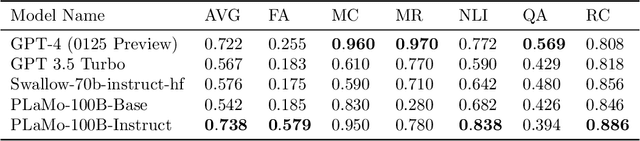
We introduce PLaMo-100B, a large-scale language model designed for Japanese proficiency. The model was trained from scratch using 2 trillion tokens, with architecture such as QK Normalization and Z-Loss to ensure training stability during the training process. Post-training techniques, including Supervised Fine-Tuning and Direct Preference Optimization, were applied to refine the model's performance. Benchmark evaluations suggest that PLaMo-100B performs well, particularly in Japanese-specific tasks, achieving results that are competitive with frontier models like GPT-4.