 Add to Chrome
 Add to Firefox
 Add to Edge
Cleo: A Transparent and Controllable Chatbot for Conversational Commerce
Aug 06, 2026
We demonstrate Cleo, a transparent and controllable conversational product advisor that addresses the challenges of opacity, unpredictability of LLMs, and the complexity of comparisons in conversational commerce. With our chatbot system, we make four contributions: First, we introduce transparency by prompting the LLM to reflect on interpreted user needs, while an auditable ranking mechanism reveals loss values per attribute, explaining ranking decisions. Second, we propose controllability through a hybrid architecture separating deterministic ranking from language generation. A ranker applies categorical filters and numeric loss functions over 3,638 product specifications. Meanwhile, a constrained LLM generates grounded descriptions constrained to catalog evidence, thus mitigating the risk of hallucinated or persuasive content. Third, we provide decision support in the form of natural-language comparisons and a highlights feature. These aim to reduce mental workload by contextualizing specifications relative to user needs. Fourth, we contribute an extensible experimental system for IR and HCI researchers, as well as practitioners of conversational search and recommendation. Unlike traditional faceted search or opaque LLM-only recommenders, our approach allows for fluid conversation while maintaining algorithmic transparency. In a live demonstration, attendees will experience information needs elicitation and reflection, conversational refinement with real-time re-ranking, inspection of per-attribute loss explanations, and AI-generated multi-item comparisons. The system aims to advance the design of transparent and controllable conversational systems that provide support for decision-making during online product search.

"I don't know anything about laptops!" - User Perception of Digital Product Advisors Adapting to Their Knowledge Levels
Aug 06, 2026Conversational commerce uses digital assistants to support the search process and decision-making in e-commerce. Effective communication in these interactions can be facilitated by assistants adapting their communication style to users and supporting shared understanding. An open challenge in this context is adapting the presentation of complex product information to users with varying levels of domain knowledge. To investigate strategies for such knowledge-level adaptation, we set up a chatbot-assisted laptop search scenario. In a between-subjects experiment (n = 251), we examined novice and expert perceptions of product attribute recommendations presented as technical information only (T), or augmented with performance categories (TC), attribute explanations (TE), or both (TCE). For novices, approaches with explanations (TE, TCE) were perceived as more helpful and led to higher perceived learning than those without. Novices also rated the combined approach (TCE) more appropriate than the baseline (T) and TC in terms of information quantity, indicating that explanations are crucial to understand and benefit from performance categories. Critically, experts showed no significant differences across conditions, suggesting that providing supplementary information beneficial to novices did not detract from their experience. We distill these findings into four concrete design guidelines for inclusive text-based product advisors in technical domains: use TCE by default; keep a single inclusive interface; avoid standalone categories; and support user agency and personalize to the stated use case.
Transparent by Design, Usable in Practice? A Formative Usability Study of a Conversational Product Advisor
Jul 23, 2026Large language models can make conversational product advisors fluent but opaque. If they hide the logic behind a ranking and the evidence for a recommendation inside natural-language replies, they challenge users' ability to understand, trust, and steer the results. One response is to build transparency into the advisor. We report a formative, moderated think-aloud usability study of one such system: a chatbot for laptop search with constrained natural-language generation, an on-demand ranking explanation, and a comparison feature. Seven participants completed three laptop-search tasks and reported post-task usability measures. We coded their sessions into severity-rated usability problems. Ease and satisfaction during the tasks were high, but two findings stand out. First, transparency by design did not guarantee understanding: several participants valued the ranking explanation in principle, yet it caused the most severe problem. Second, participants valued the effort the advisor saved, but some wanted additional direct-manipulation controls. We contribute a severity-prioritized set of usability problems and design implications for human-centered conversational product advisors.
AI Overviews in Academic Search: Evaluating AI-generated Summaries of Search Results in a Domain-specific Search Engine
Jul 03, 2026Evaluating search engine results pages (SERPs) to assess result relevance is a demanding step in academic search. In a formative mixed-methods design study, we examine AI-generated SERP-level summaries as a support feature in an academic search engine for social science information. First, we manually evaluated summaries of the top five results for 10 queries using two general-purpose models, one commercial and one open, deriving an exploratory six-category error taxonomy and five safeguards for scholarly deployment. We then conducted a within-subjects user study (n = 30) comparing interfaces with and without AI summaries. Confirmatory analyses showed consistent but non-significant trends favoring AI summaries for subjective workload, perceived usefulness, satisfaction, and decision-making confidence. Exploratory analyses suggested lower mental demand, with frustration also tending to be lower. Behaviorally, participants rarely expanded the summaries and descriptively made slightly fewer result clicks and query reformulations when summaries were available. Drawing on Information Foraging Theory and participant feedback, we suggest that AI summaries may concentrate SERP-level information scent to support early triage. Overall, the findings indicate that SERP-level AI summaries are a context- and user-dependent aid rather than a universal improvement, while contributing an error taxonomy, safeguard-aware deployment guidance, and concrete design implications for scholarly search.
Report on CHIIR 2026 Workshop on Generative AI and Academic Search (GAI&AS)
Jun 08, 2026This report summarizes the CHIIR 2026 Workshop on Generative AI and Academic Search (GAI\&AS), which examined how GenAI is reshaping academic search systems and research practices. The workshop brought together researchers in human information interaction and information retrieval to explore key challenges and opportunities in designing and evaluating future academic search systems that integrate GenAI, moving beyond traditional document retrieval to support summarization, recommendation, synthesis, and conversational interaction. Participants' interests and discussions focused on three thematic clusters: foundations and principles, applications and opportunities, and search-as-learning. Across these themes, the workshop highlighted the importance of academic search systems in supporting transparency, credibility, research integrity, and long-term scholarly needs, as well as in fostering higher-order cognitive processes. Participants discussed guiding theories, design principles, methodological approaches, partnerships, and community-building efforts aimed at advancing human-centered GenAI-enhanced academic search systems. Overall, the workshop demonstrated strong community interest and a diverse range of ongoing and emerging research initiatives at the intersection of GenAI and academic search.
Starting Conversations with Search Engines -- Interfaces that Elicit Natural Language Queries
Feb 13, 2023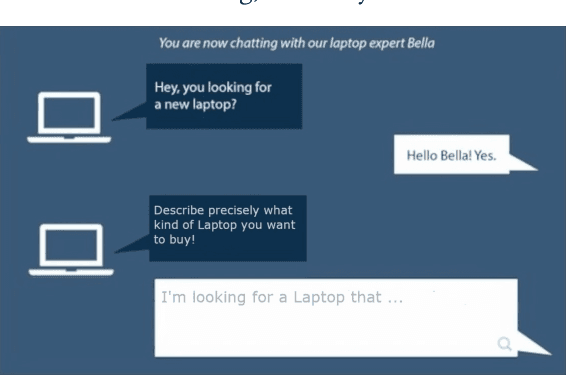
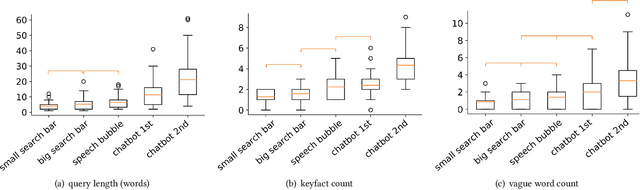
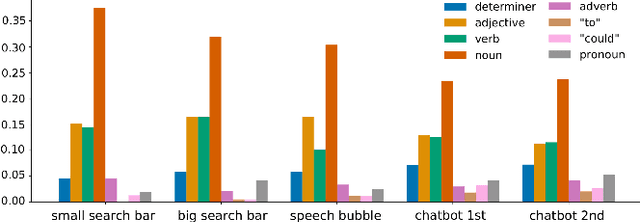
Search systems on the Web rely on user input to generate relevant results. Since early information retrieval systems, users are trained to issue keyword searches and adapt to the language of the system. Recent research has shown that users often withhold detailed information about their initial information need, although they are able to express it in natural language. We therefore conduct a user study (N = 139) to investigate how four different design variants of search interfaces can encourage the user to reveal more information. Our results show that a chatbot-inspired search interface can increase the number of mentioned product attributes by 84% and promote natural language formulations by 139% in comparison to a standard search bar interface.
Evaluation of a Search Interface for Preference-Based Ranking -- Measuring User Satisfaction and System Performance
Feb 13, 2023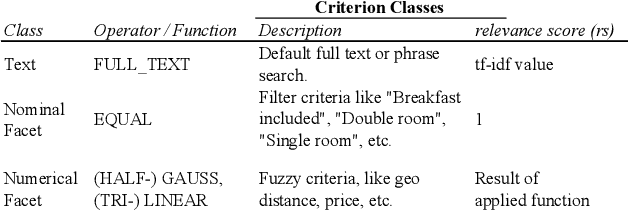

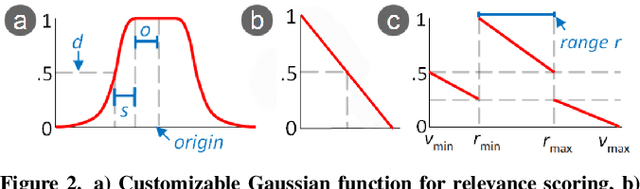
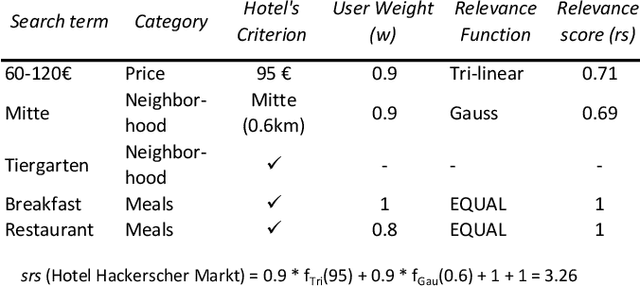
Finding a product online can be a challenging task for users. Faceted search interfaces, often in combination with recommenders, can support users in finding a product that fits their preferences. However, those preferences are not always equally weighted: some might be more important to a user than others (e.g. red is the favorite color, but blue is also fine) and sometimes preferences are even contradictory (e.g. the lowest price vs. the highest performance). Often, there is even no product that meets all preferences. In those cases, faceted search interfaces reach their limits. In our research, we investigate the potential of a search interface, which allows a preference-based ranking based on weighted search and facet terms. We performed a user study with 24 participants and measured user satisfaction and system performance. The results show that with the preference-based search interface the users were given more alternatives that best meet their preferences and that they are more satisfied with the selected product than with a search interface using standard facets. Furthermore, in this work we study the relationship between user satisfaction and search precision within the whole search session and found first indications that there might be a relation between them.
Dataset of Natural Language Queries for E-Commerce
Feb 13, 2023Shopping online is more and more frequent in our everyday life. For e-commerce search systems, understanding natural language coming through voice assistants, chatbots or from conversational search is an essential ability to understand what the user really wants. However, evaluation datasets with natural and detailed information needs of product-seekers which could be used for research do not exist. Due to privacy issues and competitive consequences, only few datasets with real user search queries from logs are openly available. In this paper, we present a dataset of 3,540 natural language queries in two domains that describe what users want when searching for a laptop or a jacket of their choice. The dataset contains annotations of vague terms and key facts of 1,754 laptop queries. This dataset opens up a range of research opportunities in the fields of natural language processing and (interactive) information retrieval for product search.
UNDR: User-Needs-Driven Ranking of Products in E-Commerce
Feb 13, 2023Online retailers often offer a vast choice of products to their customers to filter and browse through. The order in which the products are listed depends on the ranking algorithm employed in the online shop. State-of-the-art ranking methods are complex and draw on many different information, e.g., user query and intent, product attributes, popularity, recency, reviews, or purchases. However, approaches that incorporate user-generated data such as click-through data, user ratings, or reviews disadvantage new products that have not yet been rated by customers. We therefore propose the User-Needs-Driven Ranking (UNDR) method that accounts for explicit customer needs by using facet popularity and facet value popularity. As a user-centered approach that does not rely on post-purchase ratings or reviews, our method bypasses the cold-start problem while still reflecting the needs of an average customer. In two preliminary user studies, we compare our ranking method with a rating-based ranking baseline. Our findings show that our proposed approach generates a ranking that fits current customer needs significantly better than the baseline. However, a more fine-grained usage-specific ranking did not further improve the ranking.
Evaluation of Word Embeddings for the Social Sciences
Feb 13, 2023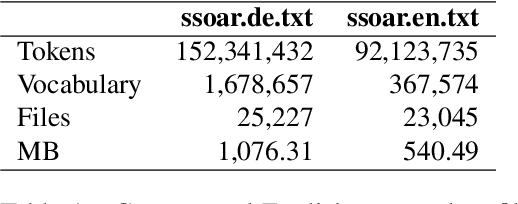
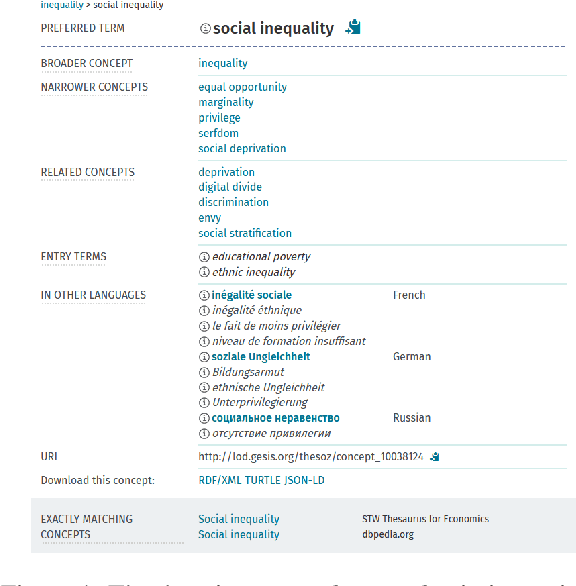
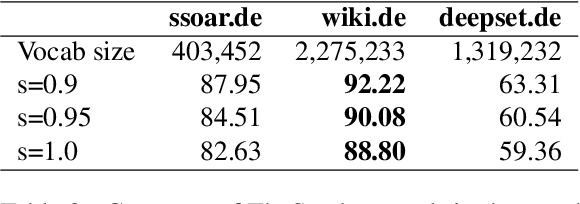
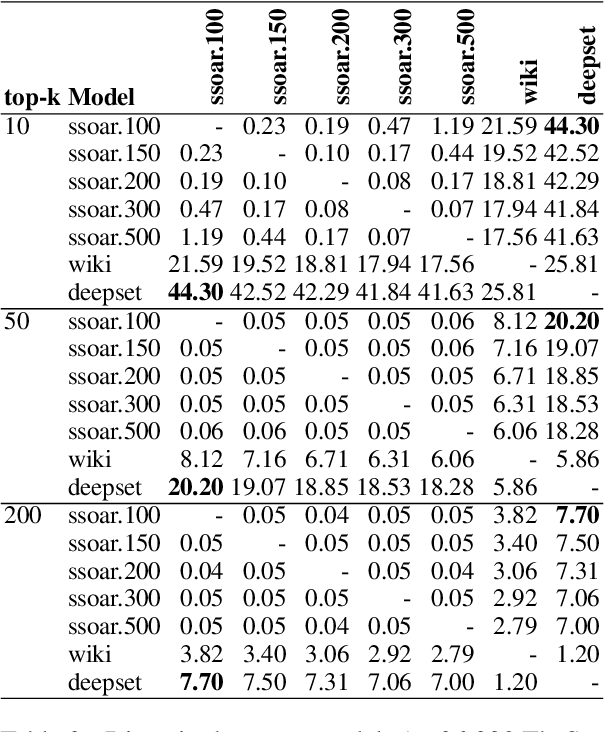
Word embeddings are an essential instrument in many NLP tasks. Most available resources are trained on general language from Web corpora or Wikipedia dumps. However, word embeddings for domain-specific language are rare, in particular for the social science domain. Therefore, in this work, we describe the creation and evaluation of word embedding models based on 37,604 open-access social science research papers. In the evaluation, we compare domain-specific and general language models for (i) language coverage, (ii) diversity, and (iii) semantic relationships. We found that the created domain-specific model, even with a relatively small vocabulary size, covers a large part of social science concepts, their neighborhoods are diverse in comparison to more general models. Across all relation types, we found a more extensive coverage of semantic relationships.