 Add to Chrome
 Add to Firefox
 Add to Edge
Categorical Flow Maps
Feb 12, 2026
We introduce Categorical Flow Maps, a flow-matching method for accelerated few-step generation of categorical data via self-distillation. Building on recent variational formulations of flow matching and the broader trend towards accelerated inference in diffusion and flow-based models, we define a flow map towards the simplex that transports probability mass toward a predicted endpoint, yielding a parametrisation that naturally constrains model predictions. Since our trajectories are continuous rather than discrete, Categorical Flow Maps can be trained with existing distillation techniques, as well as a new objective based on endpoint consistency. This continuous formulation also automatically unlocks test-time inference: we can directly reuse existing guidance and reweighting techniques in the categorical setting to steer sampling toward downstream objectives. Empirically, we achieve state-of-the-art few-step results on images, molecular graphs, and text, with strong performance even in single-step generation.

Closing the gap: Exact maximum likelihood training of generative autoencoders using invertible layers
May 19, 2022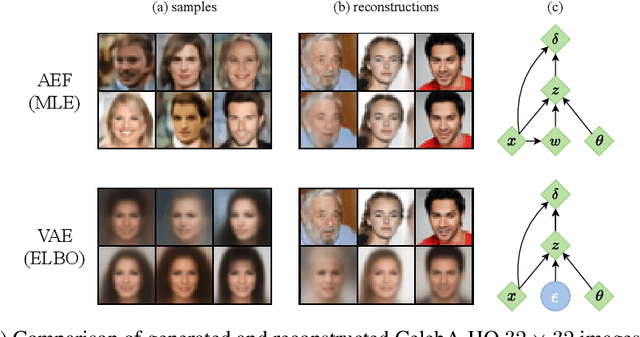

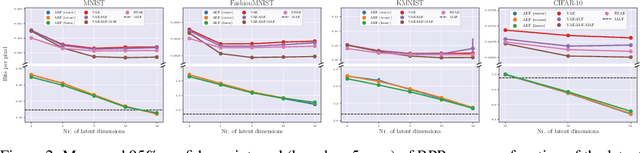

In this work, we provide an exact likelihood alternative to the variational training of generative autoencoders. We show that VAE-style autoencoders can be constructed using invertible layers, which offer a tractable exact likelihood without the need for any regularization terms. This is achieved while leaving complete freedom in the choice of encoder, decoder and prior architectures, making our approach a drop-in replacement for the training of existing VAEs and VAE-style models. We refer to the resulting models as Autoencoders within Flows (AEF), since the encoder, decoder and prior are defined as individual layers of an overall invertible architecture. We show that the approach results in strikingly higher performance than architecturally equivalent VAEs in term of log-likelihood, sample quality and denoising performance. In a broad sense, the main ambition of this work is to close the gap between the normalizing flow and autoencoder literature under the common framework of invertibility and exact maximum likelihood.