 Add to Chrome
 Add to Firefox
 Add to Edge
Linear Model Extraction via Factual and Counterfactual Queries
Feb 10, 2026
In model extraction attacks, the goal is to reveal the parameters of a black-box machine learning model by querying the model for a selected set of data points. Due to an increasing demand for explanations, this may involve counterfactual queries besides the typically considered factual queries. In this work, we consider linear models and three types of queries: factual, counterfactual, and robust counterfactual. First, for an arbitrary set of queries, we derive novel mathematical formulations for the classification regions for which the decision of the unknown model is known, without recovering any of the model parameters. Second, we derive bounds on the number of queries needed to extract the model's parameters for (robust) counterfactual queries under arbitrary norm-based distances. We show that the full model can be recovered using just a single counterfactual query when differentiable distance measures are employed. In contrast, when using polyhedral distances for instance, the number of required queries grows linearly with the dimension of the data space. For robust counterfactuals, the latter number of queries doubles. Consequently, the applied distance function and robustness of counterfactuals have a significant impact on the model's security.

Coherent Local Explanations for Mathematical Optimization
Feb 07, 2025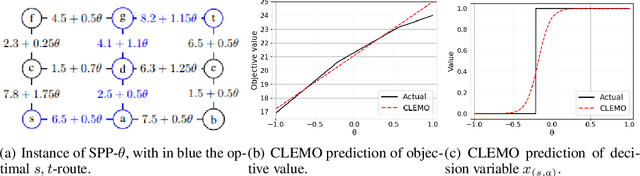
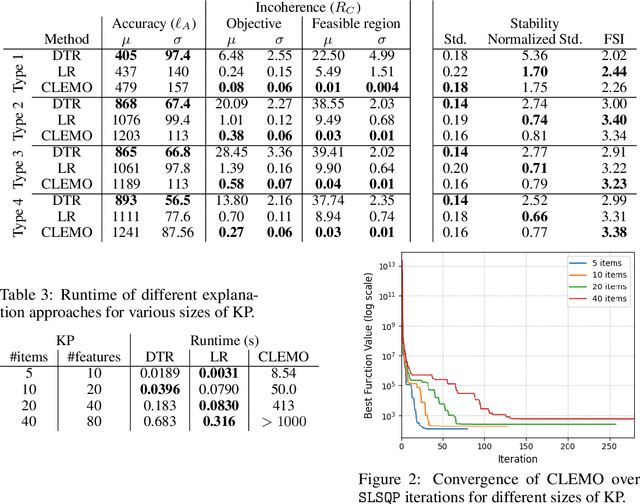
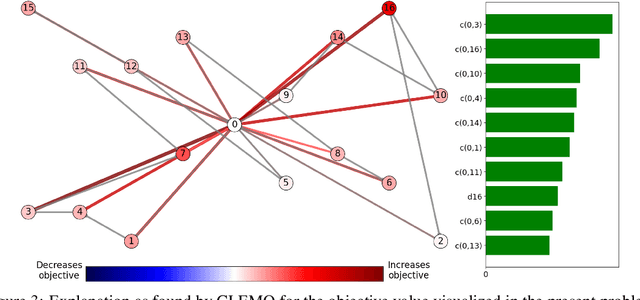
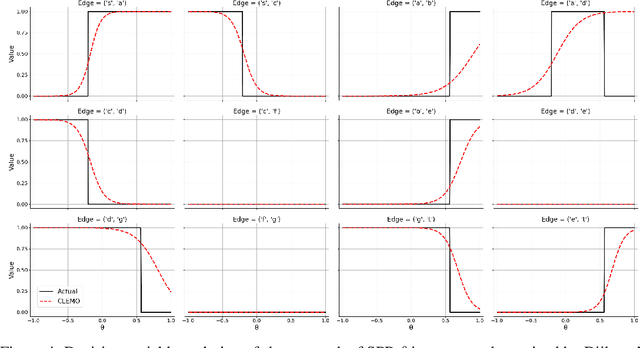
The surge of explainable artificial intelligence methods seeks to enhance transparency and explainability in machine learning models. At the same time, there is a growing demand for explaining decisions taken through complex algorithms used in mathematical optimization. However, current explanation methods do not take into account the structure of the underlying optimization problem, leading to unreliable outcomes. In response to this need, we introduce Coherent Local Explanations for Mathematical Optimization (CLEMO). CLEMO provides explanations for multiple components of optimization models, the objective value and decision variables, which are coherent with the underlying model structure. Our sampling-based procedure can provide explanations for the behavior of exact and heuristic solution algorithms. The effectiveness of CLEMO is illustrated by experiments for the shortest path problem, the knapsack problem, and the vehicle routing problem.