 Add to Chrome
 Add to Firefox
 Add to Edge
Estimating Treatment Effects in Networks using Domain Adversarial Training
Oct 24, 2025
Estimating heterogeneous treatment effects in network settings is complicated by interference, meaning that the outcome of an instance can be influenced by the treatment status of others. Existing causal machine learning approaches usually assume a known exposure mapping that summarizes how the outcome of a given instance is influenced by others' treatment, a simplification that is often unrealistic. Furthermore, the interaction between homophily -- the tendency of similar instances to connect -- and the treatment assignment mechanism can induce a network-level covariate shift that may lead to inaccurate treatment effect estimates, a phenomenon that has not yet been explicitly studied. To address these challenges, we propose HINet, a novel method that integrates graph neural networks with domain adversarial training. This combination allows estimating treatment effects under unknown exposure mappings while mitigating the impact of (network-level) covariate shift. An extensive empirical evaluation on synthetic and semi-synthetic network datasets demonstrates the effectiveness of our approach.

Using dynamic loss weighting to boost improvements in forecast stability
Sep 26, 2024
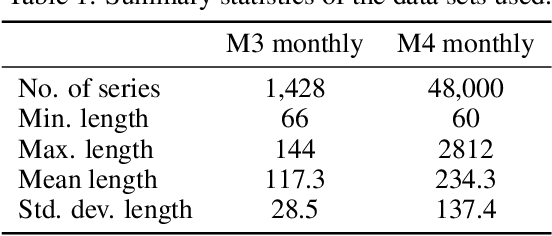
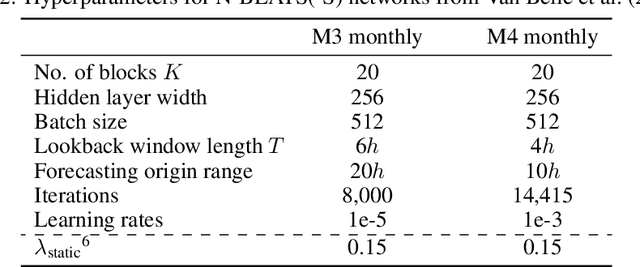
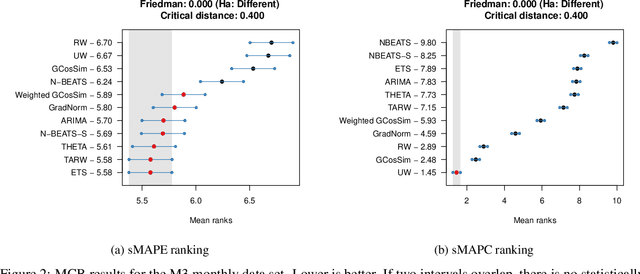
Rolling origin forecast instability refers to variability in forecasts for a specific period induced by updating the forecast when new data points become available. Recently, an extension to the N-BEATS model for univariate time series point forecasting was proposed to include forecast stability as an additional optimization objective, next to accuracy. It was shown that more stable forecasts can be obtained without harming accuracy by minimizing a composite loss function that contains both a forecast error and a forecast instability component, with a static hyperparameter to control the impact of stability. In this paper, we empirically investigate whether further improvements in stability can be obtained without compromising accuracy by applying dynamic loss weighting algorithms, which change the loss weights during training. We show that some existing dynamic loss weighting methods achieve this objective. However, our proposed extension to the Random Weighting approach -- Task-Aware Random Weighting -- shows the best performance.