 Add to Chrome
 Add to Firefox
 Add to Edge
Contextual Value Alignment via Multilayer Combinatorial Fusion
Aug 07, 2026
Aligning large language models (LLMs) with human values remains a major challenge, especially for trustworthy AI. While existing approaches such as RLHF, CAI, and their variants have achieved promising results, they often rely on a single-agent framework and a unified reward system. This limits their ability to capture ethical pluralism, adapt to diverse moral contexts, and reflect the dynamics of multi-agent moral reasoning. In this work, we propose a framework that utilizes multilayer combinatorial fusion for contextual value alignment (MCF-CVA). At the first layer of the framework, it instantiates multiple moral agents, each fine-tuned to represent a distinctive value. Their outputs are then expanded combinatorially using both score- and rank-combinations as well as average and weighted aggregations. These combined models are then reduced to the same number of initial moral agents. This expansion and reduction (EAR) process continues for multi-layers until a stopping criterion is reached. The MCF-CVA framework leverages cognitive diversity between agents to mitigate conflicts and redundancies across multiple agents, producing responses that better reflect contextual human values. The framework using the EAR algorithm is performed on the dual architecture of Euclidean score space and Kemeny rank space. Empirical evaluations demonstrated that the proposed framework outperforms single-agent baselines, multi-agent single-layer results, and previous aggregation approaches on standard metrics, showing that the MCF-CVA framework provides a robust and effective mechanism for advancing contextual value alignment in LLMs.

NCAA Bracket Prediction Using Machine Learning and Combinatorial Fusion Analysis
Mar 11, 2026Machine learning models have demonstrated remarkable success in sports prediction in the past years, often treating sports prediction as a classification task within the field. This paper introduces new perspectives for analyzing sports data to predict outcomes more accurately. We leverage rankings to generate team rankings for the 2024 dataset using Combinatorial Fusion Analysis (CFA), a new paradigm for combining multiple scoring systems through the rank-score characteristic (RSC) function and cognitive diversity (CD). Our result based on rank combination with respect to team ranking has an accuracy rate of $74.60\%$, which is higher than the best of the ten popular public ranking systems ($73.02\%$). This exhibits the efficacy of CFA in enhancing the precision of sports prediction through different lens.
Enhancing Value Alignment of LLMs with Multi-agent system and Combinatorial Fusion
Mar 11, 2026Aligning large language models (LLMs) with human values is a central challenge for ensuring trustworthy and safe deployment. While existing methods such as Reinforcement Learning from Human Feedback (RLHF) and its variants have improved alignment, they often rely on a single evaluator or narrowly defined reward signals, limiting their ability to capture ethical pluralism. In this work, we propose the Value Alignment System using Combinatorial Fusion Analysis (VAS-CFA), a framework that operationalizes multi-agent fusion alignment. It instantiates multiple moral agents, each fine-tuned to represent a distinct normative perspective, and fuses their outputs using CFA with both rank- and score-based aggregation. This design leverages cognitive diversity, between agents, to mitigate conflicts and redundancies across multiple agents, producing responses that better reflect human values. Empirical evaluation demonstrates that VAS-CFA outperforms both single agent baselines and prior aggregation approaches on standard metrics, showing that multi-agent fusion provides a robust and effective mechanism for advancing value alignment in LLMs.
Enhancing Sentiment Classification with Machine Learning and Combinatorial Fusion
Oct 30, 2025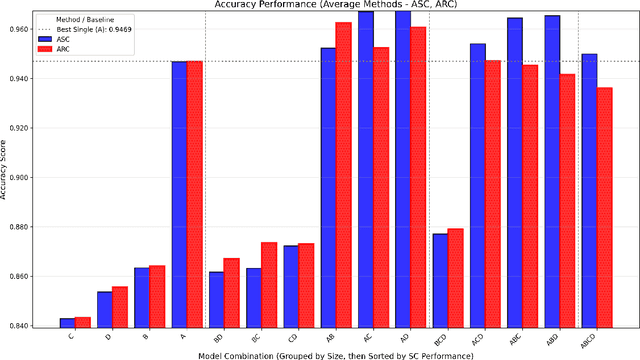
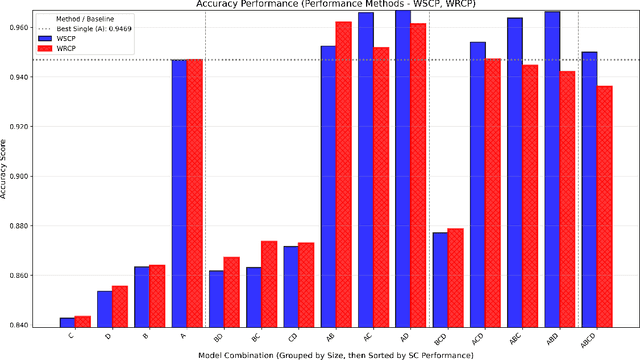
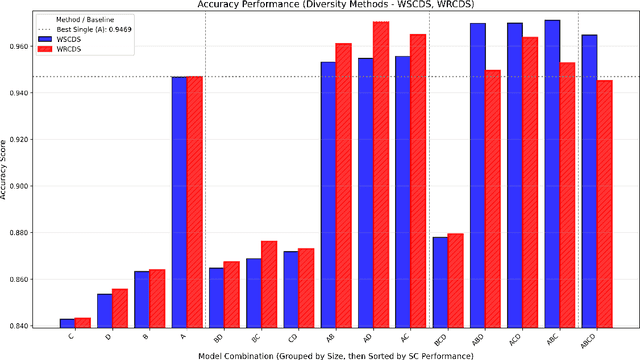
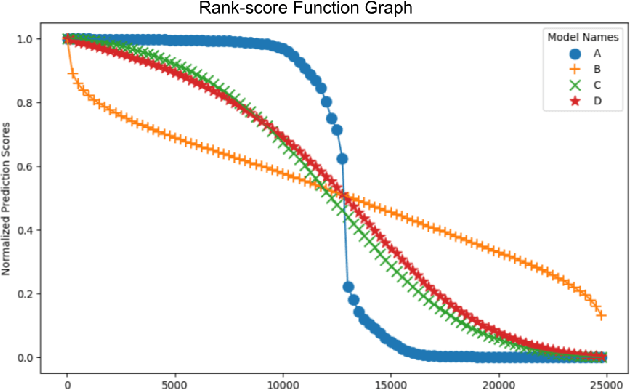
This paper presents a novel approach to sentiment classification using the application of Combinatorial Fusion Analysis (CFA) to integrate an ensemble of diverse machine learning models, achieving state-of-the-art accuracy on the IMDB sentiment analysis dataset of 97.072\%. CFA leverages the concept of cognitive diversity, which utilizes rank-score characteristic functions to quantify the dissimilarity between models and strategically combine their predictions. This is in contrast to the common process of scaling the size of individual models, and thus is comparatively efficient in computing resource use. Experimental results also indicate that CFA outperforms traditional ensemble methods by effectively computing and employing model diversity. The approach in this paper implements the combination of a transformer-based model of the RoBERTa architecture with traditional machine learning models, including Random Forest, SVM, and XGBoost.