 Add to Chrome
 Add to Firefox
 Add to Edge
SFKD: Spatial--Frequency Joint-Aware Heterogeneous Knowledge Distillation via Multi-Level Wavelet Spectral Interaction
Jul 02, 2026
Most existing knowledge distillation methods focus on homogeneous models (e.g., CNN-to-CNN), thereby overlooking the flexibility and potential of knowledge transfer across heterogeneous models. Due to intrinsic inductive bias discrepancies between heterogeneous models that cause spatial distribution inconsistencies, prior heterogeneous distillation methods often weaken or discard spatial information in heterogeneous representations. However, the spatial information in representations often encodes transferable global structural semantics as well as architecture-specific local details, and therefore should not be directly ignored. To better leverage the spatial information encoded in heterogeneous representations, we propose a Spatial-Frequency Joint-Aware Heterogeneous Knowledge Distillation framework (SFKD). By leveraging the complementary properties of wavelet transform spatial locality and Fourier representations in characterizing global energy distributions, we first apply multi-level discrete wavelet transform to explicitly decouple spatial information. The resulting wavelet sub-bands are further refined by a dual-stream dual-stage refinement module, and finally combined with a Gaussian-filtered frequency loss to selectively capture informative global information. Extensive experiments on multiple benchmark datasets under both homogeneous and heterogeneous models demonstrate the superiority of our method.

Contrastive Representation Distillation via Multi-Scale Feature Decoupling
Feb 09, 2025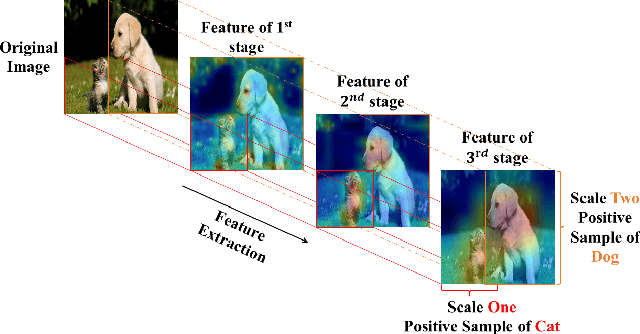
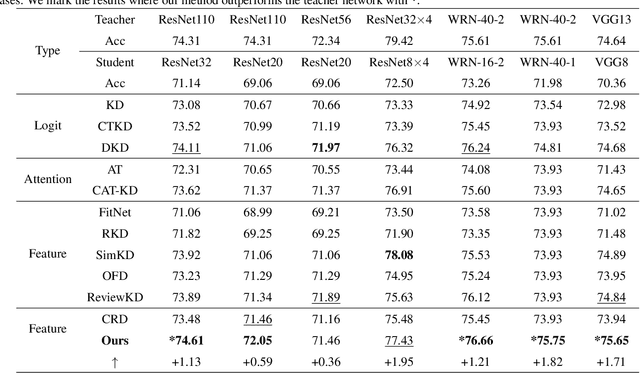


Knowledge distillation is a technique aimed at enhancing the performance of a smaller student network without increasing its parameter size by transferring knowledge from a larger, pre-trained teacher network. Previous approaches have predominantly focused on distilling global feature information while overlooking the importance of disentangling the diverse types of information embedded within different regions of the feature. In this work, we introduce multi-scale decoupling in the feature transfer process for the first time, where the decoupled local features are individually processed and integrated with contrastive learning. Moreover, compared to previous contrastive learning-based distillation methods, our approach not only reduces computational costs but also enhances efficiency, enabling performance improvements for the student network using only single-batch samples. Extensive evaluations on CIFAR-100 and ImageNet demonstrate our method's superiority, with some student networks distilled using our method even surpassing the performance of their pre-trained teacher networks. These results underscore the effectiveness of our approach in enabling student networks to thoroughly absorb knowledge from teacher networks.