 Add to Chrome
 Add to Firefox
 Add to Edge
From Verification to Amplification: Auditing Reverse Image Search as Algorithmic Gatekeeping in Visual Misinformation Fact-checking
Mar 10, 2026
As visual misinformation becomes increasingly prevalent, platform algorithms act as intermediaries that curate information for users' verification practices. Yet, it remains unclear how algorithmic gatekeeping tools, such as reverse image search (RIS), shape users' information exposure during fact-checking. This study systematically audits Google RIS by reversely searching newly identified misleading images over a 15-day window and analyzing 34,486 collected top-ranked search results. We find that Google RIS returns a substantial volume of irrelevant information and repeated misinformation, whereas debunking content constitutes less than 30% of search results. Debunking content faces visibility challenges in rankings amid repeated misinformation and irrelevant information. Our findings also indicate an inverted U-shaped curve of RIS results page quality over time, likely due to search engine "data voids" when visual falsehoods first appear. These findings contribute to scholarship of visual misinformation verification, and extend algorithmic gatekeeping research to the visual domain.

Large Language Model-Informed Feature Discovery Improves Prediction and Interpretation of Credibility Perceptions of Visual Content
Apr 15, 2025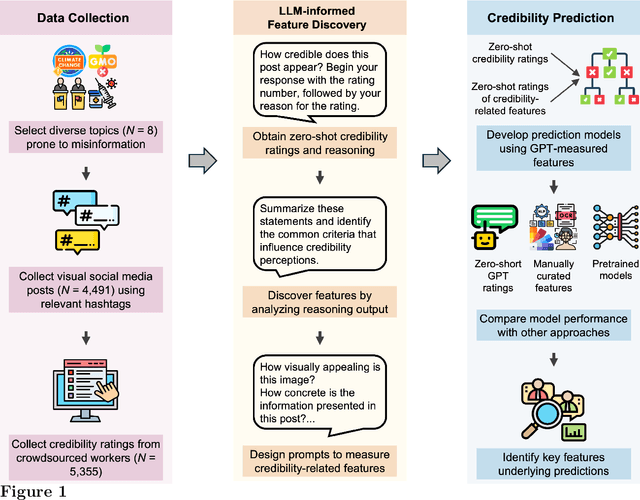
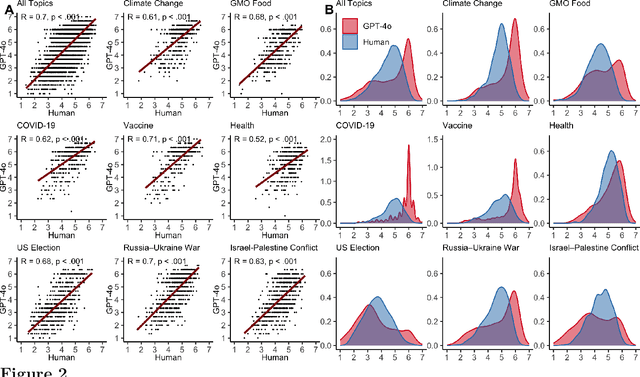

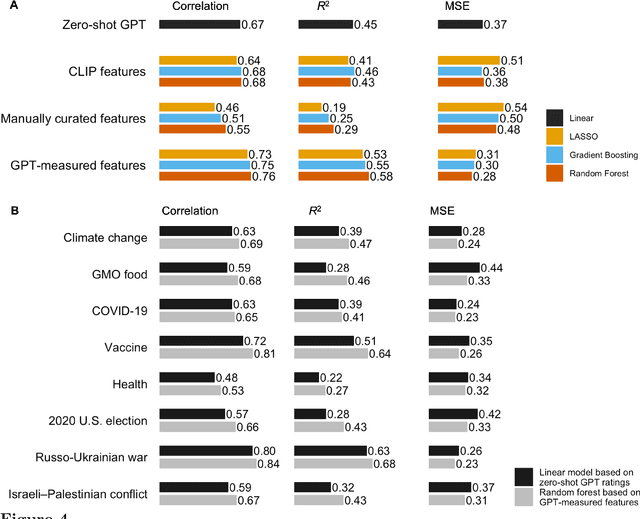
In today's visually dominated social media landscape, predicting the perceived credibility of visual content and understanding what drives human judgment are crucial for countering misinformation. However, these tasks are challenging due to the diversity and richness of visual features. We introduce a Large Language Model (LLM)-informed feature discovery framework that leverages multimodal LLMs, such as GPT-4o, to evaluate content credibility and explain its reasoning. We extract and quantify interpretable features using targeted prompts and integrate them into machine learning models to improve credibility predictions. We tested this approach on 4,191 visual social media posts across eight topics in science, health, and politics, using credibility ratings from 5,355 crowdsourced workers. Our method outperformed zero-shot GPT-based predictions by 13 percent in R2, and revealed key features like information concreteness and image format. We discuss the implications for misinformation mitigation, visual credibility, and the role of LLMs in social science.