 Add to Chrome
 Add to Firefox
 Add to Edge
Persona-Conditioned Adversarial Prompting: Multi-Identity Red-Teaming for Adversarial Discovery and Mitigation
May 12, 2026
Automated red-teaming for LLMs often discovers narrow attack slices, missing diverse real-world threats, and yielding insufficient data for safety fine-tuning. We introduce Persona-Conditioned Adversarial Prompting (PCAP), which conditions adversarial search on diverse attacker personas (e.g., doctors, students, malicious actors) and strategy sets to explore realistic attack scenarios. By running parallel persona-conditioned searches, PCAP discovers transferable jailbreaks across different contexts and generates rich defense datasets with automatic metadata tracking. On GPT-OSS 120B, PCAP increases attack success from 57\% to 97\% while producing 2-6$\times$ more diverse prompts covering varied real-world scenarios. Critically, fine-tuning lightweight adapters on PCAP-generated data significantly improves model robustness (recall: 0.36 $\rightarrow$ 0.99, F1: 0.53 $\rightarrow$ 0.96) with minimal false positives, demonstrating a practical closed-loop approach from vulnerability discovery to automated alignment.

Guidelines For The Choice Of The Baseline in XAI Attribution Methods
Mar 25, 2025Given the broad adoption of artificial intelligence, it is essential to provide evidence that AI models are reliable, trustable, and fair. To this end, the emerging field of eXplainable AI develops techniques to probe such requirements, counterbalancing the hype pushing the pervasiveness of this technology. Among the many facets of this issue, this paper focuses on baseline attribution methods, aiming at deriving a feature attribution map at the network input relying on a "neutral" stimulus usually called "baseline". The choice of the baseline is crucial as it determines the explanation of the network behavior. In this framework, this paper has the twofold goal of shedding light on the implications of the choice of the baseline and providing a simple yet effective method for identifying the best baseline for the task. To achieve this, we propose a decision boundary sampling method, since the baseline, by definition, lies on the decision boundary, which naturally becomes the search domain. Experiments are performed on synthetic examples and validated relying on state-of-the-art methods. Despite being limited to the experimental scope, this contribution is relevant as it offers clear guidelines and a simple proxy for baseline selection, reducing ambiguity and enhancing deep models' reliability and trust.
Planning and Inverse Kinematics of Hyper-Redundant Manipulators with VO-FABRIK
Mar 08, 2024
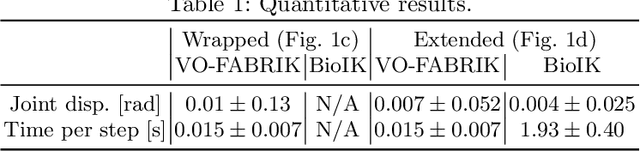
Hyper-redundant Robotic Manipulators (HRMs) offer great dexterity and flexibility of operation, but solving Inverse Kinematics (IK) is challenging. In this work, we introduce VO-FABRIK, an algorithm combining Forward and Backward Reaching Inverse Kinematics (FABRIK) for repeatable deterministic IK computation, and an approach inspired from velocity obstacles to perform path planning under collision and joint limits constraints. We show preliminary results on an industrial HRM with 19 actuated joints. Our algorithm achieves good performance where a state-of-the-art IK solver fails.