 Add to Chrome
 Add to Firefox
 Add to Edge
STEREODISCO: Discovering Stereotypicality in LLMs
Jul 30, 2026
LLMs encode, convey, and perpetuate stereotypes. Prior computational research focuses on a small set of semantic axes investigated in social psychology, and operates on word embeddings produced by language models, leaving open which other semantic axes carry stereotypical associations in LLMs and how LLMs internally represent such axes. We introduce STEREODISCO, a framework that adapts the semantic differential method (Osgood et al., 1957) to the systematic study of stereotypes in LLM internal representations. STEREODISCO constructs approx. 2,000 candidate semantic axes from WordNet antonym synsets, recovers each as a geometric axis in the LLM's activation space via probing, and identifies stereotypical axes via a statistical test over concept projections. As a case study, we apply STEREODISCO to social group stereotypes with LLAMA-3-8B-INSTRUCT and MISTRAL-7B-INSTRUCT. We find that the two LLMs agree with each other on social group ratings more than with humans, suggesting that LLM-encoded stereotype content diverges from that documented in social psychology. We also discover stereotypical axes not investigated in prior work -- including humble vs. proud, narrow-minded vs. broad-minded, and cowardly vs. brave, which human annotators independently confirm.

Wikidated 1.0: An Evolving Knowledge Graph Dataset of Wikidata's Revision History
Dec 09, 2021
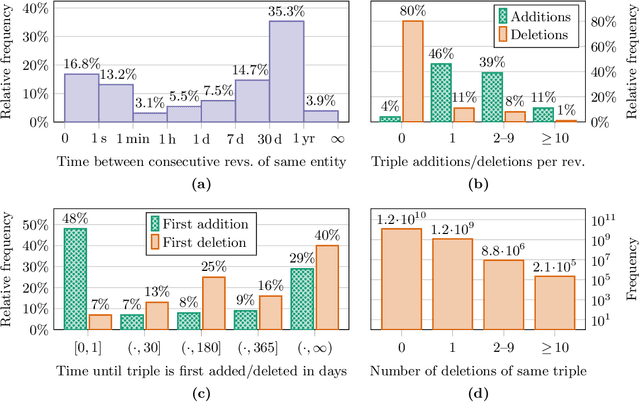
Wikidata is the largest general-interest knowledge base that is openly available. It is collaboratively edited by thousands of volunteer editors and has thus evolved considerably since its inception in 2012. In this paper, we present Wikidated 1.0, a dataset of Wikidata's full revision history, which encodes changes between Wikidata revisions as sets of deletions and additions of RDF triples. To the best of our knowledge, it constitutes the first large dataset of an evolving knowledge graph, a recently emerging research subject in the Semantic Web community. We introduce the methodology for generating Wikidated 1.0 from dumps of Wikidata, discuss its implementation and limitations, and present statistical characteristics of the dataset.
* 15 pages, 4 figures. Published at Wikidata@ISWC 2021
No Word is an Island -- A Transformation Weighting Model for Semantic Composition
Jul 11, 2019Composition models of distributional semantics are used to construct phrase representations from the representations of their words. Composition models are typically situated on two ends of a spectrum. They either have a small number of parameters but compose all phrases in the same way, or they perform word-specific compositions at the cost of a far larger number of parameters. In this paper we propose transformation weighting (TransWeight), a composition model that consistently outperforms existing models on nominal compounds, adjective-noun phrases and adverb-adjective phrases in English, German and Dutch. TransWeight drastically reduces the number of parameters needed compared to the best model in the literature by composing similar words in the same way.