 Add to Chrome
 Add to Firefox
 Add to Edge
A Domain Incremental Continual Learning Benchmark for ICU Time Series Model Transportability
May 05, 2026
In recent years, machine learning has made significant progress in clinical outcome prediction, demonstrating increasingly accurate results. However, the substantial resources required for hospitals to train these models, such as data collection, labeling, and computational power, limit the feasibility for smaller hospitals to develop their own models. An alternative approach involves transferring a machine learning model trained by a large hospital to smaller hospitals, allowing them to fine-tune the model on their specific patient data. However, these models are often trained and validated on data from a single hospital, raising concerns about their generalizability to new data. Our research shows that there are notable differences in measurement distributions and frequencies across various regions in the United States. To address this, we propose a benchmark that tests a machine learning model's ability to transfer from a source domain to different regions across the country. This benchmark assesses a model's capacity to learn meaningful information about each new domain while retaining key features from the original domain. Using this benchmark, we frame the transfer of a machine learning model from one region to another as a domain incremental learning problem. While the task of patient outcome prediction remains the same, the input data distribution varies, necessitating a model that can effectively manage these shifts. We evaluate two popular domain incremental learning methods: data replay, which stores examples from previous data sources for fine-tuning on the current source, and Elastic Weight Consolidation (EWC), a model parameter regularization method that maintains features important for both data sources.

An Efficient Contrastive Unimodal Pretraining Method for EHR Time Series Data
Oct 11, 2024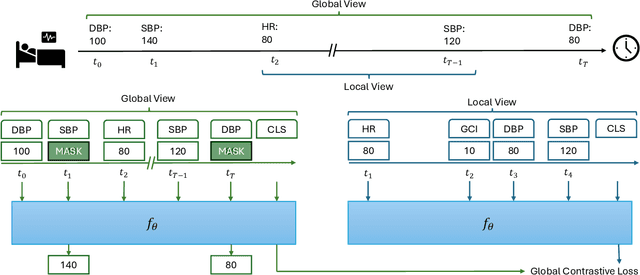
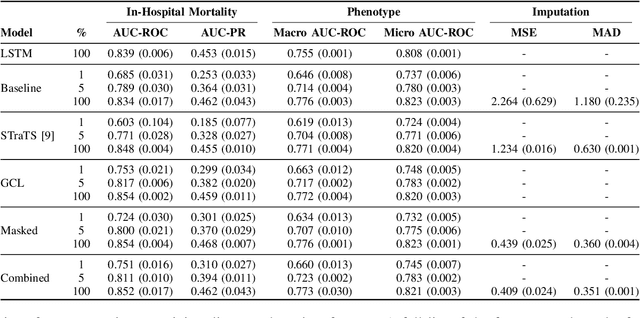
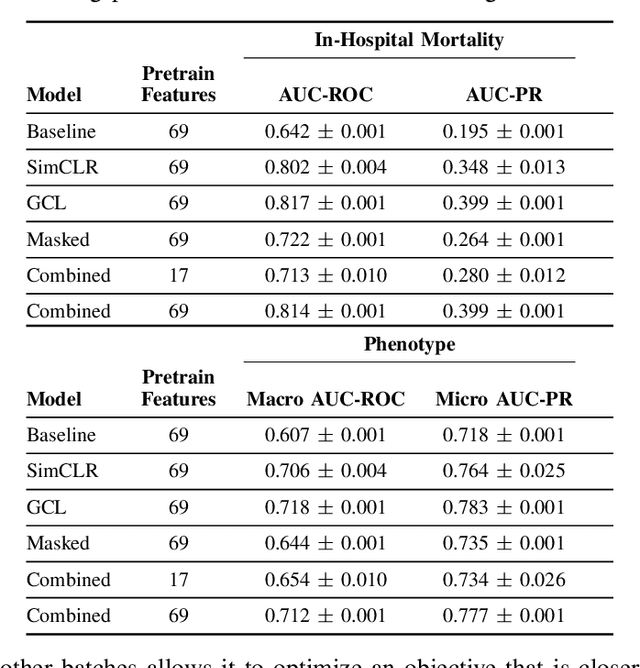
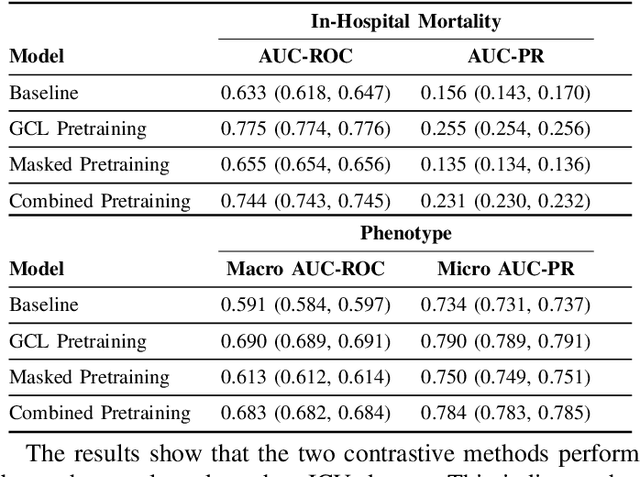
Machine learning has revolutionized the modeling of clinical timeseries data. Using machine learning, a Deep Neural Network (DNN) can be automatically trained to learn a complex mapping of its input features for a desired task. This is particularly valuable in Electronic Health Record (EHR) databases, where patients often spend extended periods in intensive care units (ICUs). Machine learning serves as an efficient method for extract meaningful information. However, many state-of-the-art (SOTA) methods for training DNNs demand substantial volumes of labeled data, posing significant challenges for clinics in terms of cost and time. Self-supervised learning offers an alternative by allowing practitioners to extract valuable insights from data without the need for costly labels. Yet, current SOTA methods often necessitate large data batches to achieve optimal performance, increasing computational demands. This presents a challenge when working with long clinical timeseries data. To address this, we propose an efficient method of contrastive pretraining tailored for long clinical timeseries data. Our approach utilizes an estimator for negative pair comparison, enabling effective feature extraction. We assess the efficacy of our pretraining using standard self-supervised tasks such as linear evaluation and semi-supervised learning. Additionally, our model demonstrates the ability to impute missing measurements, providing clinicians with deeper insights into patient conditions. We demonstrate that our pretraining is capable of achieving better performance as both the size of the model and the size of the measurement vocabulary scale. Finally, we externally validate our model, trained on the MIMIC-III dataset, using the eICU dataset. We demonstrate that our model is capable of learning robust clinical information that is transferable to other clinics.