 Add to Chrome
 Add to Firefox
 Add to Edge
Inference-Time Policy Alignment for Fair Reinforcement Learning
Jul 31, 2026
Deep reinforcement learning (RL) agents achieve strong performance by optimizing scalar reward functions. However, once deployed, the policies of these RL agents are often rigid and costly to adapt to new performance criteria. For instance, an agent trained to maximize expected cumulative reward may not accommodate previously unknown stakeholder preferences. Existing approaches to achieve fairness, a type of preference, in RL typically assume that such preferences are known a priori and require complete retraining of the policy under a fairness-oriented metric. Inspired by inference-time alignment in large language models, we investigate the problem of steering a pretrained RL policy toward welfare-based fairness objectives at inference time without updating the base policy's parameters. We formalize inference-time fairness alignment as a policy shaping problem and propose a multiplicative policy shaping framework that adjusts action probabilities using action-dependent welfare scores, thus requiring no modification to the base policy. Our framework is general and compatible with any deep RL agent. Through extensive experiments across multiple domains, we demonstrate that inference-time policy shaping substantially improves welfare-based fairness objectives while preserving core task performance.

Aerial Infrared Health Monitoring of Solar Photovoltaic Farms at Scale
Mar 03, 2025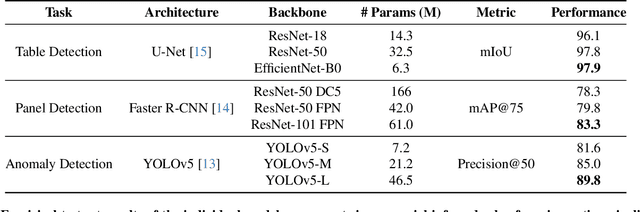
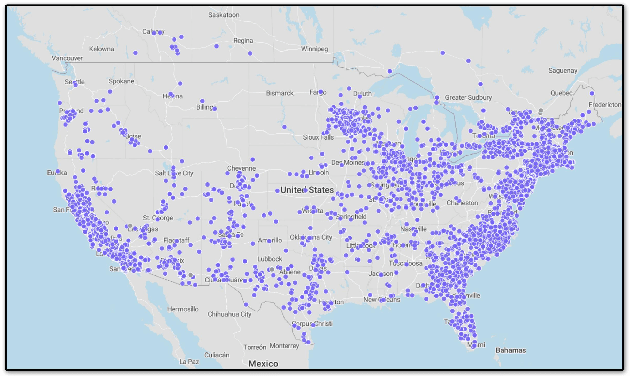
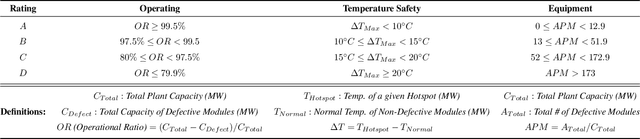
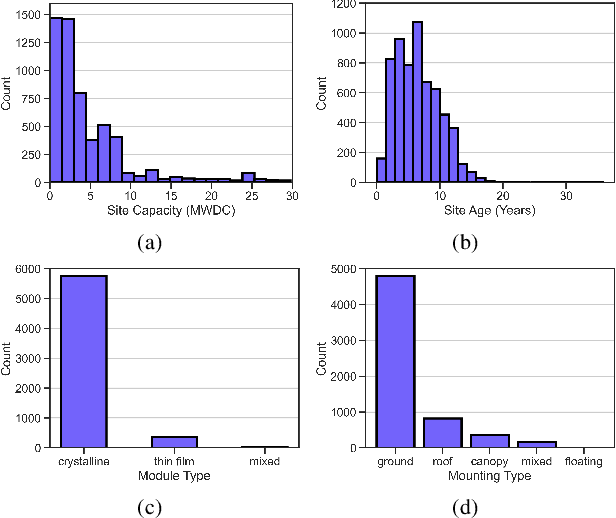
Solar photovoltaic (PV) farms represent a major source of global renewable energy generation, yet their true operational efficiency often remains unknown at scale. In this paper, we present a comprehensive, data-driven framework for large-scale airborne infrared inspection of North American solar installations. Leveraging high-resolution thermal imagery, we construct and curate a geographically diverse dataset encompassing thousands of PV sites, enabling machine learning-based detection and localization of defects that are not detectable in the visible spectrum. Our pipeline integrates advanced image processing, georeferencing, and airborne thermal infrared anomaly detection to provide rigorous estimates of performance losses. We highlight practical considerations in aerial data collection, annotation methodologies, and model deployment across a wide range of environmental and operational conditions. Our work delivers new insights into the reliability of large-scale solar assets and serves as a foundation for ongoing research on performance trends, predictive maintenance, and scalable analytics in the renewable energy sector.
Solar Panel Mapping via Oriented Object Detection
Feb 05, 2025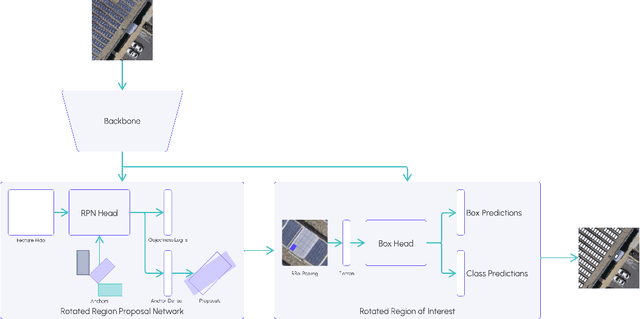

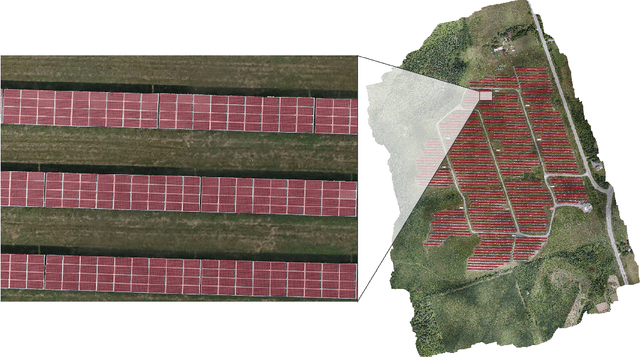

Maintaining the integrity of solar power plants is a vital component in dealing with the current climate crisis. This process begins with analysts creating a detailed map of a plant with the coordinates of every solar panel, making it possible to quickly locate and mitigate potential faulty solar panels. However, this task is extremely tedious and is not scalable for the ever increasing capacity of solar power across the globe. Therefore, we propose an end-to-end deep learning framework for detecting individual solar panels using a rotated object detection architecture. We evaluate our approach on a diverse dataset of solar power plants collected from across the United States and report a mAP score of 83.3%.
Barely-Visible Surface Crack Detection for Wind Turbine Sustainability
Jul 09, 2024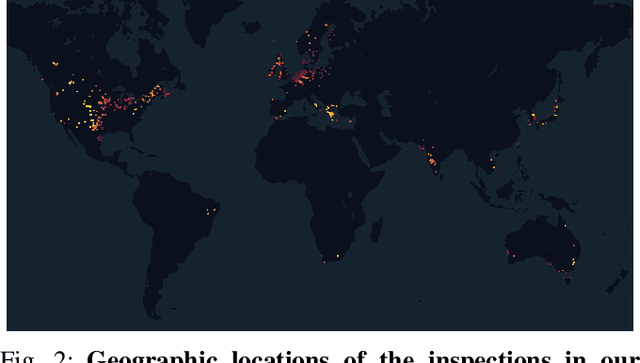
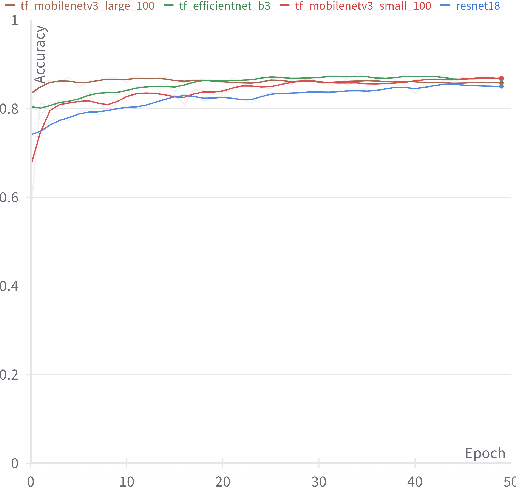

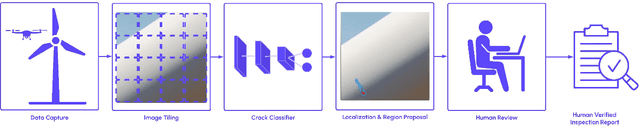
The production of wind energy is a crucial part of sustainable development and reducing the reliance on fossil fuels. Maintaining the integrity of wind turbines to produce this energy is a costly and time-consuming task requiring repeated inspection and maintenance. While autonomous drones have proven to make this process more efficient, the algorithms for detecting anomalies to prevent catastrophic damage to turbine blades have fallen behind due to some dangerous defects, such as hairline cracks, being barely-visible. Existing datasets and literature are lacking and tend towards detecting obvious and visible defects in addition to not being geographically diverse. In this paper we introduce a novel and diverse dataset of barely-visible hairline cracks collected from numerous wind turbine inspections. To prove the efficacy of our dataset, we detail our end-to-end deployed turbine crack detection pipeline from the image acquisition stage to the use of predictions in providing automated maintenance recommendations to extend the life and efficiency of wind turbines.