 Add to Chrome
 Add to Firefox
 Add to Edge
Multinex: Lightweight Low-light Image Enhancement via Multi-prior Retinex
Apr 11, 2026
Low-light image enhancement (LLIE) aims to restore natural visibility, color fidelity, and structural detail under severe illumination degradation. State-of-the-art (SOTA) LLIE techniques often rely on large models and multi-stage training, limiting practicality for edge deployment. Moreover, their dependence on a single color space introduces instability and visible exposure or color artifacts. To address these, we propose Multinex, an ultra-lightweight structured framework that integrates multiple fine-grained representations within a principled Retinex residual formulation. It decomposes an image into illumination and color prior stacks derived from distinct analytic representations, and learns to fuse these representations into luminance and reflectance adjustments required to correct exposure. By prioritizing enhancement over reconstruction and exploiting lightweight neural operations, Multinex significantly reduces computational cost, exemplified by its lightweight (45K parameters) and nano (0.7K parameters) versions. Extensive benchmarks show that all lightweight variants significantly outperform their corresponding lightweight SOTA models, and reach comparable performance to heavy models. Paper page available at https://albrateanu.github.io/multinex.

ISALux: Illumination and Segmentation Aware Transformer Employing Mixture of Experts for Low Light Image Enhancement
Aug 25, 2025
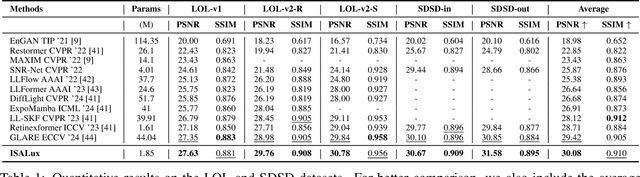
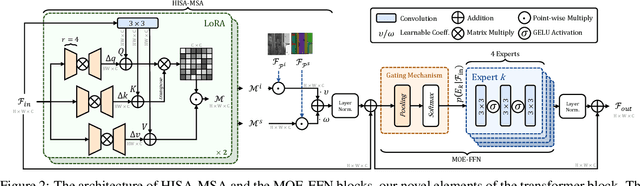
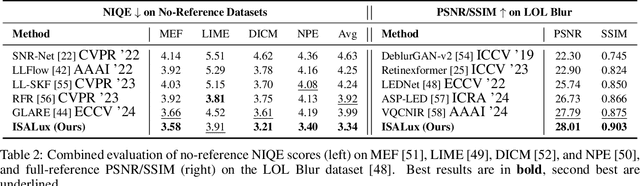
We introduce ISALux, a novel transformer-based approach for Low-Light Image Enhancement (LLIE) that seamlessly integrates illumination and semantic priors. Our architecture includes an original self-attention block, Hybrid Illumination and Semantics-Aware Multi-Headed Self- Attention (HISA-MSA), which integrates illumination and semantic segmentation maps for en- hanced feature extraction. ISALux employs two self-attention modules to independently process illumination and semantic features, selectively enriching each other to regulate luminance and high- light structural variations in real-world scenarios. A Mixture of Experts (MoE)-based Feed-Forward Network (FFN) enhances contextual learning, with a gating mechanism conditionally activating the top K experts for specialized processing. To address overfitting in LLIE methods caused by distinct light patterns in benchmarking datasets, we enhance the HISA-MSA module with low-rank matrix adaptations (LoRA). Extensive qualitative and quantitative evaluations across multiple specialized datasets demonstrate that ISALux is competitive with state-of-the-art (SOTA) methods. Addition- ally, an ablation study highlights the contribution of each component in the proposed model. Code will be released upon publication.
ModalFormer: Multimodal Transformer for Low-Light Image Enhancement
Jul 27, 2025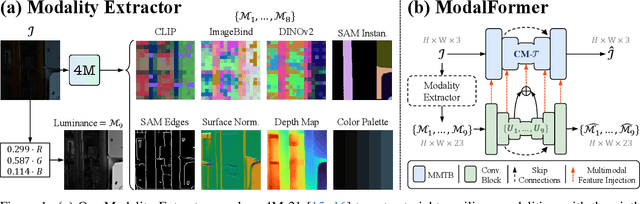
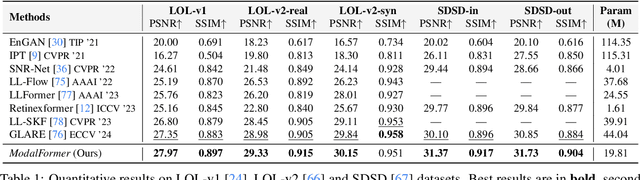
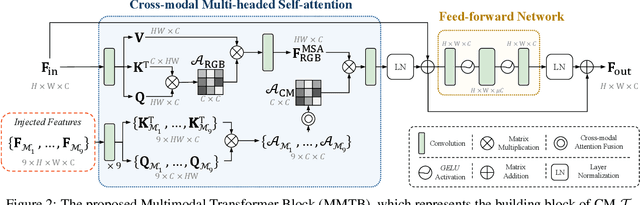
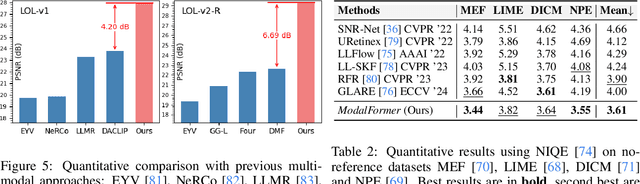
Low-light image enhancement (LLIE) is a fundamental yet challenging task due to the presence of noise, loss of detail, and poor contrast in images captured under insufficient lighting conditions. Recent methods often rely solely on pixel-level transformations of RGB images, neglecting the rich contextual information available from multiple visual modalities. In this paper, we present ModalFormer, the first large-scale multimodal framework for LLIE that fully exploits nine auxiliary modalities to achieve state-of-the-art performance. Our model comprises two main components: a Cross-modal Transformer (CM-T) designed to restore corrupted images while seamlessly integrating multimodal information, and multiple auxiliary subnetworks dedicated to multimodal feature reconstruction. Central to the CM-T is our novel Cross-modal Multi-headed Self-Attention mechanism (CM-MSA), which effectively fuses RGB data with modality-specific features--including deep feature embeddings, segmentation information, geometric cues, and color information--to generate information-rich hybrid attention maps. Extensive experiments on multiple benchmark datasets demonstrate ModalFormer's state-of-the-art performance in LLIE. Pre-trained models and results are made available at https://github.com/albrateanu/ModalFormer.