 Add to Chrome
 Add to Firefox
 Add to Edge
Face-trace: Open-Set Attribution and Progressive Discovery of Synthetic Face Generators
Jul 08, 2026
Recent advances in generative Artificial Intelligence have made synthetic face images increasingly realistic, creating new challenges for multimedia forensics. Source attribution methods should not only identify the generator of an image when the source is known, but also handle samples produced by previously unseen models. However, most existing approaches address synthetic face attribution in a closed-set setting, where all possible generators are available during training. This assumption does not hold in real-world scenarios, where new generators continuously appear and rejected samples should be organized rather than simply discarded. In this work we propose a pipeline for open-set synthetic face source attribution that combines known generator classification, energy-based OOD rejection, and unknown generator discovery. A classifier is trained on known generators using frozen I-JEPA embeddings, while rejected samples are represented by combining projected I-JEPA features with Forensic Self-Descriptors and then clustered to discover groups of unknown generators. We also extend the discovery stage to an incremental scenario, where rejected samples arrive over time. Experiments on the WILD dataset show that the proposed method achieves 96.73% closed-set attribution accuracy. In the open-set setting, energy-based rejection reaches 71.25% balanced accuracy, while rejected samples are clustered into meaningful unknown-generator groups, obtaining an ARI of 0.81, an NMI of 0.90, and an overall clustering purity of 87.74%. In the incremental setting, the discovered generator space is progressively extended while maintaining a final purity of 99.23%. Cross-dataset experiments suggest that the pipeline can operate beyond the original dataset distribution, although post-processing remains challenging.

Shedding Light on Depth: Explainability Assessment in Monocular Depth Estimation
Sep 19, 2025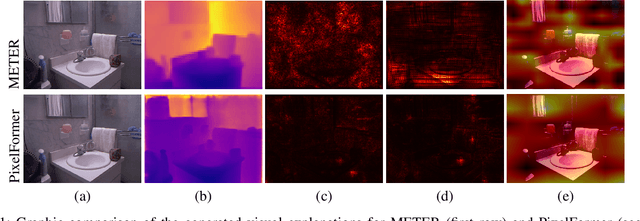
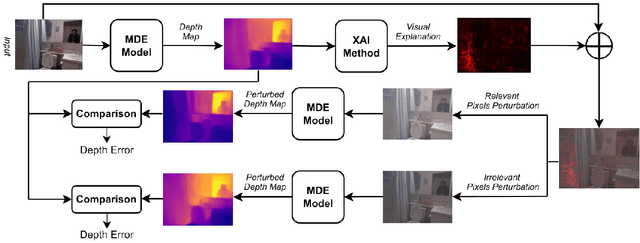
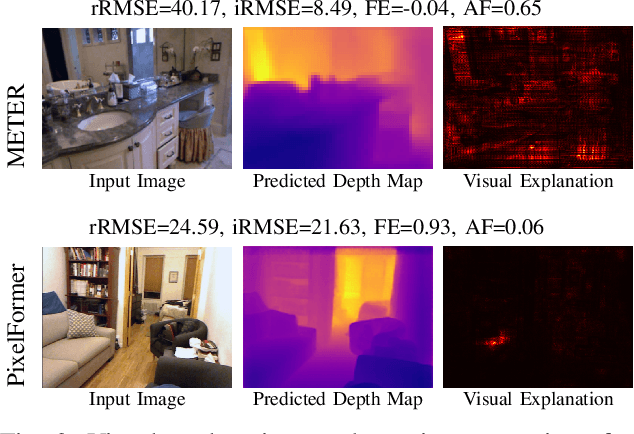
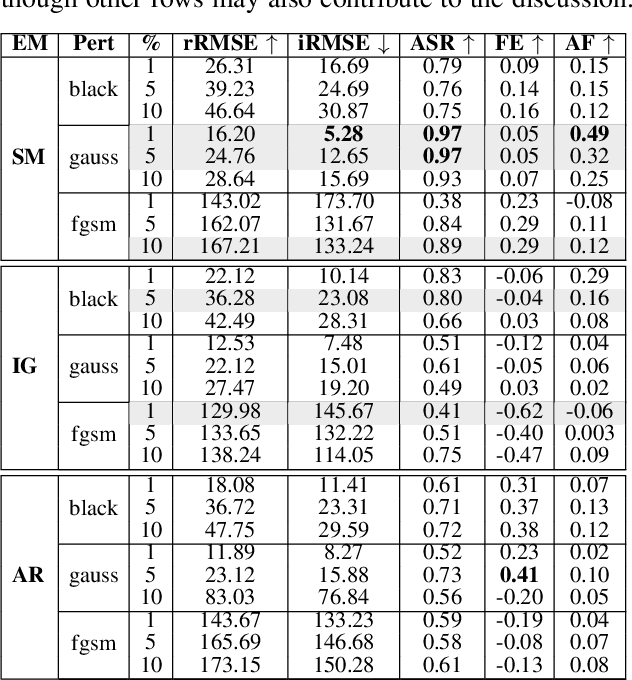
Explainable artificial intelligence is increasingly employed to understand the decision-making process of deep learning models and create trustworthiness in their adoption. However, the explainability of Monocular Depth Estimation (MDE) remains largely unexplored despite its wide deployment in real-world applications. In this work, we study how to analyze MDE networks to map the input image to the predicted depth map. More in detail, we investigate well-established feature attribution methods, Saliency Maps, Integrated Gradients, and Attention Rollout on different computationally complex models for MDE: METER, a lightweight network, and PixelFormer, a deep network. We assess the quality of the generated visual explanations by selectively perturbing the most relevant and irrelevant pixels, as identified by the explainability methods, and analyzing the impact of these perturbations on the model's output. Moreover, since existing evaluation metrics can have some limitations in measuring the validity of visual explanations for MDE, we additionally introduce the Attribution Fidelity. This metric evaluates the reliability of the feature attribution by assessing their consistency with the predicted depth map. Experimental results demonstrate that Saliency Maps and Integrated Gradients have good performance in highlighting the most important input features for MDE lightweight and deep models, respectively. Furthermore, we show that Attribution Fidelity effectively identifies whether an explainability method fails to produce reliable visual maps, even in scenarios where conventional metrics might suggest satisfactory results.