 Add to Chrome
 Add to Firefox
 Add to Edge
Causal Reconstruction of Sentiment Signals from Sparse News Data
Mar 24, 2026
Sentiment signals derived from sparse news are commonly used in financial analysis and technology monitoring, yet transforming raw article-level observations into reliable temporal series remains a largely unsolved engineering problem. Rather than treating this as a classification challenge, we propose to frame it as a causal signal reconstruction problem: given probabilistic sentiment outputs from a fixed classifier, recover a stable latent sentiment series that is robust to the structural pathologies of news data such as sparsity, redundancy, and classifier uncertainty. We present a modular three-stage pipeline that (i) aggregates article-level scores onto a regular temporal grid with uncertainty-aware and redundancy-aware weights, (ii) fills coverage gaps through strictly causal projection rules, and (iii) applies causal smoothing to reduce residual noise. Because ground-truth longitudinal sentiment labels are typically unavailable, we introduce a label-free evaluation framework based on signal stability diagnostics, information preservation lag proxies, and counterfactual tests for causality compliance and redundancy robustness. As a secondary external check, we evaluate the consistency of reconstructed signals against stock-price data for a multi-firm dataset of AI-related news titles (November 2024 to February 2026). The key empirical finding is a three-week lead lag pattern between reconstructed sentiment and price that persists across all tested pipeline configurations and aggregation regimes, a structural regularity more informative than any single correlation coefficient. Overall, the results support the view that stable, deployable sentiment indicators require careful reconstruction, not only better classifiers.

PICZL: Image-based Photometric Redshifts for AGN
Nov 13, 2024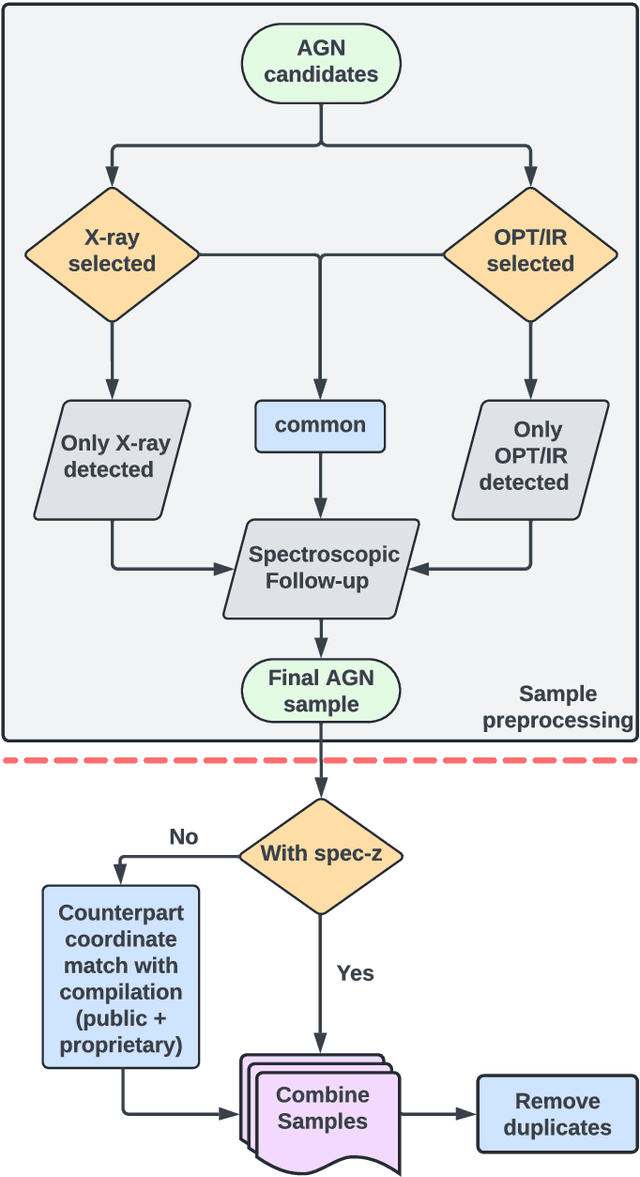
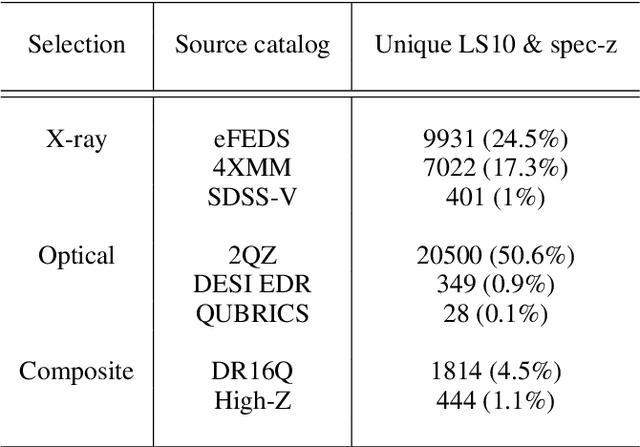
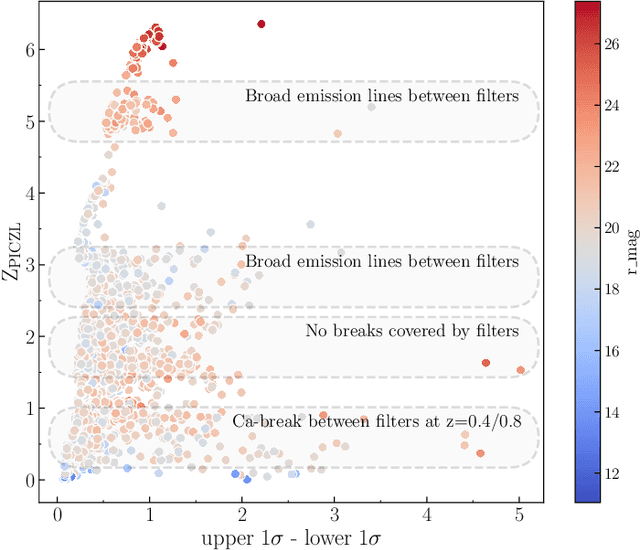
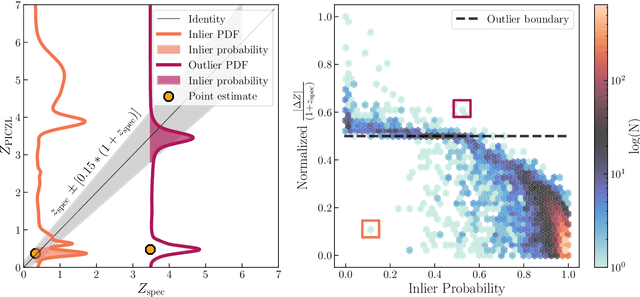
Computing photo-z for AGN is challenging, primarily due to the interplay of relative emissions associated with the SMBH and its host galaxy. SED fitting methods, effective in pencil-beam surveys, face limitations in all-sky surveys with fewer bands available, lacking the ability to capture the AGN contribution to the SED accurately. This limitation affects the many 10s of millions of AGN clearly singled out and identified by SRG/eROSITA. Our goal is to significantly enhance photometric redshift performance for AGN in all-sky surveys while avoiding the need to merge multiple data sets. Instead, we employ readily available data products from the 10th Data Release of the Imaging Legacy Survey for DESI, covering > 20,000 deg$^{2}$ with deep images and catalog-based photometry in the grizW1-W4 bands. We introduce PICZL, a machine-learning algorithm leveraging an ensemble of CNNs. Utilizing a cross-channel approach, the algorithm integrates distinct SED features from images with those obtained from catalog-level data. Full probability distributions are achieved via the integration of Gaussian mixture models. On a validation sample of 8098 AGN, PICZL achieves a variance $\sigma_{\textrm{NMAD}}$ of 4.5% with an outlier fraction $\eta$ of 5.6%, outperforming previous attempts to compute accurate photo-z for AGN using ML. We highlight that the model's performance depends on many variables, predominantly the depth of the data. A thorough evaluation of these dependencies is presented in the paper. Our streamlined methodology maintains consistent performance across the entire survey area when accounting for differing data quality. The same approach can be adopted for future deep photometric surveys such as LSST and Euclid, showcasing its potential for wide-scale realisation. With this paper, we release updated photo-z (including errors) for the XMM-SERVS W-CDF-S, ELAIS-S1 and LSS fields.