 Add to Chrome
 Add to Firefox
 Add to Edge
Resonant Brane Splatting for Arbitrary-Scale Super-Resolution
Jun 28, 2026
Arbitrary-Scale Super-Resolution (ASR) reconstructs images at continuous magnification factors. Recent methods accelerate inference by replacing computationally heavy implicit neural decoders with explicit 2D Gaussian Splatting (GS). However, since standard Gaussians are smooth low-pass primitives, modeling edges and fine textures requires multiple overlapping, well-aligned splats, which creates severe bottlenecks during rasterization. To address this, we introduce Resonant Brane Splatting (RBS), a feed-forward ASR framework. RBS replaces flat Gaussians with Branes: expressive primitives that emit spatially varying colors to natively model local contrast and complex textures within a single footprint. We achieve this by augmenting the standard Gaussian envelope with internal Gaussian-Hermite modes, assigning a distinct color coefficient to each. The zero-order mode recovers standard GS, while higher-order modes capture high frequencies. We predict Brane parameters directly from low-resolution features. Because Branes provide a mathematically richer formulation than simple Gaussians, far fewer primitives need to overlap to reconstruct a given target pixel. To exploit this, we introduce an efficient fully differentiable rasterizer with a precise culling strategy based on the classical quantum turning point. This allows us to safely skip negligible regions, drastically reducing the rendering overhead. Experiments on standard ASR benchmarks show that RBS improves reconstruction quality over implicit and GS baselines, while achieving superior speed-quality trade-off than prior GS methods.

Learning to Adaptively Allocate Gaussians for Arbitrary-Scale Image Super-Resolution
Jun 28, 2026In computer graphics, visual content is continuously warped, zoomed and resampled. This occurs when engines upscale frames, users zoom into 3D scenes, or foveated VR applies varying scaling. Handling these transformations requires Arbitrary-Scale Super-Resolution (ASR). Traditional models, designed for fixed scales, typically predict at a lower integer scale (e.g., x4) and rely on sub-optimal interpolation for continuous resolutions, compromising quality. Furthermore, most methods process pixels uniformly. Since fine details are sparse, this creates overhead; efficiency dictates concentrating resources only where structural complexity demands it. While implicit models and Gaussian Splatting (GS) enable continuous representation, GS is advantageous due to adaptive densification. However, transitioning GS into a feed-forward model for ASR is non-trivial. Standard GS optimization needs high-resolution gradients to drive primitive growth, which are unavailable during inference. Thus, the network must autonomously predict GS densification from low-resolution inputs. To solve this, we propose QuADA-GS. After encoding inputs into a latent space, a Neural Routing Architecture evaluates local complexity to distribute a global budget, assigning specific upsampling factors to features to avoid redundant processing. Features are dynamically densified based on these factors, forming an irregular topology decoded into 2D Gaussian primitives. To coordinate features before decoding, we introduce Hierarchical Pointer Convolution. This non-grid operator achieves O(1) neighbor lookup complexity, facilitating efficient spatial communication and bypassing dense bottlenecks. Experiments show QuADA-GS achieves state-of-the-art ASR performance, maintaining low latency and a lean memory footprint.
CA3D: Convolutional-Attentional 3D Nets for Efficient Video Activity Recognition on the Edge
May 26, 2025In this paper, we introduce a deep learning solution for video activity recognition that leverages an innovative combination of convolutional layers with a linear-complexity attention mechanism. Moreover, we introduce a novel quantization mechanism to further improve the efficiency of our model during both training and inference. Our model maintains a reduced computational cost, while preserving robust learning and generalization capabilities. Our approach addresses the issues related to the high computing requirements of current models, with the goal of achieving competitive accuracy on consumer and edge devices, enabling smart home and smart healthcare applications where efficiency and privacy issues are of concern. We experimentally validate our model on different established and publicly available video activity recognition benchmarks, improving accuracy over alternative models at a competitive computing cost.
ViSketch-GPT: Collaborative Multi-Scale Feature Extraction for Sketch Recognition and Generation
Mar 28, 2025Understanding the nature of human sketches is challenging because of the wide variation in how they are created. Recognizing complex structural patterns improves both the accuracy in recognizing sketches and the fidelity of the generated sketches. In this work, we introduce ViSketch-GPT, a novel algorithm designed to address these challenges through a multi-scale context extraction approach. The model captures intricate details at multiple scales and combines them using an ensemble-like mechanism, where the extracted features work collaboratively to enhance the recognition and generation of key details crucial for classification and generation tasks. The effectiveness of ViSketch-GPT is validated through extensive experiments on the QuickDraw dataset. Our model establishes a new benchmark, significantly outperforming existing methods in both classification and generation tasks, with substantial improvements in accuracy and the fidelity of generated sketches. The proposed algorithm offers a robust framework for understanding complex structures by extracting features that collaborate to recognize intricate details, enhancing the understanding of structures like sketches and making it a versatile tool for various applications in computer vision and machine learning.
Towards Identity-Aware Cross-Modal Retrieval: a Dataset and a Baseline
Dec 30, 2024
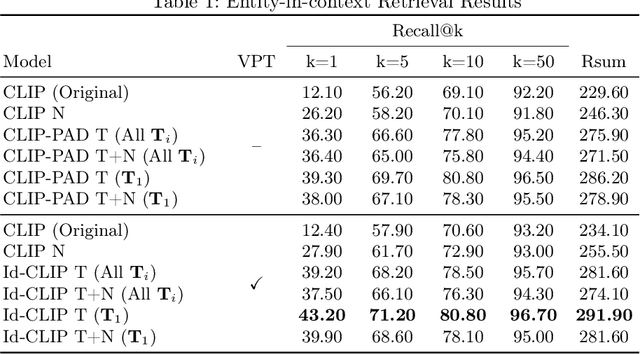

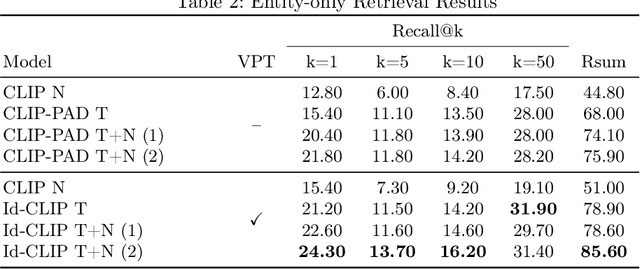
Recent advancements in deep learning have significantly enhanced content-based retrieval methods, notably through models like CLIP that map images and texts into a shared embedding space. However, these methods often struggle with domain-specific entities and long-tail concepts absent from their training data, particularly in identifying specific individuals. In this paper, we explore the task of identity-aware cross-modal retrieval, which aims to retrieve images of persons in specific contexts based on natural language queries. This task is critical in various scenarios, such as for searching and browsing personalized video collections or large audio-visual archives maintained by national broadcasters. We introduce a novel dataset, COCO Person FaceSwap (COCO-PFS), derived from the widely used COCO dataset and enriched with deepfake-generated faces from VGGFace2. This dataset addresses the lack of large-scale datasets needed for training and evaluating models for this task. Our experiments assess the performance of different CLIP variations repurposed for this task, including our architecture, Identity-aware CLIP (Id-CLIP), which achieves competitive retrieval performance through targeted fine-tuning. Our contributions lay the groundwork for more robust cross-modal retrieval systems capable of recognizing long-tail identities and contextual nuances. Data and code are available at https://github.com/mesnico/IdCLIP.
Exploring Strengths and Weaknesses of Super-Resolution Attack in Deepfake Detection
Oct 05, 2024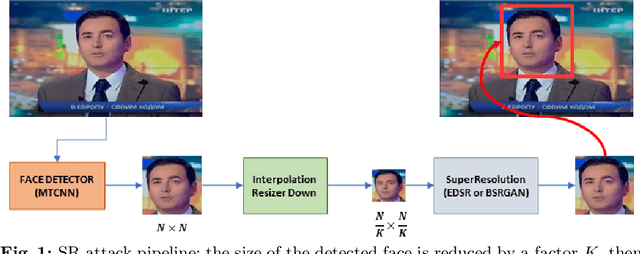
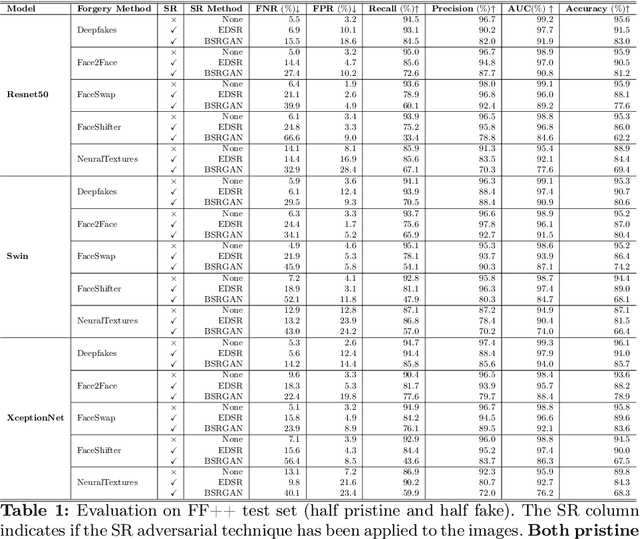
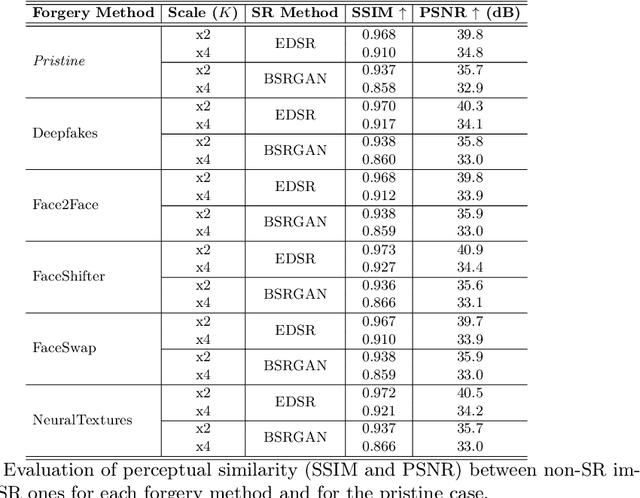
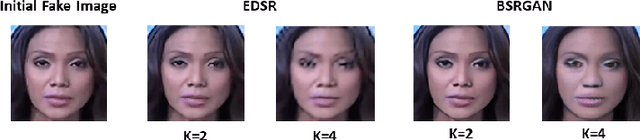
Image manipulation is rapidly evolving, allowing the creation of credible content that can be used to bend reality. Although the results of deepfake detectors are promising, deepfakes can be made even more complicated to detect through adversarial attacks. They aim to further manipulate the image to camouflage deepfakes' artifacts or to insert signals making the image appear pristine. In this paper, we further explore the potential of super-resolution attacks based on different super-resolution techniques and with different scales that can impact the performance of deepfake detectors with more or less intensity. We also evaluated the impact of the attack on more diverse datasets discovering that the super-resolution process is effective in hiding the artifacts introduced by deepfake generation models but fails in hiding the traces contained in fully synthetic images. Finally, we propose some changes to the detectors' training process to improve their robustness to this kind of attack.
Adversarial Magnification to Deceive Deepfake Detection through Super Resolution
Jul 02, 2024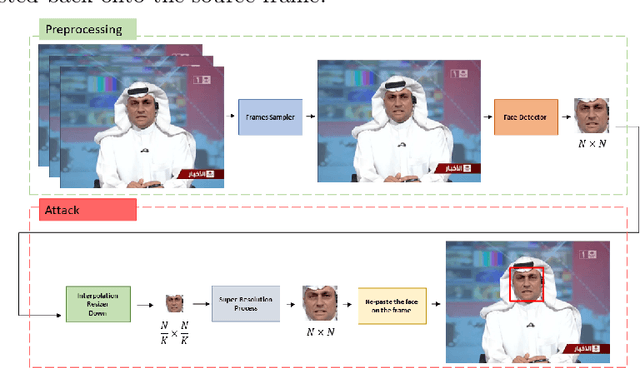
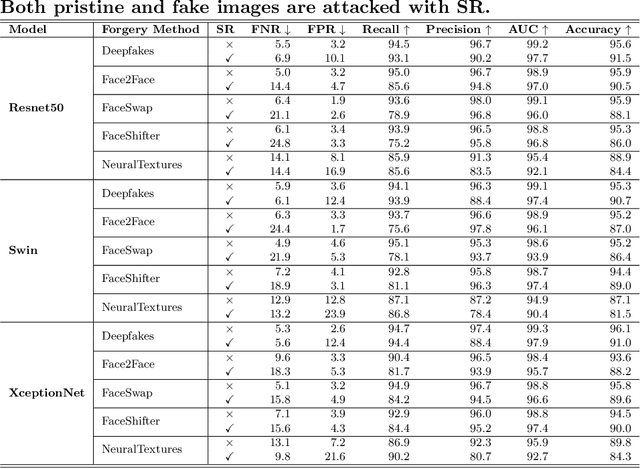
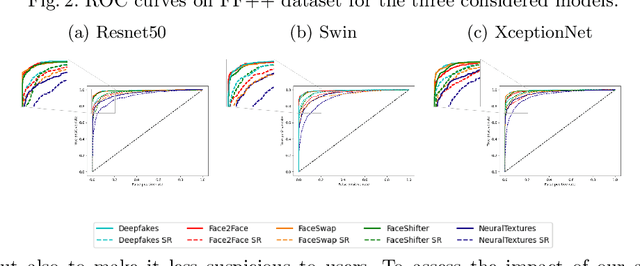
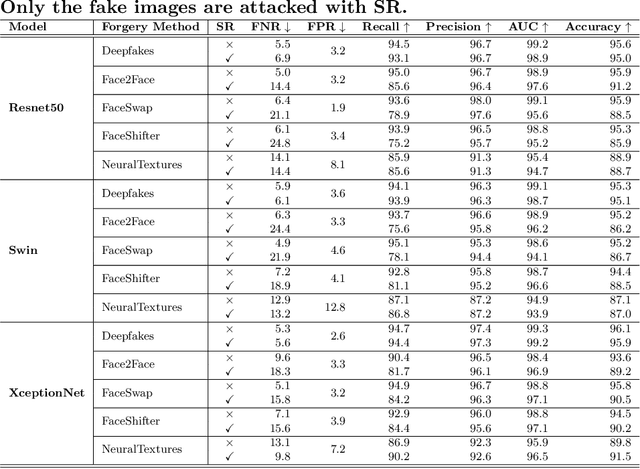
Deepfake technology is rapidly advancing, posing significant challenges to the detection of manipulated media content. Parallel to that, some adversarial attack techniques have been developed to fool the deepfake detectors and make deepfakes even more difficult to be detected. This paper explores the application of super resolution techniques as a possible adversarial attack in deepfake detection. Through our experiments, we demonstrate that minimal changes made by these methods in the visual appearance of images can have a profound impact on the performance of deepfake detection systems. We propose a novel attack using super resolution as a quick, black-box and effective method to camouflage fake images and/or generate false alarms on pristine images. Our results indicate that the usage of super resolution can significantly impair the accuracy of deepfake detectors, thereby highlighting the vulnerability of such systems to adversarial attacks. The code to reproduce our experiments is available at: https://github.com/davide-coccomini/Adversarial-Magnification-to-Deceive-Deepfake-Detection-through-Super-Resolution
Deepfake Detection without Deepfakes: Generalization via Synthetic Frequency Patterns Injection
Mar 20, 2024Deepfake detectors are typically trained on large sets of pristine and generated images, resulting in limited generalization capacity; they excel at identifying deepfakes created through methods encountered during training but struggle with those generated by unknown techniques. This paper introduces a learning approach aimed at significantly enhancing the generalization capabilities of deepfake detectors. Our method takes inspiration from the unique "fingerprints" that image generation processes consistently introduce into the frequency domain. These fingerprints manifest as structured and distinctly recognizable frequency patterns. We propose to train detectors using only pristine images injecting in part of them crafted frequency patterns, simulating the effects of various deepfake generation techniques without being specific to any. These synthetic patterns are based on generic shapes, grids, or auras. We evaluated our approach using diverse architectures across 25 different generation methods. The models trained with our approach were able to perform state-of-the-art deepfake detection, demonstrating also superior generalization capabilities in comparison with previous methods. Indeed, they are untied to any specific generation technique and can effectively identify deepfakes regardless of how they were made.
The devil is in the fine-grained details: Evaluating open-vocabulary object detectors for fine-grained understanding
Nov 29, 2023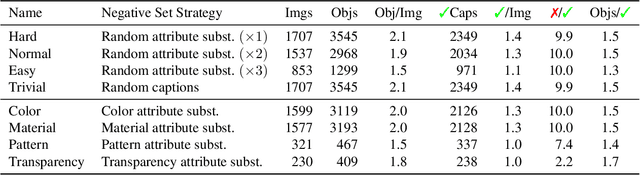
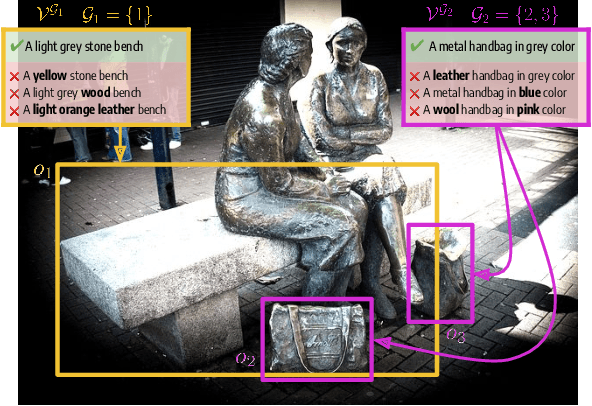
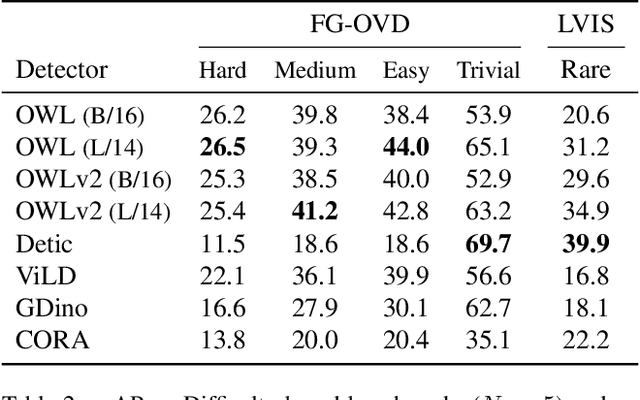
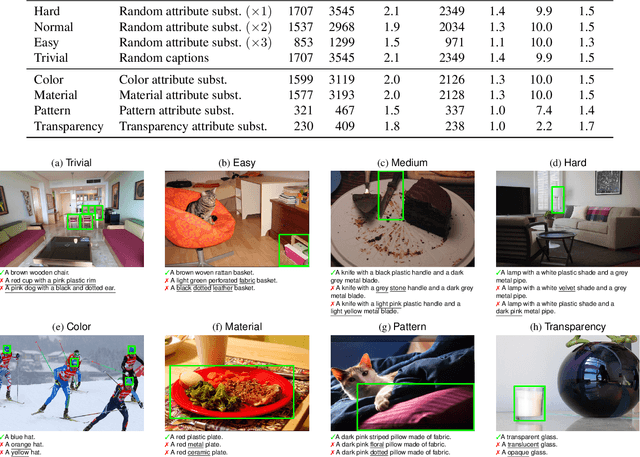
Recent advancements in large vision-language models enabled visual object detection in open-vocabulary scenarios, where object classes are defined in free-text formats during inference. In this paper, we aim to probe the state-of-the-art methods for open-vocabulary object detection to determine to what extent they understand fine-grained properties of objects and their parts. To this end, we introduce an evaluation protocol based on dynamic vocabulary generation to test whether models detect, discern, and assign the correct fine-grained description to objects in the presence of hard-negative classes. We contribute with a benchmark suite of increasing difficulty and probing different properties like color, pattern, and material. We further enhance our investigation by evaluating several state-of-the-art open-vocabulary object detectors using the proposed protocol and find that most existing solutions, which shine in standard open-vocabulary benchmarks, struggle to accurately capture and distinguish finer object details. We conclude the paper by highlighting the limitations of current methodologies and exploring promising research directions to overcome the discovered drawbacks. Data and code are available at https://github.com/lorebianchi98/FG-OVD.
Synaptic Plasticity Models and Bio-Inspired Unsupervised Deep Learning: A Survey
Jul 30, 2023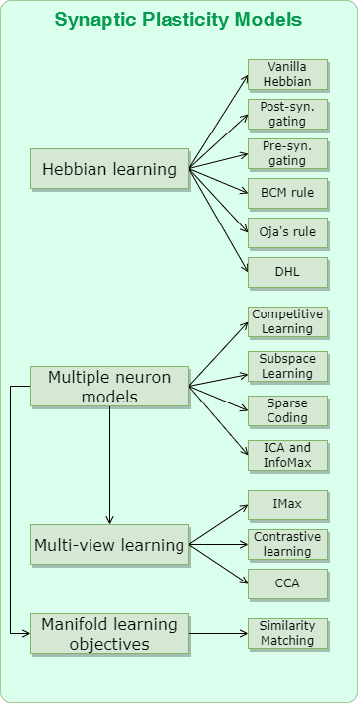

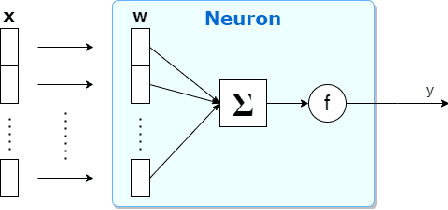
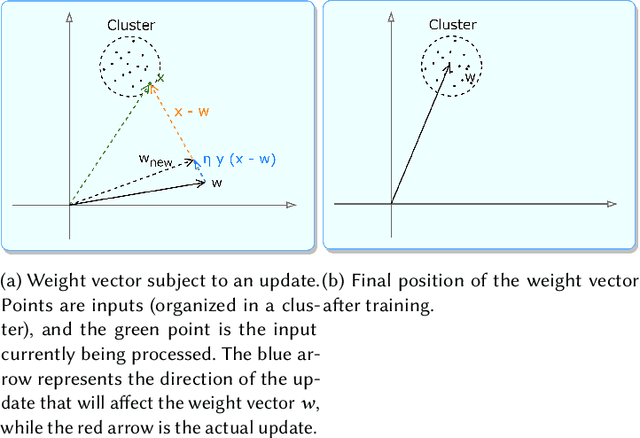
Recently emerged technologies based on Deep Learning (DL) achieved outstanding results on a variety of tasks in the field of Artificial Intelligence (AI). However, these encounter several challenges related to robustness to adversarial inputs, ecological impact, and the necessity of huge amounts of training data. In response, researchers are focusing more and more interest on biologically grounded mechanisms, which are appealing due to the impressive capabilities exhibited by biological brains. This survey explores a range of these biologically inspired models of synaptic plasticity, their application in DL scenarios, and the connections with models of plasticity in Spiking Neural Networks (SNNs). Overall, Bio-Inspired Deep Learning (BIDL) represents an exciting research direction, aiming at advancing not only our current technologies but also our understanding of intelligence.