 Add to Chrome
 Add to Firefox
 Add to Edge
Analogies between Transformer Layers and Power Method
May 25, 2026
In the paper we show that there is an analogy between the operations occurring in a layer of a transformer (projections and layer normalizations, disregarding the feedforward neural network) and a step in the power method. Coherently with this analogy, we show that passing through a layer the tokens tend to be tilted towards the principal eigenvector of a matrix which is the product of the output and value weight matrices of that layer. In the special case of a transformer with shared weights (i.e., in which all layers have identical weights) then the alignment with this principal eigenvector is particularly evident empirically, and can also be shown analytically. The analogy also suggests a method to steer the output of the transformer towards an arbitrary desired direction in token space.

Multistability of Self-Attention Dynamics in Transformers
Nov 14, 2025In machine learning, a self-attention dynamics is a continuous-time multiagent-like model of the attention mechanisms of transformers. In this paper we show that such dynamics is related to a multiagent version of the Oja flow, a dynamical system that computes the principal eigenvector of a matrix corresponding for transformers to the value matrix. We classify the equilibria of the ``single-head'' self-attention system into four classes: consensus, bipartite consensus, clustering and polygonal equilibria. Multiple asymptotically stable equilibria from the first three classes often coexist in the self-attention dynamics. Interestingly, equilibria from the first two classes are always aligned with the eigenvectors of the value matrix, often but not exclusively with the principal eigenvector.
Gradient Flow Equations for Deep Linear Neural Networks: A Survey from a Network Perspective
Nov 13, 2025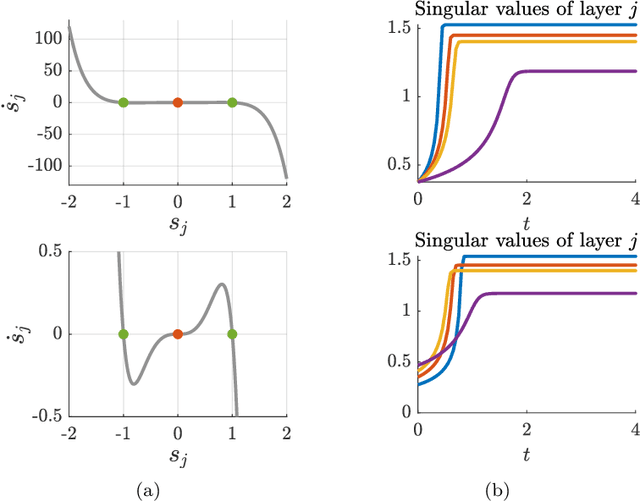
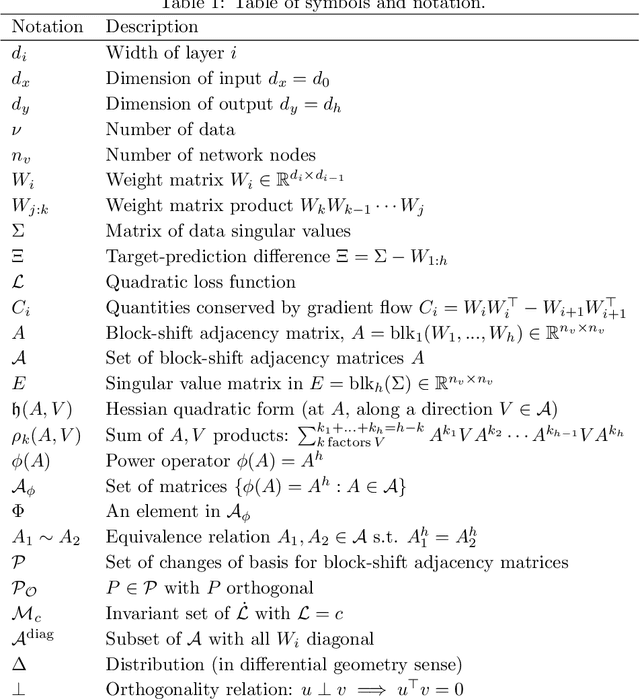
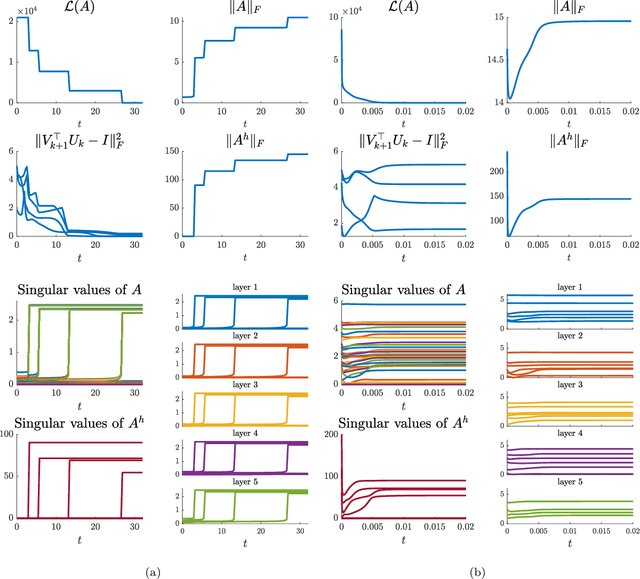
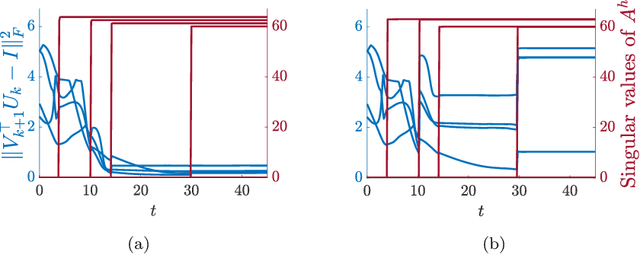
The paper surveys recent progresses in understanding the dynamics and loss landscape of the gradient flow equations associated to deep linear neural networks, i.e., the gradient descent training dynamics (in the limit when the step size goes to 0) of deep neural networks missing the activation functions and subject to quadratic loss functions. When formulated in terms of the adjacency matrix of the neural network, as we do in the paper, these gradient flow equations form a class of converging matrix ODEs which is nilpotent, polynomial, isospectral, and with conservation laws. The loss landscape is described in detail. It is characterized by infinitely many global minima and saddle points, both strict and nonstrict, but lacks local minima and maxima. The loss function itself is a positive semidefinite Lyapunov function for the gradient flow, and its level sets are unbounded invariant sets of critical points, with critical values that correspond to the amount of singular values of the input-output data learnt by the gradient along a certain trajectory. The adjacency matrix representation we use in the paper allows to highlight the existence of a quotient space structure in which each critical value of the loss function is represented only once, while all other critical points with the same critical value belong to the fiber associated to the quotient space. It also allows to easily determine stable and unstable submanifolds at the saddle points, even when the Hessian fails to obtain them.