 Add to Chrome
 Add to Firefox
 Add to Edge
TransportAgents: a multi-agents LLM framework for traffic accident severity prediction
Jan 21, 2026
Accurate prediction of traffic crash severity is critical for improving emergency response and public safety planning. Although recent large language models (LLMs) exhibit strong reasoning capabilities, their single-agent architectures often struggle with heterogeneous, domain-specific crash data and tend to generate biased or unstable predictions. To address these limitations, this paper proposes TransportAgents, a hybrid multi-agent framework that integrates category-specific LLM reasoning with a multilayer perceptron (MLP) integration module. Each specialized agent focuses on a particular subset of traffic information, such as demographics, environmental context, or incident details, to produce intermediate severity assessments that are subsequently fused into a unified prediction. Extensive experiments on two complementary U.S. datasets, the Consumer Product Safety Risk Management System (CPSRMS) and the National Electronic Injury Surveillance System (NEISS), demonstrate that TransportAgents consistently outperforms both traditional machine learning and advanced LLM-based baselines. Across three representative backbones, including closed-source models such as GPT-3.5 and GPT-4o, as well as open-source models such as LLaMA-3.3, the framework exhibits strong robustness, scalability, and cross-dataset generalizability. A supplementary distributional analysis further shows that TransportAgents produces more balanced and well-calibrated severity predictions than standard single-agent LLM approaches, highlighting its interpretability and reliability for safety-critical decision support applications.

E-bike agents: Large Language Model-Driven E-Bike Accident Analysis and Severity Prediction
Jun 05, 2025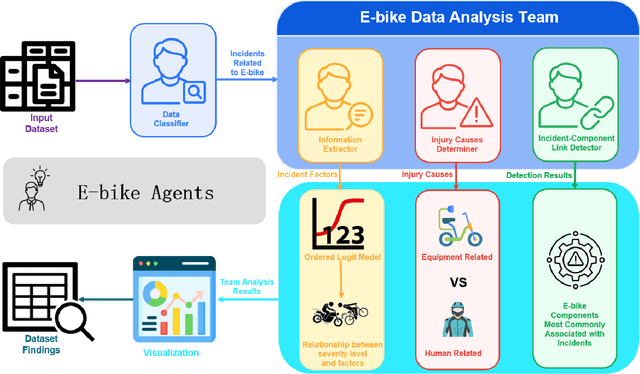
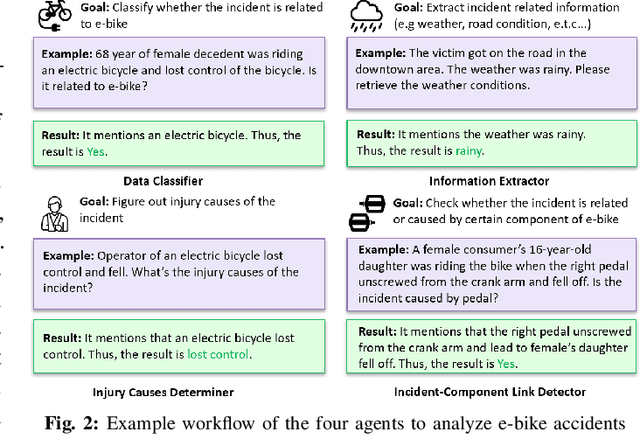
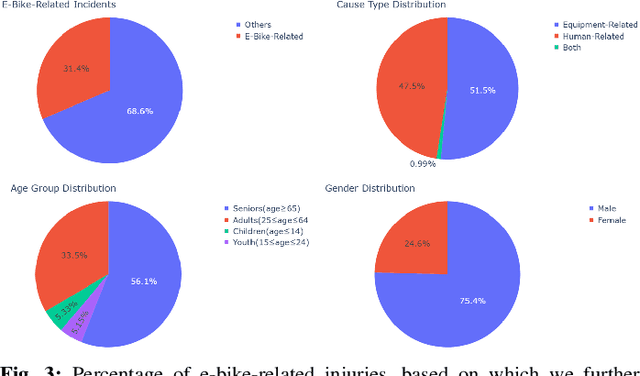
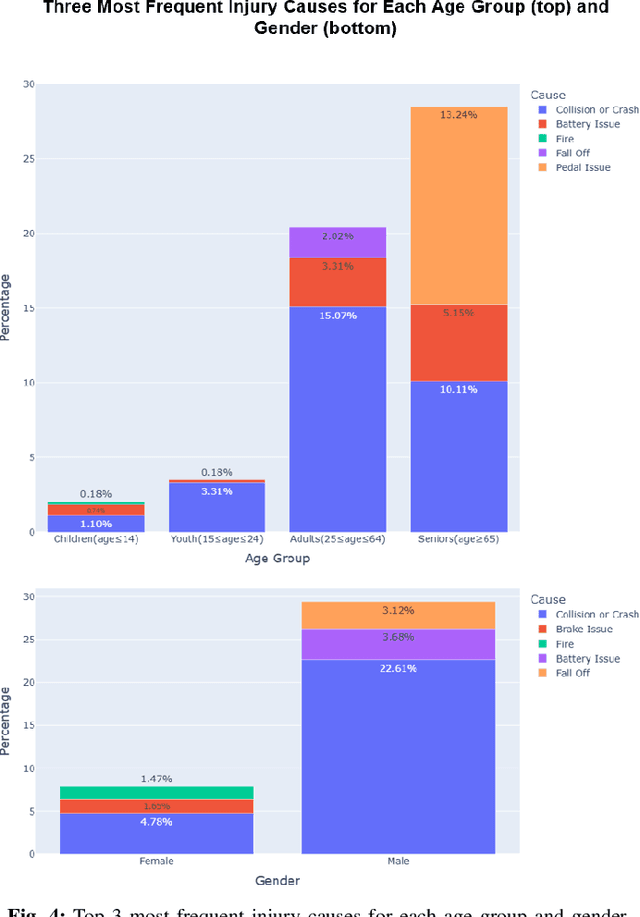
Electric bicycles (e-bikes) are rapidly increasing in use, raising safety concerns due to a rise in accident reports. However, e-bike incident reports often use unstructured narrative formats, which hinders quantitative safety analysis. This study introduces E-bike agents, a framework that uses large language models (LLM) powered agents to classify and extract safety variables from unstructured incident reports. Our framework consists of four LLM agents, handling data classification, information extraction, injury cause determination, and component linkage, to extract the key factors that could lead to E-bike accidents and cause varying severity levels. Furthermore, we used an ordered logit model to examine the relationship between the severity of the incident and the factors retrieved, such as gender, the type of cause, and environmental conditions. Our research shows that equipment issues are slightly more common than human-related ones, but human-related incidents are more often fatal. Specifically, pedals, tires, and brakes are frequent contributors to accidents. The model achieves a high weighted F1 score of 0.87 in classification accuracy, highlighting the potential of using LLMs to extract unstructured data in niche domains, such as transportation. Our method offers a scalable solution to improve e-bike safety analytics and provides actionable information for policy makers, designers, and regulators.