 Add to Chrome
 Add to Firefox
 Add to Edge
Predicting Large Model Test Losses with a Noisy Quadratic System
May 09, 2026
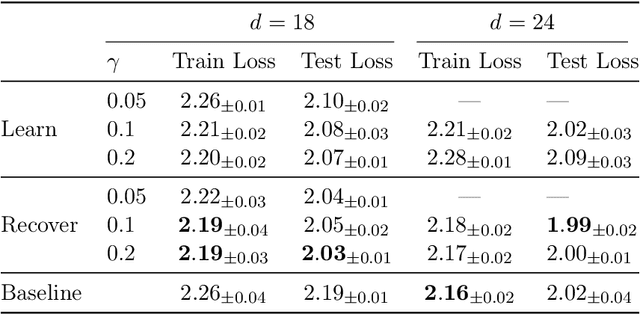
We introduce a predictive model that estimates the pre-training loss of large models from model size (N), batch size (B) and number of weight updates (K). This is the first loss prediction model that can handle changing batch size. The model outperforms Chinchilla's loss model, a model of the test loss using the batch size and number of tokens, in terms of projecting the loss at extrapolated compute budgets (up to 1000 folds). A natural use of the model is to find optimal N, B, K configurations under explicit and compound resource constraints like time, memory and compute. In our experiments, the model-selected configurations are close to ground-truth optimal. Our work advocates for loss prediction as a better alternative to heuristic-based laws, which are growing in complexity. The implementation is available on https://github.com/chuningxdy/Noisy-Quadratic-System.

The Shaped Transformer: Attention Models in the Infinite Depth-and-Width Limit
Jun 30, 2023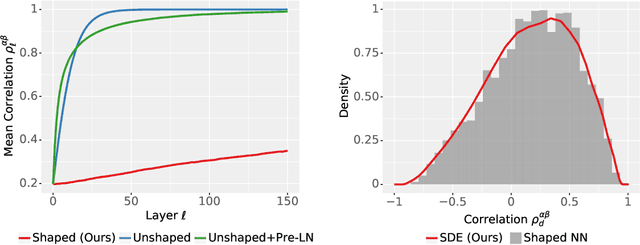
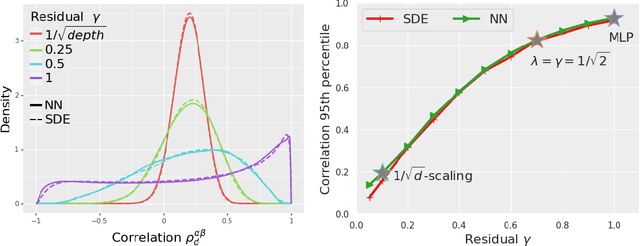
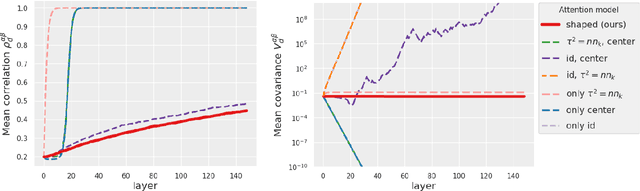
In deep learning theory, the covariance matrix of the representations serves as a proxy to examine the network's trainability. Motivated by the success of Transformers, we study the covariance matrix of a modified Softmax-based attention model with skip connections in the proportional limit of infinite-depth-and-width. We show that at initialization the limiting distribution can be described by a stochastic differential equation (SDE) indexed by the depth-to-width ratio. To achieve a well-defined stochastic limit, the Transformer's attention mechanism is modified by centering the Softmax output at identity, and scaling the Softmax logits by a width-dependent temperature parameter. We examine the stability of the network through the corresponding SDE, showing how the scale of both the drift and diffusion can be elegantly controlled with the aid of residual connections. The existence of a stable SDE implies that the covariance structure is well-behaved, even for very large depth and width, thus preventing the notorious issues of rank degeneracy in deep attention models. Finally, we show, through simulations, that the SDE provides a surprisingly good description of the corresponding finite-size model. We coin the name shaped Transformer for these architectural modifications.