 Add to Chrome
 Add to Firefox
 Add to Edge
Dynamic Elliptical Graph Factor Models via Riemannian Optimization with Geodesic Temporal Regularization
May 18, 2026
Inferring time-varying graph structures from high-dimensional nodal observations is a fundamental problem arising in neuroscience, finance, climatology, and beyond. Two intrinsic challenges govern this problem: maintaining the \emph{temporal coherence} of the latent graph across successive observation windows, and respecting the \emph{intrinsic Riemannian geometry} of the symmetric positive definite manifold on which precision matrices naturally reside, a curved space whose geodesic structure departs fundamentally from that of the ambient Euclidean space. In this paper we propose dynamic estimation on the Grassmann manifold with a factor model (\textsc{Degfm}), a novel algorithm that jointly addresses both challenges. We model the time-varying precision matrix sequence as a low-rank-plus-diagonal structure governed by a latent elliptical graph factor model, which drastically reduces the effective parameter count and enables reliable estimation in the challenging small-sample regime. Temporal coherence is enforced through a Riemannian geodesic penalty defined on the Grassmann manifold, ensuring that the estimated graph trajectory is smooth with respect to the intrinsic geometry rather than the ambient Euclidean space. To solve the resulting non-convex optimization problem over Grassmann-manifold-valued sequences subject to the LRaD constraint, we derive an efficient Riemannian gradient descent algorithm that respects the manifold structure at every iterate and rigorously establish its convergence to a stationary point. Extensive experiments on both synthetic benchmarks and real-world datasets demonstrate that \textsc{Degfm} consistently outperforms state-of-the-art baselines across all evaluation metrics, confirming the practical effectiveness of the proposed framework.

A First-Order Algorithm for Graph Learning from Smooth Signals Under Partial Observability
Oct 08, 2024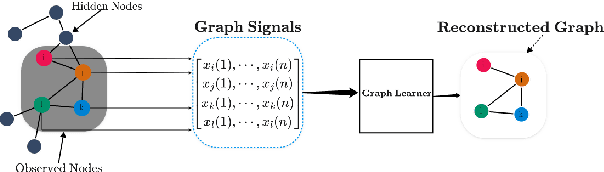
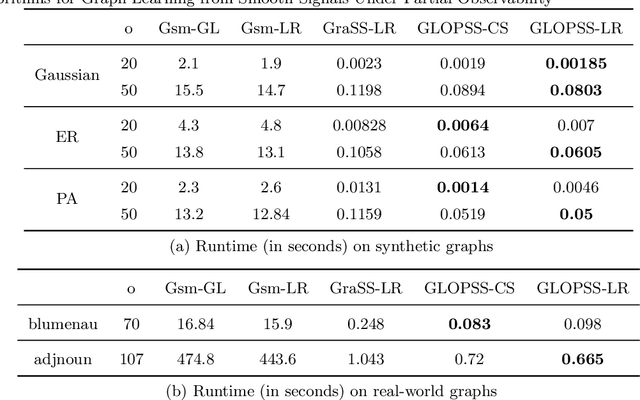
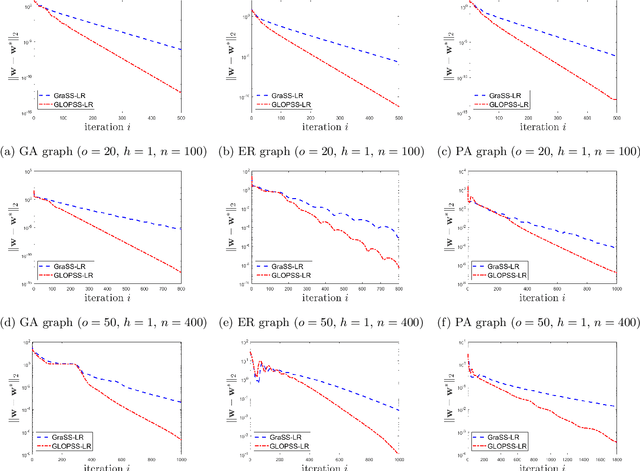
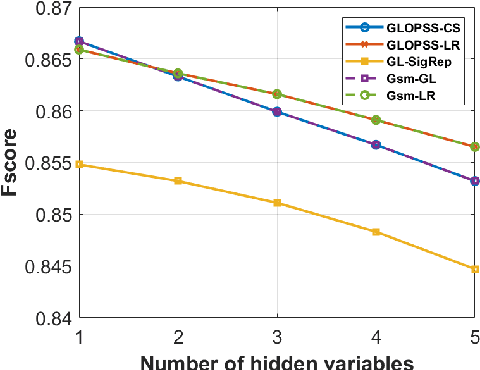
Learning graph structures from smooth signals is a significant problem in data science and engineering. A common challenge in real-world scenarios is the availability of only partially observed nodes. While some studies have considered hidden nodes and proposed various optimization frameworks, existing methods often lack the practical efficiency needed for large-scale networks or fail to provide theoretical convergence guarantees. In this paper, we address the problem of inferring network topologies from smooth signals with partially observed nodes. We propose a first-order algorithmic framework that includes two variants: one based on column sparsity regularization and the other on a low-rank constraint. We establish theoretical convergence guarantees and demonstrate the linear convergence rate of our algorithms. Extensive experiments on both synthetic and real-world data show that our results align with theoretical predictions, exhibiting not only linear convergence but also superior speed compared to existing methods. To the best of our knowledge, this is the first work to propose a first-order algorithmic framework for inferring network structures from smooth signals under partial observability, offering both guaranteed linear convergence and practical effectiveness for large-scale networks.