 Add to Chrome
 Add to Firefox
 Add to Edge
A Two-Stage LLM Framework for Accessible and Verified XAI Explanations
Apr 14, 2026
Large Language Models (LLMs) are increasingly used to translate the technical outputs of eXplainable Artificial Intelligence (XAI) methods into accessible natural-language explanations. However, existing approaches often lack guarantees of accuracy, faithfulness, and completeness. At the same time, current efforts to evaluate such narratives remain largely subjective or confined to post-hoc scoring, offering no safeguards to prevent flawed explanations from reaching end-users. To address these limitations, this paper proposes a Two-Stage LLM Meta-Verification Framework that consists of (i) an Explainer LLM that converts raw XAI outputs into natural-language narratives, (ii) a Verifier LLM that assesses them in terms of faithfulness, coherence, completeness, and hallucination risk, and (iii) an iterative refeed mechanism that uses the Verifier's feedback to refine and improve them. Experiments across five XAI techniques and datasets, using three families of open-weight LLMs, show that verification is crucial for filtering unreliable explanations while improving linguistic accessibility compared with raw XAI outputs. In addition, the analysis of the Entropy Production Rate (EPR) during the refinement process indicates that the Verifier's feedback progressively guides the Explainer toward more stable and coherent reasoning. Overall, the proposed framework provides an efficient pathway toward more trustworthy and democratized XAI systems.

Advancing Explainable AI with Causal Analysis in Large-Scale Fuzzy Cognitive Maps
May 15, 2024In the quest for accurate and interpretable AI models, eXplainable AI (XAI) has become crucial. Fuzzy Cognitive Maps (FCMs) stand out as an advanced XAI method because of their ability to synergistically combine and exploit both expert knowledge and data-driven insights, providing transparency and intrinsic interpretability. This letter introduces and investigates the "Total Causal Effect Calculation for FCMs" (TCEC-FCM) algorithm, an innovative approach that, for the first time, enables the efficient calculation of total causal effects among concepts in large-scale FCMs by leveraging binary search and graph traversal techniques, thereby overcoming the challenge of exhaustive causal path exploration that hinder existing methods. We evaluate the proposed method across various synthetic FCMs that demonstrate TCEC-FCM's superior performance over exhaustive methods, marking a significant advancement in causal effect analysis within FCMs, thus broadening their usability for modern complex XAI applications.
Towards a Taxonomy of Industrial Challenges and Enabling Technologies in Industry 4.0
Nov 29, 2022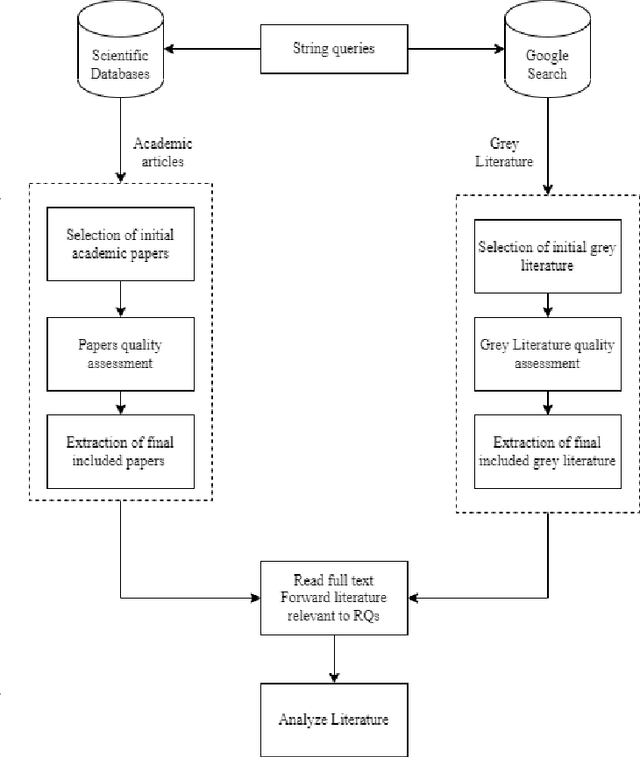
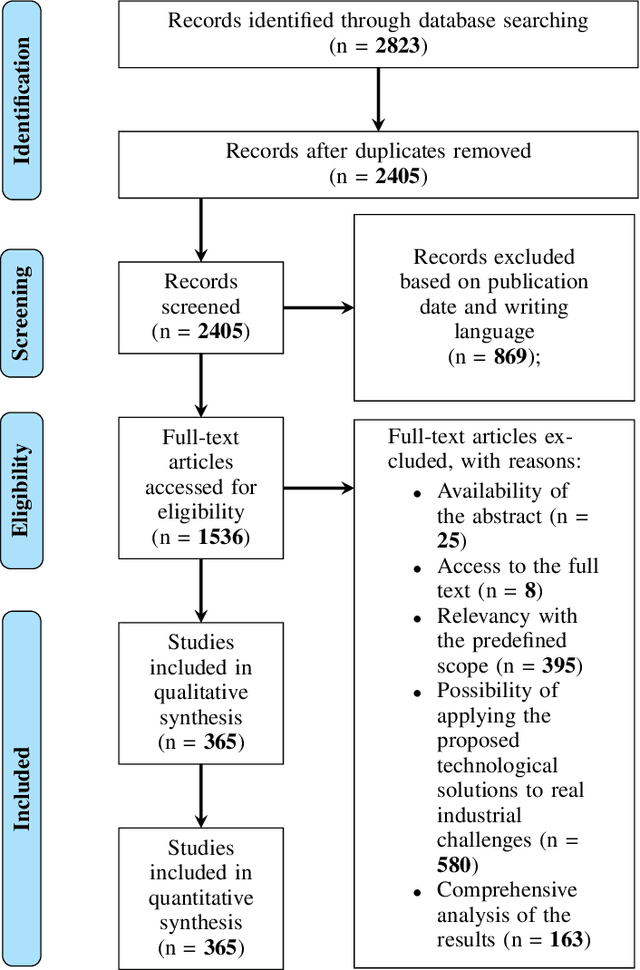
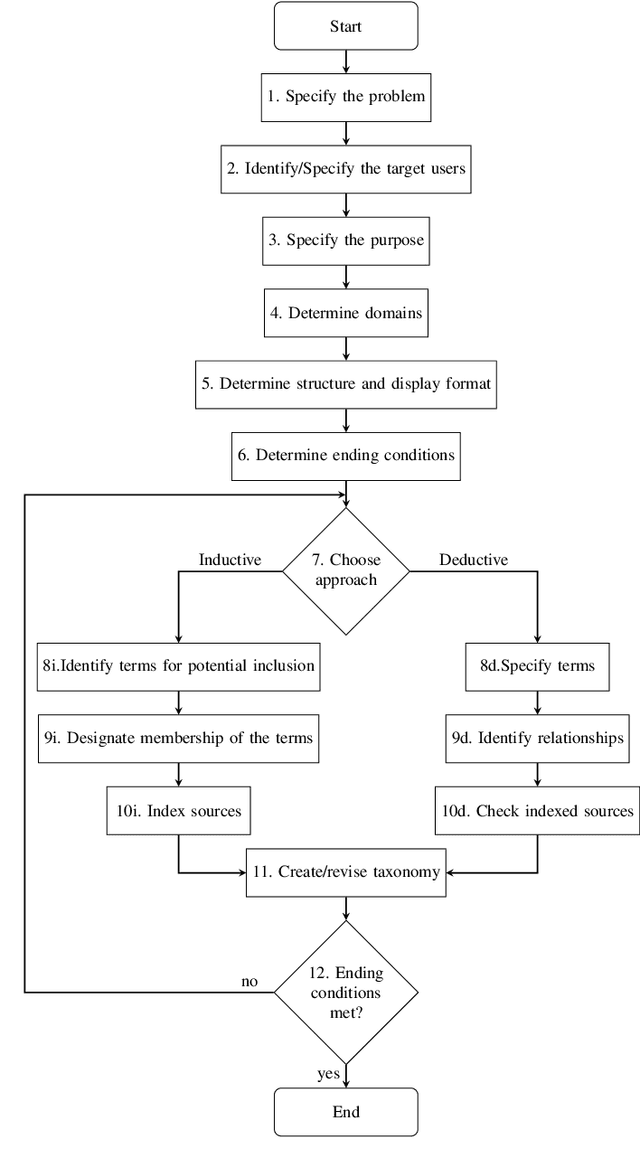
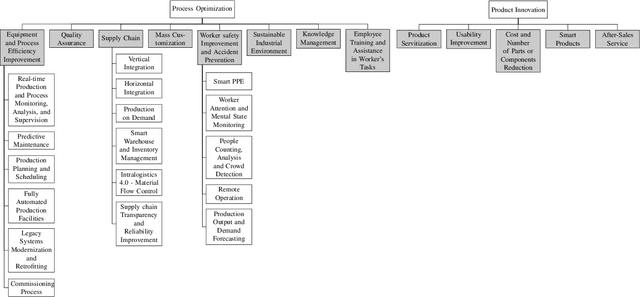
Today, one of the biggest challenges for digital transformation in the Industry 4.0 paradigm is the lack of mutual understanding between the academic and the industrial world. On the one hand, the industry fails to apply new technologies and innovations from scientific research. At the same time, academics struggle to find and focus on real-world applications for their developing technological solutions. Moreover, the increasing complexity of industrial challenges and technologies is widening this hiatus. To reduce this knowledge and communication gap, this article proposes a mixed approach of humanistic and engineering techniques applied to the technological and enterprise fields. The study's results are represented by a taxonomy in which industrial challenges and I4.0-focused technologies are categorized and connected through academic and grey literature analysis. This taxonomy also formed the basis for creating a public web platform where industrial practitioners can identify candidate solutions for an industrial challenge. At the same time, from the educational perspective, the learning procedure can be supported since, through this tool, academics can identify real-world scenarios to integrate digital technologies' teaching process.