 Add to Chrome
 Add to Firefox
 Add to Edge
Single-Shot HDR Recovery via a Video Diffusion Prior
May 12, 2026
Recent generative methods for single-shot high dynamic range (HDR) image reconstruction show promising results, but often struggle with preserving fidelity to the input image. They require separate models to handle highlights and shadows, or sacrifice interpretability by directly predicting the final HDR image. We address these limitations by re-casting single-shot HDR reconstruction as conditional video generation and fusing the generated frames into an HDR image. We finetune a video diffusion model to generate an exposure bracket, conditioned on a low dynamic range (LDR) input. We fuse this image bracket using per-pixel weights predicted by a light-weight UNet. This formulation is simple, interpretable, and effective. Rather than directly hallucinating an HDR image, it explicitly reconstructs the intermediate exposure stack and fuses it into the final output. Our method eliminates the need for separate models across exposure regimes and produces HDR reconstructions with high input fidelity. On quantitative benchmarks, we outperform state-of-the-art generative baselines with comparable model capacity on several reconstruction metrics. Human evaluators further prefer our results in 72% of pairwise comparisons against existing methods. Finally, we show that this input-conditioned sequence generation and fusion framework extends beyond HDR to other image reconstruction tasks, such as all-in-focus image recovery from a single defocus-blurred input.

Dynamic Scene 3D Reconstruction of an Uncooperative Resident Space Object
Sep 09, 2025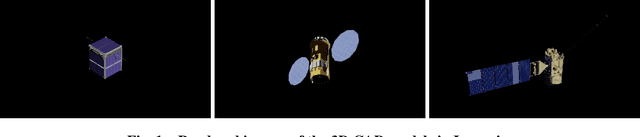
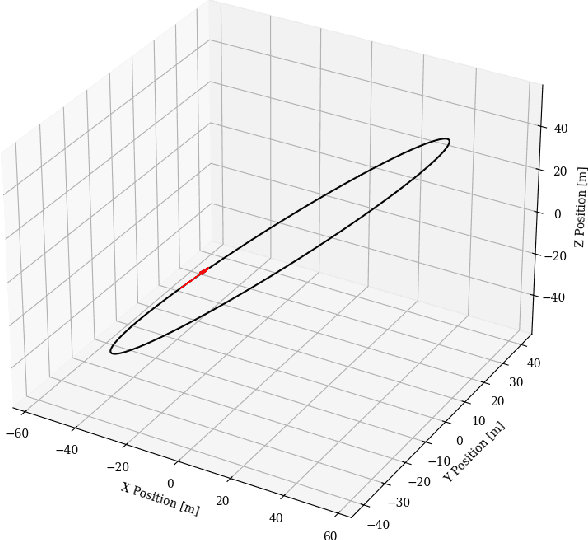
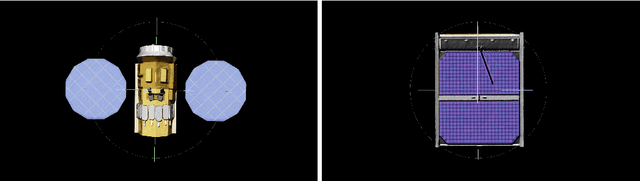
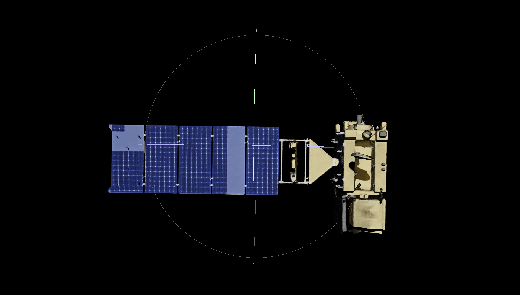
Characterization of uncooperative Resident Space Objects (RSO) play a crucial role in On-Orbit Servicing (OOS) and Active Debris Removal (ADR) missions to assess the geometry and motion properties. To address the challenges of reconstructing tumbling uncooperative targets, this study evaluates the performance of existing state-of-the-art 3D reconstruction algorithms for dynamic scenes, focusing on their ability to generate geometrically accurate models with high-fidelity. To support our evaluation, we developed a simulation environment using Isaac Sim to generate physics-accurate 2D image sequences of tumbling satellite under realistic orbital lighting conditions. Our preliminary results on static scenes using Neuralangelo demonstrate promising reconstruction quality. The generated 3D meshes closely match the original CAD models with minimal errors and artifacts when compared using Cloud Compare (CC). The reconstructed models were able to capture critical fine details for mission planning. This provides a baseline for our ongoing evaluation of dynamic scene reconstruction.