 Add to Chrome
 Add to Firefox
 Add to Edge
Using Hierarchical Controlled Vocabularies to Understand CLIP Retrieval Failures in Historical Photo Collections
Jul 22, 2026
GLAM institutions (Galleries, Libraries, Archives, and Museums) organise image access using controlled vocabularies such as the Art and Architecture Thesaurus (AAT). For content-based image retrieval in these settings, vision-language models like CLIP are increasingly used, but their performance varies. This variation is known to relate to measures like concept abstraction and concept frequency. However, no prior work explains this variation in terms of the structural properties of vocabularies like the AAT that GLAM professionals already use. The AAT groups concepts into broad facets (Objects, Activities, Agents, etc.) and arranges terms hierarchically within them. In this paper, we ask whether two structural properties (root facet type and hierarchy depth) explain where CLIP retrieval succeeds and fails, and where fine-tuning helps. Across three historical photographic collections annotated with AAT terms, we examine visual coherence (whether a term's photographs cluster in CLIP's embedding space), text-image alignment (whether its label is near that cluster), and standard retrieval measures, which conflate the two. We find that visual coherence and text-image alignment are nearly uncorrelated across terms and jointly separate distinct failure modes. Terms whose photographs cluster tightly but whose label is distant from the cluster retrieve poorly in every collection, in two of three collections even worse than terms that fail on both metrics. We also show that while retrieval metrics do not correlate significantly with either structural property, root facet type does significantly separate categories with varying visual coherence. Finally, we find that fine-tuning improves retrieval overall, but its gains favour shallower terms in the hierarchy, where text-image alignment improves most, beyond what concept frequency explains.

Designing an LLM-Based Copilot for Manufacturing Equipment Selection
Dec 18, 2024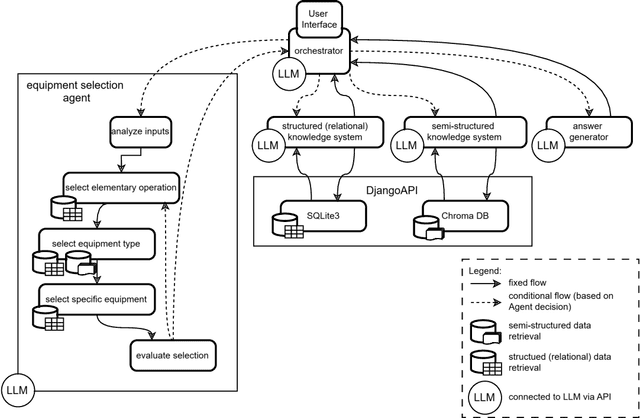
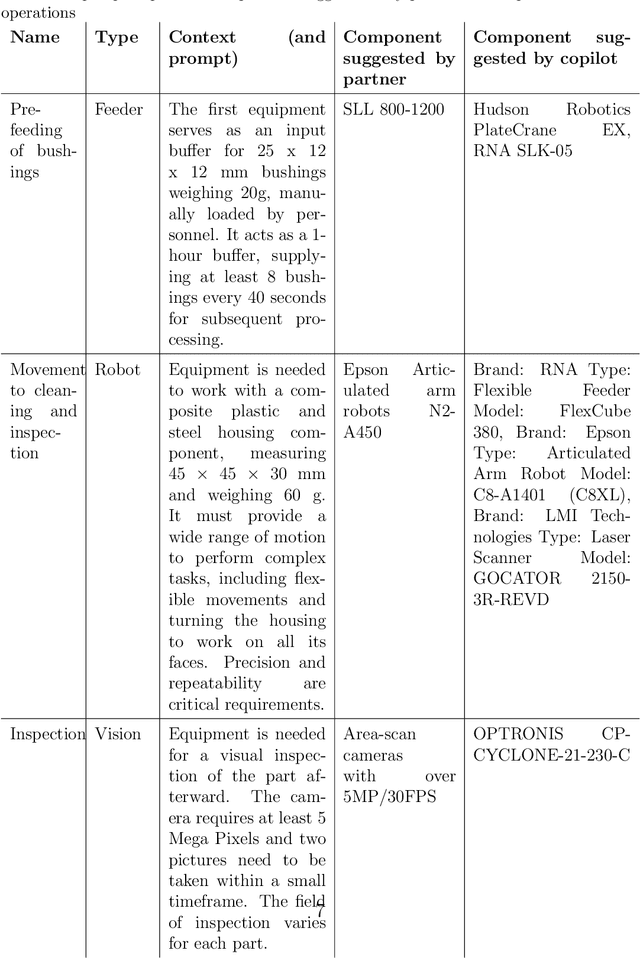
Effective decision-making in automation equipment selection is critical for reducing ramp-up time and maintaining production quality, especially in the face of increasing product variation and market demands. However, limited expertise and resource constraints often result in inefficiencies during the ramp-up phase when new products are integrated into production lines. Existing methods often lack structured and tailored solutions to support automation engineers in reducing ramp-up time, leading to compromises in quality. This research investigates whether large-language models (LLMs), combined with Retrieval-Augmented Generation (RAG), can assist in streamlining equipment selection in ramp-up planning. We propose a factual-driven copilot integrating LLMs with structured and semi-structured knowledge retrieval for three component types (robots, feeders and vision systems), providing a guided and traceable state-machine process for decision-making in automation equipment selection. The system was demonstrated to an industrial partner, who tested it on three internal use-cases. Their feedback affirmed its capability to provide logical and actionable recommendations for automation equipment. More specifically, among 22 equipment prompts analyzed, 19 involved selecting the correct equipment while considering most requirements, and in 6 cases, all requirements were fully met.