 Add to Chrome
 Add to Firefox
 Add to Edge
LoRA-based Parameter-Efficient LLMs for Continuous Learning in Edge-based Malware Detection
Feb 12, 2026
The proliferation of edge devices has created an urgent need for security solutions capable of detecting malware in real time while operating under strict computational and memory constraints. Recently, Large Language Models (LLMs) have demonstrated remarkable capabilities in recognizing complex patterns, yet their deployment on edge devices remains impractical due to their resource demands. However, in edge malware detection, static or centrally retrained models degrade under evolving threats and heterogeneous traffic; locally trained models become siloed and fail to transfer across domains. To overcome these limitations, in this paper, we present a continuous learning architecture for edge-based malware detection that combines local adaptation on each device with global knowledge sharing through parameter-efficient LoRA adapters. Lightweight transformer models (DistilBERT, DistilGPT-2, TinyT5) run on edge nodes and are incrementally fine-tuned on device-specific traffic; only the resulting LoRA modules are aggregated by a lightweight coordinator and redistributed, enabling cross-device generalization without exchanging raw data. We evaluate on two public IoT security datasets, Edge-IIoTset and TON-IoT, under multi-round learning to simulate evolving threats. Compared to isolated fine-tuning, the LoRA-based exchange yields up to 20-25% accuracy gains when models encounter previously unseen attacks from another domain, while maintaining stable loss and F1 across rounds. LoRA adds less than 1% to model size (~0.6-1.8 MB), making updates practical for constrained edge hardware.

Malware Detection at the Edge with Lightweight LLMs: A Performance Evaluation
Mar 06, 2025
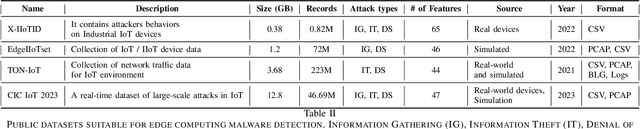
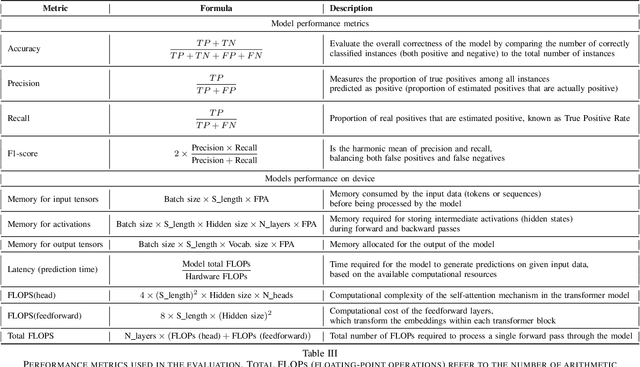
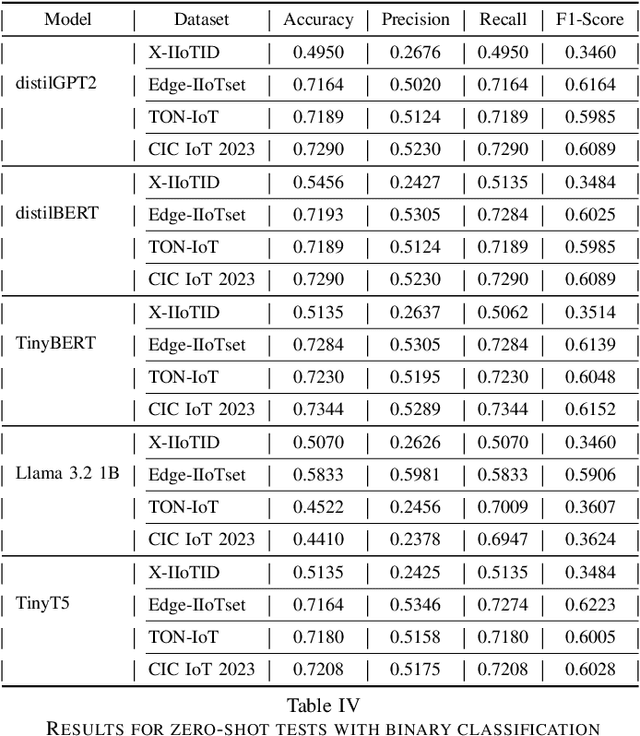
The rapid evolution of malware attacks calls for the development of innovative detection methods, especially in resource-constrained edge computing. Traditional detection techniques struggle to keep up with modern malware's sophistication and adaptability, prompting a shift towards advanced methodologies like those leveraging Large Language Models (LLMs) for enhanced malware detection. However, deploying LLMs for malware detection directly at edge devices raises several challenges, including ensuring accuracy in constrained environments and addressing edge devices' energy and computational limits. To tackle these challenges, this paper proposes an architecture leveraging lightweight LLMs' strengths while addressing limitations like reduced accuracy and insufficient computational power. To evaluate the effectiveness of the proposed lightweight LLM-based approach for edge computing, we perform an extensive experimental evaluation using several state-of-the-art lightweight LLMs. We test them with several publicly available datasets specifically designed for edge and IoT scenarios and different edge nodes with varying computational power and characteristics.