 Add to Chrome
 Add to Firefox
 Add to Edge
From Observation to Intervention: A Causal Audit of Expert Importance in Mixture-of-Experts Models
Jun 09, 2026
Interpretability methods routinely use population-level summary statistics over observed model behaviour to license claims about the effects of targeted interventions on specific computations; in Pearl's terms, they treat rung-1 associational evidence as if it supported rung-2 interventional conclusions, a move whose validity is rarely tested. We examine one concrete instance: the use of routing statistics in Mixture-of-Experts (MoE) pruning, where utilization rates, activation norms, and routing weight distributions are treated as predictors of which experts can be removed without functional cost. A token-level interventional audit across three high-redundancy MoE architectures (OLMoE-1B-7B-0924, Qwen1.5-MoE-A2.7B, DeepSeek-V2-Lite) finds no observational metric predicts causal expert importance after multiple-comparison correction in any model, with effect sizes below Cohen's $d = 0.17$ across all 60 metric-layer combinations. A per-token routing weight control rules out insufficient power, recovering a single Bonferroni-significant signal at OLMoE's final MoE layer ($d = +0.231$, $p = 0.0013$). Existing pruning methods succeed in this regime not by identifying dispensable experts but because early-layer redundancy renders most selection criteria interchangeable. Our results provide an explicit counterexample to the common inferential step from population-level observational summaries to token-level interventional claims about expert importance, and illustrate how interventional audits can calibrate the evidential standards for interpretability claims.

Mind the Gap Between Synthetic and Real: Utilizing Transfer Learning to Probe the Boundaries of Stable Diffusion Generated Data
May 06, 2024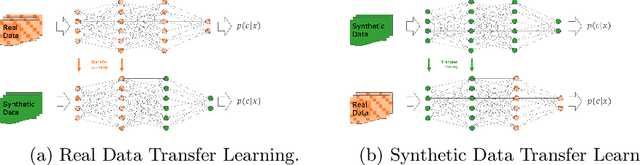
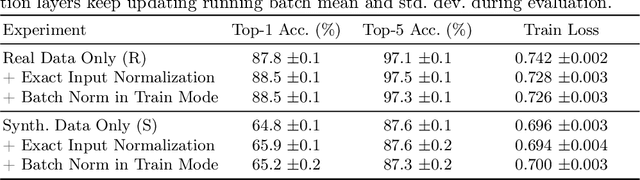
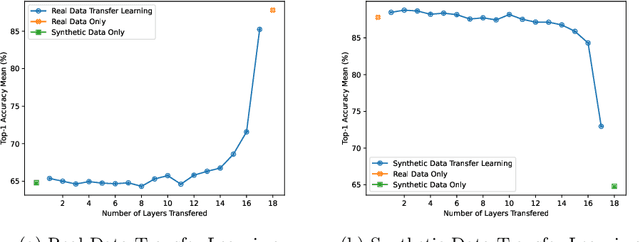
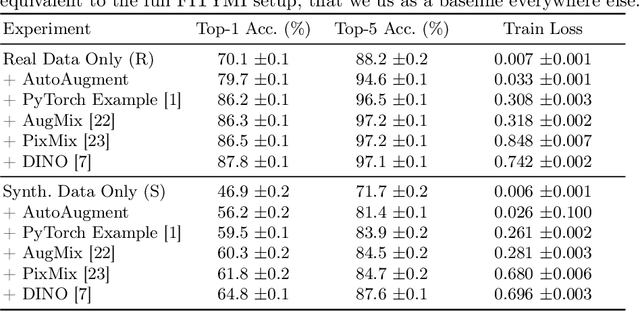
Generative foundation models like Stable Diffusion comprise a diverse spectrum of knowledge in computer vision with the potential for transfer learning, e.g., via generating data to train student models for downstream tasks. This could circumvent the necessity of collecting labeled real-world data, thereby presenting a form of data-free knowledge distillation. However, the resultant student models show a significant drop in accuracy compared to models trained on real data. We investigate possible causes for this drop and focus on the role of the different layers of the student model. By training these layers using either real or synthetic data, we reveal that the drop mainly stems from the model's final layers. Further, we briefly investigate other factors, such as differences in data-normalization between synthetic and real, the impact of data augmentations, texture vs.\ shape learning, and assuming oracle prompts. While we find that some of those factors can have an impact, they are not sufficient to close the gap towards real data. Building upon our insights that mainly later layers are responsible for the drop, we investigate the data-efficiency of fine-tuning a synthetically trained model with real data applied to only those last layers. Our results suggest an improved trade-off between the amount of real training data used and the model's accuracy. Our findings contribute to the understanding of the gap between synthetic and real data and indicate solutions to mitigate the scarcity of labeled real data.