 Add to Chrome
 Add to Firefox
 Add to Edge
Transfer Learning Beyond the Standard Model
Oct 22, 2025
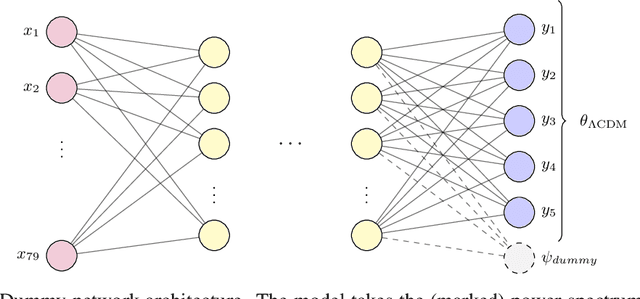
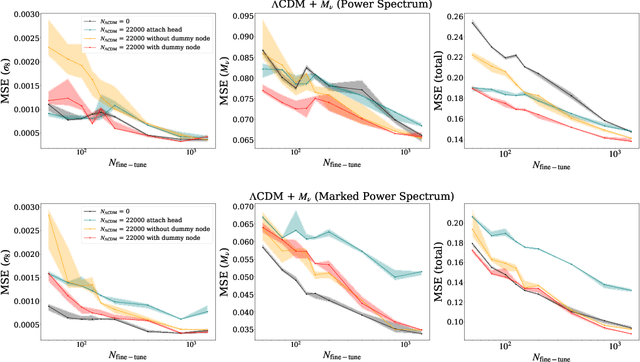
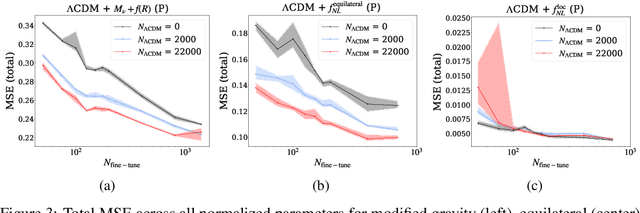
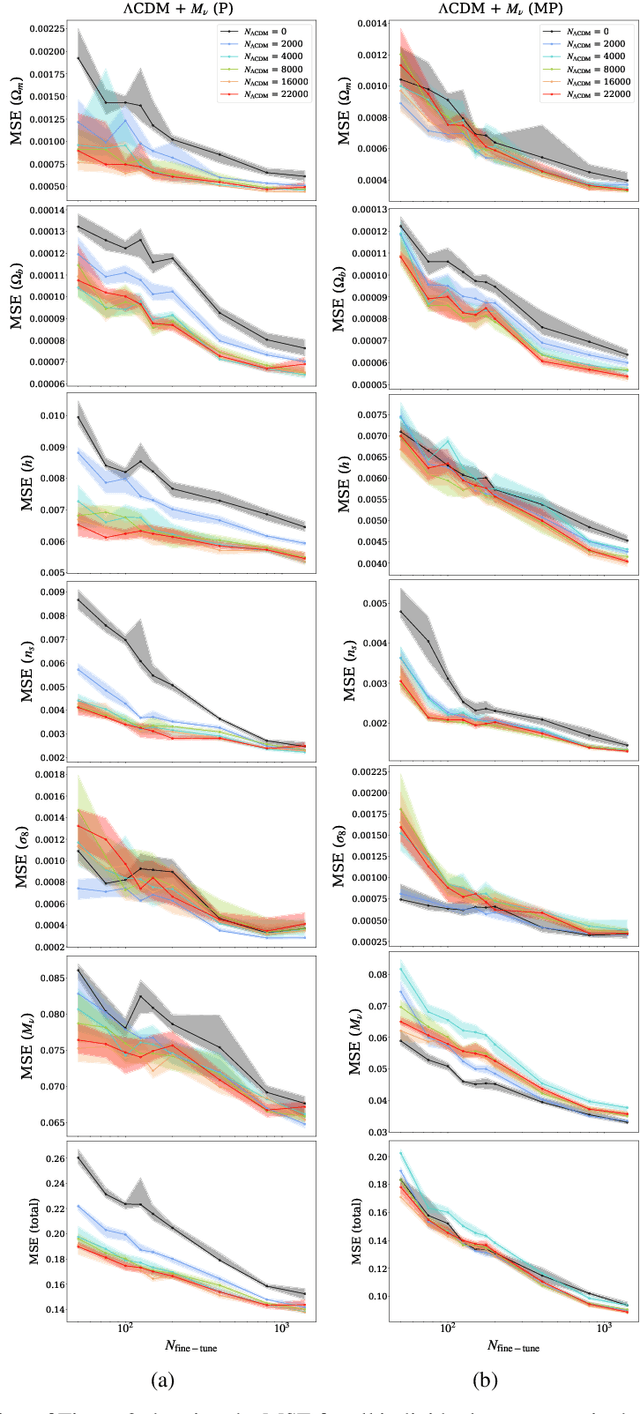
Machine learning enables powerful cosmological inference but typically requires many high-fidelity simulations covering many cosmological models. Transfer learning offers a way to reduce the simulation cost by reusing knowledge across models. We show that pre-training on the standard model of cosmology, $\Lambda$CDM, and fine-tuning on various beyond-$\Lambda$CDM scenarios -- including massive neutrinos, modified gravity, and primordial non-Gaussianities -- can enable inference with significantly fewer beyond-$\Lambda$CDM simulations. However, we also show that negative transfer can occur when strong physical degeneracies exist between $\Lambda$CDM and beyond-$\Lambda$CDM parameters. We consider various transfer architectures, finding that including bottleneck structures provides the best performance. Our findings illustrate the opportunities and pitfalls of foundation-model approaches in physics: pre-training can accelerate inference, but may also hinder learning new physics.

$\texttt{Mangrove}$: Learning Galaxy Properties from Merger Trees
Oct 24, 2022Efficiently mapping baryonic properties onto dark matter is a major challenge in astrophysics. Although semi-analytic models (SAMs) and hydrodynamical simulations have made impressive advances in reproducing galaxy observables across cosmologically significant volumes, these methods still require significant computation times, representing a barrier to many applications. Graph Neural Networks (GNNs) have recently proven to be the natural choice for learning physical relations. Among the most inherently graph-like structures found in astrophysics are the dark matter merger trees that encode the evolution of dark matter halos. In this paper we introduce a new, graph-based emulator framework, $\texttt{Mangrove}$, and show that it emulates the galactic stellar mass, cold gas mass and metallicity, instantaneous and time-averaged star formation rate, and black hole mass -- as predicted by a SAM -- with root mean squared error up to two times lower than other methods across a $(75 Mpc/h)^3$ simulation box in 40 seconds, 4 orders of magnitude faster than the SAM. We show that $\texttt{Mangrove}$ allows for quantification of the dependence of galaxy properties on merger history. We compare our results to the current state of the art in the field and show significant improvements for all target properties. $\texttt{Mangrove}$ is publicly available.