 Add to Chrome
 Add to Firefox
 Add to Edge
XSRD-Net: EXplainable Stroke Relapse Detection
Sep 09, 2025
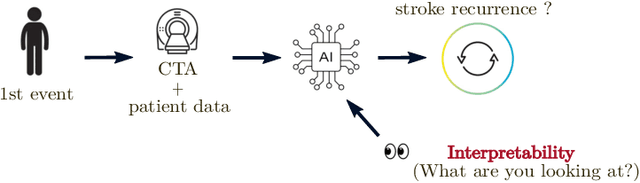
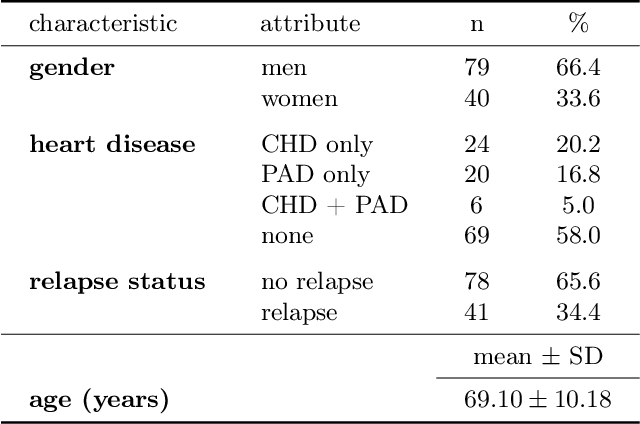
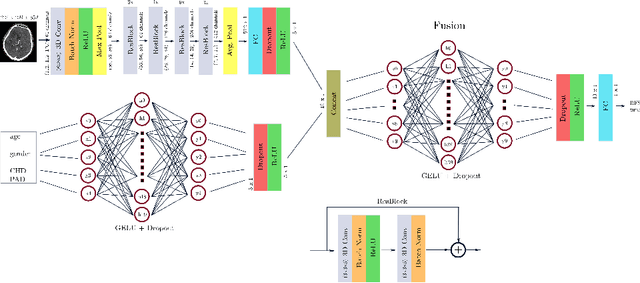
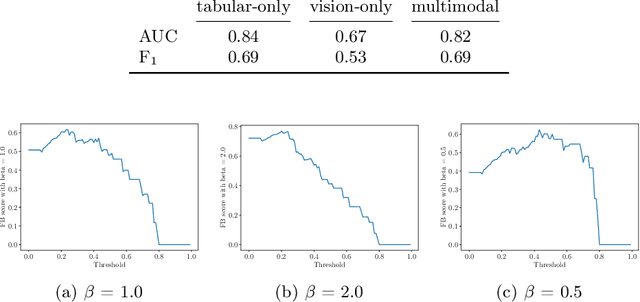
Stroke is the second most frequent cause of death world wide with an annual mortality of around 5.5 million. Recurrence rates of stroke are between 5 and 25% in the first year. As mortality rates for relapses are extraordinarily high (40%) it is of utmost importance to reduce the recurrence rates. We address this issue by detecting patients at risk of stroke recurrence at an early stage in order to enable appropriate therapy planning. To this end we collected 3D intracranial CTA image data and recorded concomitant heart diseases, the age and the gender of stroke patients between 2010 and 2024. We trained single- and multimodal deep learning based neural networks for binary relapse detection (Task 1) and for relapse free survival (RFS) time prediction together with a subsequent classification (Task 2). The separation of relapse from non-relapse patients (Task 1) could be solved with tabular data (AUC on test dataset: 0.84). However, for the main task, the regression (Task 2), our multimodal XSRD-net processed the modalities vision:tabular with 0.68:0.32 according to modality contribution measures. The c-index with respect to relapses for the multimodal model reached 0.68, and the AUC is 0.71 for the test dataset. Final, deeper interpretability analysis results could highlight a link between both heart diseases (tabular) and carotid arteries (vision) for the detection of relapses and the prediction of the RFS time. This is a central outcome that we strive to strengthen with ongoing data collection and model retraining.

Multimodal Medical Disease Classification with LLaMA II
Dec 02, 2024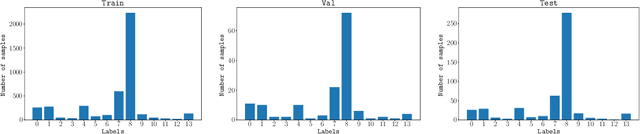
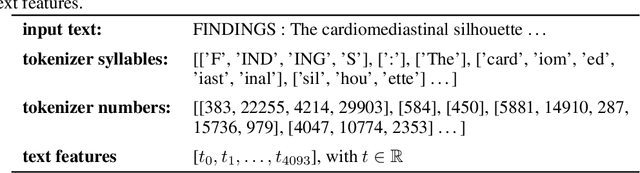
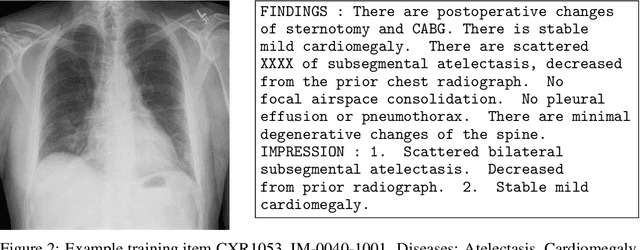
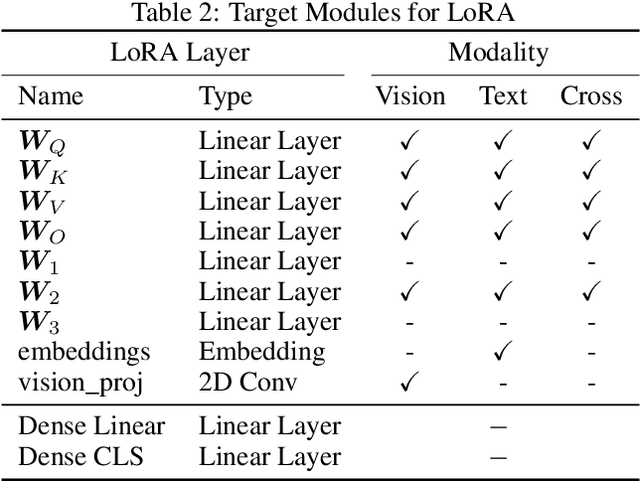
Medical patient data is always multimodal. Images, text, age, gender, histopathological data are only few examples for different modalities in this context. Processing and integrating this multimodal data with deep learning based methods is of utmost interest due to its huge potential for medical procedure such as diagnosis and patient treatment planning. In this work we retrain a multimodal transformer-based model for disease classification. To this end we use the text-image pair dataset from OpenI consisting of 2D chest X-rays associated with clinical reports. Our focus is on fusion methods for merging text and vision information extracted from medical datasets. Different architecture structures with a LLaMA II backbone model are tested. Early fusion of modality specific features creates better results with the best model reaching 97.10% mean AUC than late fusion from a deeper level of the architecture (best model: 96.67% mean AUC). Both outperform former classification models tested on the same multimodal dataset. The newly introduced multimodal architecture can be applied to other multimodal datasets with little effort and can be easily adapted for further research, especially, but not limited to, the field of medical AI.