 Add to Chrome
 Add to Firefox
 Add to Edge
AnchorBench: A Multi-Pathway Benchmark for the Anchoring Effect in LLMs
Aug 14, 2026
The anchoring effect is a cognitive bias in which an initial reference value shifts a later judgment toward itself. This effect is well established in human judgment and decision-making, and recent work suggests that large language models (LLMs) exhibit similar behavior. However, existing work on anchoring in LLMs typically evaluates only a narrow set of anchor pathways and rarely distinguishes irrelevant from plausible anchors. We introduce AnchorBench, a benchmark for the anchoring effect in LLMs that evaluates multiple anchor pathways under an explicit anchor relevance axis. Across fourteen models, including ten open-weight models and four frontier API models, and a large set of controlled prompts, we find that (1) anchoring is strongly pathway-dependent, (2) plausible anchors usually induce larger shifts than irrelevant ones when introduced through stronger pathways, (3) anchor influence generally weakens as the anchor moves farther from the evidence-supported answer, most clearly on External and RAG, and (4) high task accuracy on the anchor-free control condition (Acc$_{10}$: answers within 10 points of gold) does not guarantee robustness: even frontier API models above 95% control accuracy remain susceptible to plausible anchors.

LLM-driven design of physics-constrained constitutive models: two agents are better than one
May 22, 2026Developing constitutive models that capture how materials deform under load traditionally requires years of specialized expertise in continuum mechanics, machine learning, and scientific programming. Large language models (LLMs) have recently been shown to lower this barrier by generating constitutive models on demand, but existing single-agent pipelines lack systematic checks that the resulting models respect fundamental physical laws. To close this gap, we introduce the first multi-agent LLM-driven approach for constitutive model generation: a Creator agent proposes a model tailored to the data, while an Inspector agent critically audits each proposal against nine physical constraints and returns it for refinement whenever a violation is detected. We demonstrate this concept with constitutive artificial neural networks (CANNs) and benchmark it on brain tissue, experimental rubber, and synthetic rubber, using two different LLM backbones (Claude Opus 4.7 and Kimi K2.5). Adding the Inspector raises the share of exported models that truly satisfy all physical constraints from 91% to a perfect 100% for Opus and from 37% to 56% for Kimi, while preserving near-baseline accuracy and remarkable generalization to unseen loading paths. In combination, the generated models are physically valid, highly accurate, and extrapolate reliably beyond the training data - properties that together make them directly usable in practice. Separating generation from inspection thus turns LLM-driven constitutive modeling into a genuinely trustworthy process. The paradigm is deliberately technique-agnostic and scales automatically with advances in LLM capability, opening a promising path toward automated, physics-aware model discovery.
From Model Training to Model Raising
Nov 17, 2025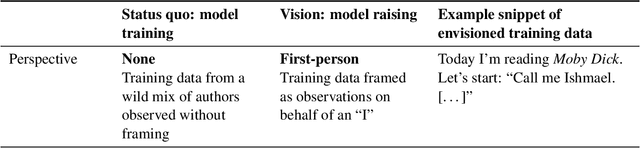
Current AI training methods align models with human values only after their core capabilities have been established, resulting in models that are easily misaligned and lack deep-rooted value systems. We propose a paradigm shift from "model training" to "model raising", in which alignment is woven into a model's development from the start. We identify several key components for this paradigm, all centered around redesigning the training corpus: reframing training data from a first-person perspective, recontextualizing information as lived experience, simulating social interactions, and scaffolding the ordering of training data. We expect that this redesign of the training corpus will lead to an early commitment to values from the first training token onward, such that knowledge, skills, and values are intrinsically much harder to separate. In an ecosystem in which large language model capabilities start overtaking human capabilities in many tasks, this seems to us like a critical need.