 Add to Chrome
 Add to Firefox
 Add to Edge
SINT-Flow: Schema Integration using Large Language Model Workflows
Jul 27, 2026
The goal of schema integration is, given a set of input schemata or tables, to derive a global, unified schema that is able to represent the concepts, attributes, and relationships of all input tables in a coherent fashion. This paper presents SINT-Flow, a schema integration framework composed of five LLM-based operators that can be combined into workflows to perform fully automated, end-to-end schema integration. In contrast to existing approaches, SINT-Flow can process denormalized source tables that contain attributes describing multiple entity types. During the schema integration process, these tables are decomposed into separate entity-specific relations. To evaluate SINT-Flow, we introduce SINT-Bench, a schema integration benchmark comprising 10 schema integration tasks consisting of altogether 93 relational tables, including tables that describe multiple types of entities. We evaluate SINT-Flow using GPT-5.2 as well as the open-weight model Qwen-3.6-27B as alternative backbone models. Using these models, SINT-Flow achieves F1 scores of at least 96% for entity-type detection, 85% for attribute detection, and 83% for schema mapping. Furthermore, we perform an ablation study to prove the utility of the applied self-consistency strategy as well as the inclusion of a review loop into the schema matching operator.

MaDI-Bench: An End-to-End Data Integration Benchmark
Jun 29, 2026Data integration combines heterogeneous data sets into a single, coherent representation. Data integration involves a sequence of interdependent tasks including schema matching, value normalization, entity blocking, entity matching, and data fusion. Existing benchmarks either evaluate these steps in isolation or cover only incomplete versions of the data integration pipeline, omitting specific steps. The lack of public end-to-end data integration benchmarks hinders research on data integration methods that address the integration process as a whole. This paper fills this gap by introducing the Mannheim Data Integration Benchmark (MaDI-Bench), the first benchmark for the end-to-end integration of relational tables covering all steps of the integration process. MaDI-Bench contributes (i) a set of base end-to-end data integration tasks spanning several application domains, each requiring the full schema matching, value normalization, entity matching, and conflict resolution pipeline; and (ii) a generic method for deriving task variants that mitigates rapid benchmark saturation as data integration systems advance. We validate the benchmark using human-engineered pipelines, a best-of-breed pipeline, and an LLM-based pipeline. The validation demonstrates the utility of the benchmark for measuring the step-wise as well as the end-to-end performance of data integration pipelines. All benchmark artifacts are available for public download.
Labeling Training Data for Entity Matching Using Large Language Models
Jun 27, 2026Recent large language models (LLMs) achieve strong performance on entity matching without requiring task-specific training data. However, applying these models to large sets of candidate pairs remains slow and costly. In contrast, entity matchers using traditional machine learning methods or small language models (SLMs), such as RoBERTa, offer much faster inference but require task-specific training data. This paper investigates whether the need to provide task-specific training data can be avoided by using knowledge-distillation workflows, in which an LLM serves as a teacher model to label training pairs that are subsequently used to train a smaller student model. We investigate knowledge distillation for entity matching along the following dimensions: pair-selection strategy, teacher model, label post-processing method, and student model. We evaluate the workflows using the Abt-Buy, Walmart-Amazon, WDC Products, DBLP-ACM, and DBLP-Scholar benchmarks, and compare the performance of student models trained with machine-labeled data to the performance of the same models trained using the benchmark training sets. Our experiments show that student models trained using the machine-labeled sets perform approximately on par with models trained on the benchmark training sets, with the remaining differences in both directions staying below two F1 points. Using GPT-5.2 to label the training sets for all five benchmarks costs US\$28.31 to US\$40.88, whereas manually labeling the same training sets is estimated to require 470 hours of work. At inference time, Ditto is 41.5 to 534 times faster than directly using an LLM to perform the matching tasks. These results indicate that current LLMs, when combined with a suitable pair-selection method, can substantially reduce or even eliminate the manual effort required to label use case-specific training data for entity matching.
Automatic End-to-End Data Integration using Large Language Models
Mar 11, 2026Designing data integration pipelines typically requires substantial manual effort from data engineers to configure pipeline components and label training data. While LLMs have shown promise in handling individual steps of the integration process, their potential to replace all human input across end-to-end data integration pipelines has not been investigated. As a step toward exploring this potential, we present an automatic data integration pipeline that uses GPT-5.2 to generate all artifacts required to adapt the pipeline to specific use cases. These artifacts are schema mappings, value mappings for data normalization, training data for entity matching, and validation data for selecting conflict resolution heuristics in data fusion. We compare the performance of this LLM-based pipeline to the performance of human-designed pipelines along three case studies requiring the integration of video game, music, and company related data. Our experiments show that the LLM-based pipeline is able to produce similar results, for some tasks even better results, as the human-designed pipelines. End-to-end, the human and the LLM pipelines produce integrated datasets of comparable size and density. Having the LLM configure the pipelines costs approximately \$10 per case study, which represents only a small fraction of the cost of having human data engineers perform the same tasks.
Evaluating Knowledge Generation and Self-Refinement Strategies for LLM-based Column Type Annotation
Mar 04, 2025Understanding the semantics of columns in relational tables is an important pre-processing step for indexing data lakes in order to provide rich data search. An approach to establishing such understanding is column type annotation (CTA) where the goal is to annotate table columns with terms from a given vocabulary. This paper experimentally compares different knowledge generation and self-refinement strategies for LLM-based column type annotation. The strategies include using LLMs to generate term definitions, error-based refinement of term definitions, self-correction, and fine-tuning using examples and term definitions. We evaluate these strategies along two dimensions: effectiveness measured as F1 performance and efficiency measured in terms of token usage and cost. Our experiments show that the best performing strategy depends on the model/dataset combination. We find that using training data to generate label definitions outperforms using the same data as demonstrations for in-context learning for two out of three datasets using OpenAI models. The experiments further show that using the LLMs to refine label definitions brings an average increase of 3.9% F1 in 10 out of 12 setups compared to the performance of the non-refined definitions. Combining fine-tuned models with self-refined term definitions results in the overall highest performance, outperforming zero-shot prompting fine-tuned models by at least 3% in F1 score. The costs analysis shows that while reaching similar F1 score, self-refinement via prompting is more cost efficient for use cases requiring smaller amounts of tables to be annotated while fine-tuning is more efficient for large amounts of tables.
Automated Self-Refinement and Self-Correction for LLM-based Product Attribute Value Extraction
Jan 02, 2025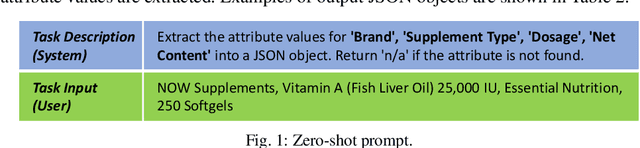
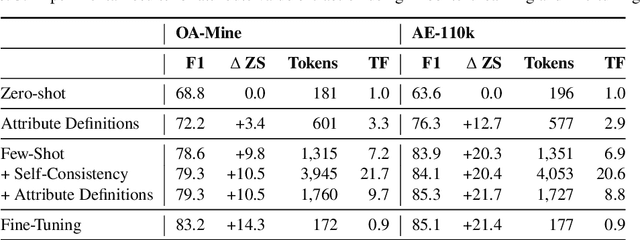
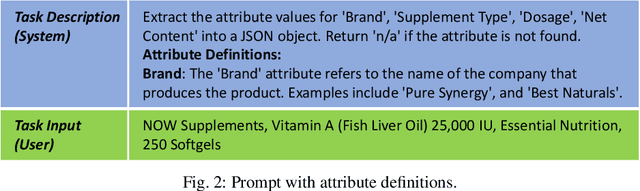
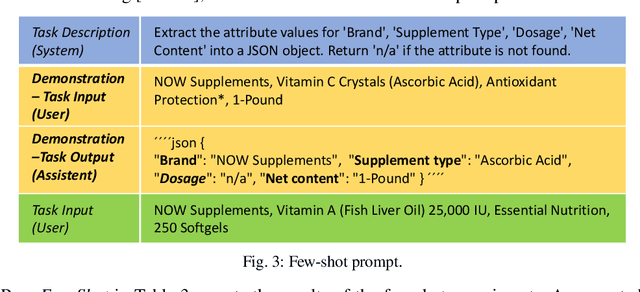
Structured product data, in the form of attribute-value pairs, is essential for e-commerce platforms to support features such as faceted product search and attribute-based product comparison. However, vendors often provide unstructured product descriptions, making attribute value extraction necessary to ensure data consistency and usability. Large language models (LLMs) have demonstrated their potential for product attribute value extraction in few-shot scenarios. Recent research has shown that self-refinement techniques can improve the performance of LLMs on tasks such as code generation and text-to-SQL translation. For other tasks, the application of these techniques has resulted in increased costs due to processing additional tokens, without achieving any improvement in performance. This paper investigates applying two self-refinement techniques, error-based prompt rewriting and self-correction, to the product attribute value extraction task. The self-refinement techniques are evaluated across zero-shot, few-shot in-context learning, and fine-tuning scenarios using GPT-4o. The experiments show that both self-refinement techniques have only a marginal impact on the model's performance across the different scenarios, while significantly increasing processing costs. For scenarios with training data, fine-tuning yields the highest performance, while the ramp-up costs of fine-tuning are balanced out as the amount of product descriptions increases.
Fine-tuning Large Language Models for Entity Matching
Sep 12, 2024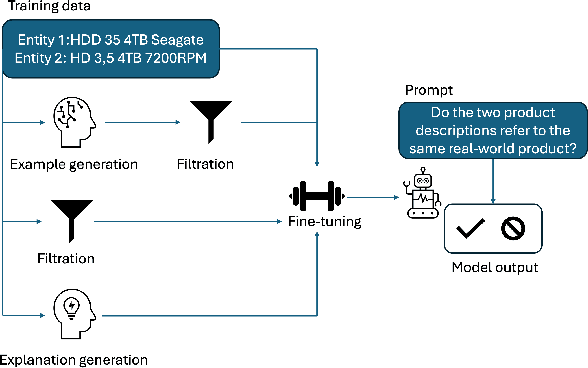
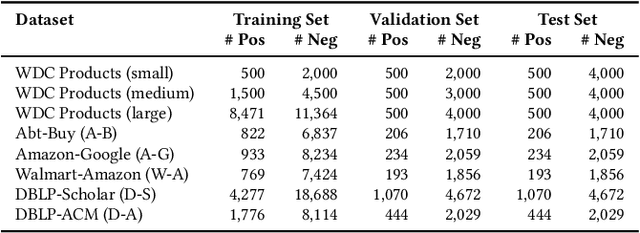
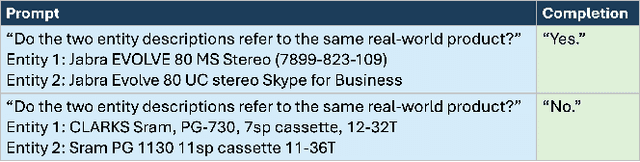
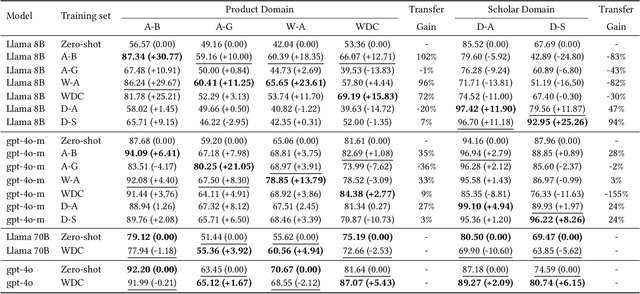
Generative large language models (LLMs) are a promising alternative to pre-trained language models for entity matching due to their high zero-shot performance and their ability to generalize to unseen entities. Existing research on using LLMs for entity matching has focused on prompt engineering and in-context learning. This paper explores the potential of fine-tuning LLMs for entity matching. We analyze fine-tuning along two dimensions: 1) The representation of training examples, where we experiment with adding different types of LLM-generated explanations to the training set, and 2) the selection and generation of training examples using LLMs. In addition to the matching performance on the source dataset, we investigate how fine-tuning affects the model's ability to generalize to other in-domain datasets as well as across topical domains. Our experiments show that fine-tuning significantly improves the performance of the smaller models while the results for the larger models are mixed. Fine-tuning also improves the generalization to in-domain datasets while hurting cross-domain transfer. We show that adding structured explanations to the training set has a positive impact on the performance of three out of four LLMs, while the proposed example selection and generation methods only improve the performance of Llama 3.1 8B while decreasing the performance of GPT-4o Mini.
Desk-AId: Humanitarian Aid Desk Assessment with Geospatial AI for Predicting Landmine Areas
May 15, 2024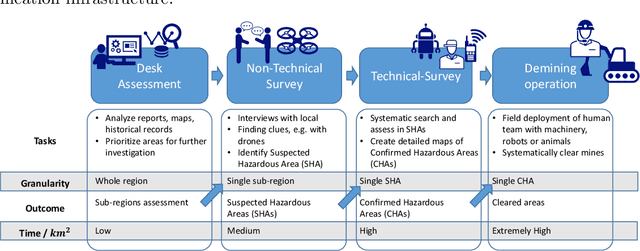
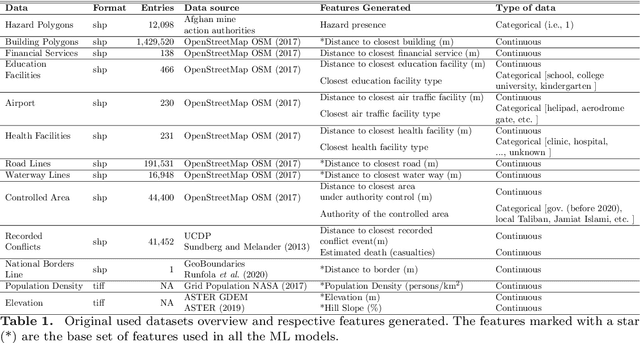


The process of clearing areas, namely demining, starts by assessing and prioritizing potential hazardous areas (i.e., desk assessment) to go under thorough investigation of experts, who confirm the risk and proceed with the mines clearance operations. This paper presents Desk-AId that supports the desk assessment phase by estimating landmine risks using geospatial data and socioeconomic information. Desk-AId uses a Geospatial AI approach specialized to landmines. The approach includes mixed data sampling strategies and context-enrichment by historical conflicts and key multi-domain facilities (e.g., buildings, roads, health sites). The proposed system addresses the issue of having only ground-truth for confirmed hazardous areas by implementing a new hard-negative data sampling strategy, where negative points are sampled in the vicinity of hazardous areas. Experiments validate Desk-Aid in two domains for landmine risk assessment: 1) country-wide, and 2) uncharted study areas). The proposed approach increases the estimation accuracies up to 92%, for different classification models such as RandomForest (RF), Feedforward Neural Networks (FNN), and Graph Neural Networks (GNN).
Using LLMs for the Extraction and Normalization of Product Attribute Values
Mar 05, 2024Product offers on e-commerce websites often consist of a textual product title and a textual product description. In order to provide features such as faceted product filtering or content-based product recommendation, the websites need to extract attribute-value pairs from the unstructured product descriptions. This paper explores the potential of using large language models (LLMs), such as OpenAI's GPT-3.5 and GPT-4, to extract and normalize attribute values from product titles and product descriptions. For our experiments, we introduce the WDC Product Attribute-Value Extraction (WDC PAVE) dataset. WDC PAVE consists of product offers from 87 websites that provide schema$.$org annotations. The offers belong to five different categories, each featuring a specific set of attributes. The dataset provides manually verified attribute-value pairs in two forms: (i) directly extracted values and (ii) normalized attribute values. The normalization of the attribute values requires systems to perform the following types of operations: name expansion, generalization, unit of measurement normalization, and string wrangling. Our experiments demonstrate that GPT-4 outperforms PLM-based extraction methods by 10%, achieving an F1-Score of 91%. For the extraction and normalization of product attribute values, GPT-4 achieves a similar performance to the extraction scenario, while being particularly strong at string wrangling and name expansion.
Product Attribute Value Extraction using Large Language Models
Oct 19, 2023E-commerce applications such as faceted product search or product comparison are based on structured product descriptions like attribute/value pairs. The vendors on e-commerce platforms do not provide structured product descriptions but describe offers using titles or descriptions. To process such offers, it is necessary to extract attribute/value pairs from textual product attributes. State-of-the-art attribute/value extraction techniques rely on pre-trained language models (PLMs), such as BERT. Two major drawbacks of these models for attribute/value extraction are that (i) the models require significant amounts of task-specific training data and (ii) the fine-tuned models face challenges in generalizing to attribute values not included in the training data. This paper explores the potential of large language models (LLMs) as a training data-efficient and robust alternative to PLM-based attribute/value extraction methods. We consider hosted LLMs, such as GPT-3.5 and GPT-4, as well as open-source LLMs based on Llama2. We evaluate the models in a zero-shot scenario and in a scenario where task-specific training data is available. In the zero-shot scenario, we compare various prompt designs for representing information about the target attributes of the extraction. In the scenario with training data, we investigate (i) the provision of example attribute values, (ii) the selection of in-context demonstrations, and (iii) the fine-tuning of GPT-3.5. Our experiments show that GPT-4 achieves an average F1-score of 85% on the two evaluation datasets while the best PLM-based techniques perform on average 5% worse using the same amount of training data. GPT-4 achieves a 10% higher F1-score than the best open-source LLM. The fine-tuned GPT-3.5 model reaches a similar performance as GPT-4 while being significantly more cost-efficient.