 Add to Chrome
 Add to Firefox
 Add to Edge
MaDI-Bench: An End-to-End Data Integration Benchmark
Jun 29, 2026
Data integration combines heterogeneous data sets into a single, coherent representation. Data integration involves a sequence of interdependent tasks including schema matching, value normalization, entity blocking, entity matching, and data fusion. Existing benchmarks either evaluate these steps in isolation or cover only incomplete versions of the data integration pipeline, omitting specific steps. The lack of public end-to-end data integration benchmarks hinders research on data integration methods that address the integration process as a whole. This paper fills this gap by introducing the Mannheim Data Integration Benchmark (MaDI-Bench), the first benchmark for the end-to-end integration of relational tables covering all steps of the integration process. MaDI-Bench contributes (i) a set of base end-to-end data integration tasks spanning several application domains, each requiring the full schema matching, value normalization, entity matching, and conflict resolution pipeline; and (ii) a generic method for deriving task variants that mitigates rapid benchmark saturation as data integration systems advance. We validate the benchmark using human-engineered pipelines, a best-of-breed pipeline, and an LLM-based pipeline. The validation demonstrates the utility of the benchmark for measuring the step-wise as well as the end-to-end performance of data integration pipelines. All benchmark artifacts are available for public download.

Labeling Training Data for Entity Matching Using Large Language Models
Jun 27, 2026Recent large language models (LLMs) achieve strong performance on entity matching without requiring task-specific training data. However, applying these models to large sets of candidate pairs remains slow and costly. In contrast, entity matchers using traditional machine learning methods or small language models (SLMs), such as RoBERTa, offer much faster inference but require task-specific training data. This paper investigates whether the need to provide task-specific training data can be avoided by using knowledge-distillation workflows, in which an LLM serves as a teacher model to label training pairs that are subsequently used to train a smaller student model. We investigate knowledge distillation for entity matching along the following dimensions: pair-selection strategy, teacher model, label post-processing method, and student model. We evaluate the workflows using the Abt-Buy, Walmart-Amazon, WDC Products, DBLP-ACM, and DBLP-Scholar benchmarks, and compare the performance of student models trained with machine-labeled data to the performance of the same models trained using the benchmark training sets. Our experiments show that student models trained using the machine-labeled sets perform approximately on par with models trained on the benchmark training sets, with the remaining differences in both directions staying below two F1 points. Using GPT-5.2 to label the training sets for all five benchmarks costs US\$28.31 to US\$40.88, whereas manually labeling the same training sets is estimated to require 470 hours of work. At inference time, Ditto is 41.5 to 534 times faster than directly using an LLM to perform the matching tasks. These results indicate that current LLMs, when combined with a suitable pair-selection method, can substantially reduce or even eliminate the manual effort required to label use case-specific training data for entity matching.
Automatic End-to-End Data Integration using Large Language Models
Mar 11, 2026Designing data integration pipelines typically requires substantial manual effort from data engineers to configure pipeline components and label training data. While LLMs have shown promise in handling individual steps of the integration process, their potential to replace all human input across end-to-end data integration pipelines has not been investigated. As a step toward exploring this potential, we present an automatic data integration pipeline that uses GPT-5.2 to generate all artifacts required to adapt the pipeline to specific use cases. These artifacts are schema mappings, value mappings for data normalization, training data for entity matching, and validation data for selecting conflict resolution heuristics in data fusion. We compare the performance of this LLM-based pipeline to the performance of human-designed pipelines along three case studies requiring the integration of video game, music, and company related data. Our experiments show that the LLM-based pipeline is able to produce similar results, for some tasks even better results, as the human-designed pipelines. End-to-end, the human and the LLM pipelines produce integrated datasets of comparable size and density. Having the LLM configure the pipelines costs approximately \$10 per case study, which represents only a small fraction of the cost of having human data engineers perform the same tasks.
Fine-tuning Large Language Models for Entity Matching
Sep 12, 2024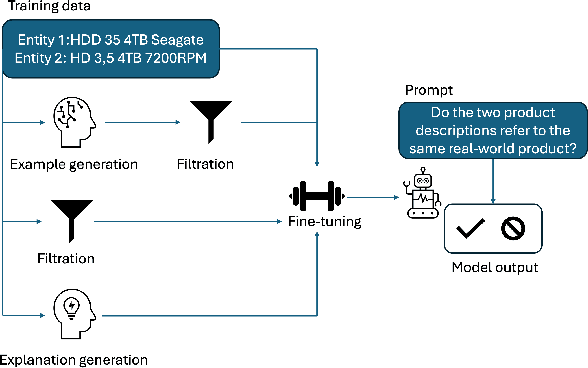
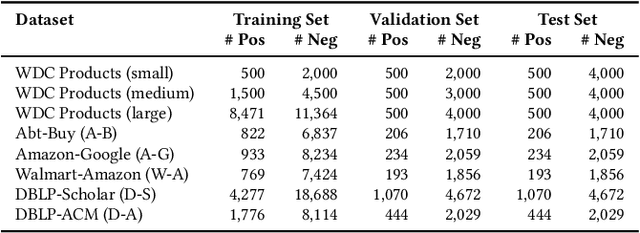
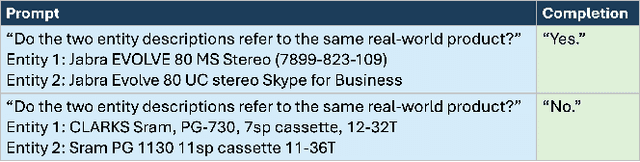
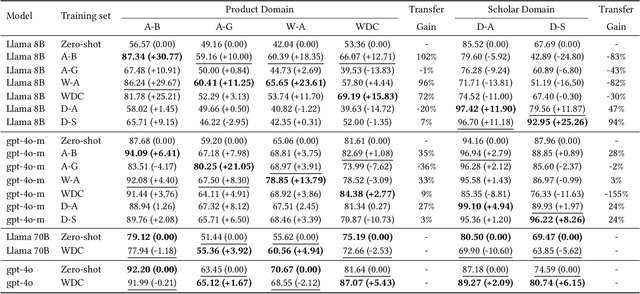
Generative large language models (LLMs) are a promising alternative to pre-trained language models for entity matching due to their high zero-shot performance and their ability to generalize to unseen entities. Existing research on using LLMs for entity matching has focused on prompt engineering and in-context learning. This paper explores the potential of fine-tuning LLMs for entity matching. We analyze fine-tuning along two dimensions: 1) The representation of training examples, where we experiment with adding different types of LLM-generated explanations to the training set, and 2) the selection and generation of training examples using LLMs. In addition to the matching performance on the source dataset, we investigate how fine-tuning affects the model's ability to generalize to other in-domain datasets as well as across topical domains. Our experiments show that fine-tuning significantly improves the performance of the smaller models while the results for the larger models are mixed. Fine-tuning also improves the generalization to in-domain datasets while hurting cross-domain transfer. We show that adding structured explanations to the training set has a positive impact on the performance of three out of four LLMs, while the proposed example selection and generation methods only improve the performance of Llama 3.1 8B while decreasing the performance of GPT-4o Mini.