 Add to Chrome
 Add to Firefox
 Add to Edge
TREA-Net: A Transferable Residual Epidemiological Adaptation Network for Dengue Incidence Forecasting
Jul 29, 2026
Accurate multi-week dengue forecasting supports timely vector-control interventions, outbreak preparedness, and healthcare resource allocation. However, newly established surveillance systems often lack the historical data needed to train reliable neural forecasting models. Although pretrained time-series models offer promising zero-shot forecasts, their cross-domain training may not capture local epidemiological dynamics. We propose TREA-Net, a Transferable Residual Epidemiological Adaptation Network for dengue forecasting under limited data. TREA-Net augments neural forecasting backbones with projections from an Environmental Time-Series Susceptible-Infected-Recovered model and learns a lightweight gated residual correction transferable from data-rich to data-scarce regions. Its node-invariant design accommodates surveillance systems with different numbers of locations, while target adaptation requires learning only two global parameters. We transfer knowledge from long-running dengue surveillance in Colombia and Nicaragua to 8-week-ahead forecasting in Mexico and Malaysia using only 78 or 104 weeks of target data. Across five neural backbones and ten transfer settings, TREA-Net improves the corresponding backbone in 9 out of 10 settings, with statistically significant gains. When integrated with TiRex, a foundation model for forecasting, it achieves the lowest mean absolute error across all target datasets. Conformal prediction further maintains empirical coverage while reducing 8-week prediction-interval width by 29.6% in Mexico. These results demonstrate TREA-Net's potential as a lightweight and portable early-warning framework for health agencies with limited surveillance data.

Identifying Influential Pandemic Regions Using Graph Signal Variation
Nov 10, 2022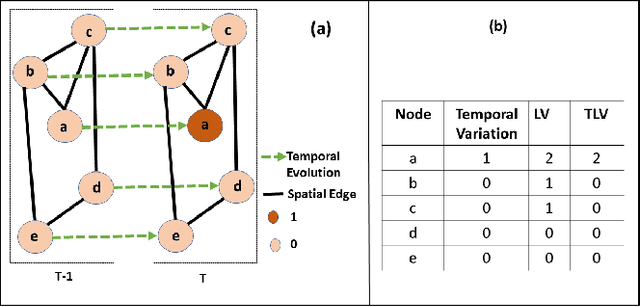
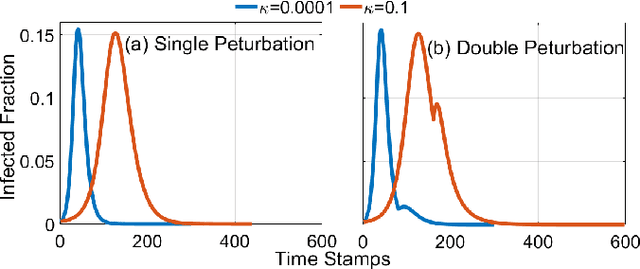
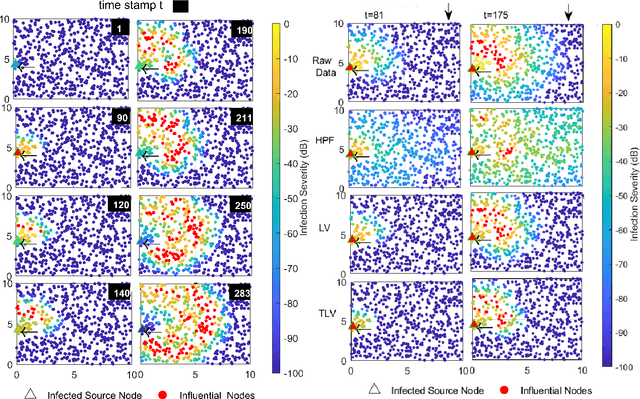
Developing methods to analyse infection spread is an important step in the study of pandemic and containing them. The principal mode for geographical spreading of pandemics is the movement of population across regions. We are interested in identifying regions (cities, states, or countries) which are influential in aggressively spreading the disease to neighboring regions. We consider a meta-population network with SIR (Susceptible-Infected-Recovered) dynamics and develop graph signal-based metrics to identify influential regions. Specifically, a local variation and a temporal local variation metric is proposed. Simulations indicate usefulness of the local variation metrics over the global graph-based processing such as filtering.