 Add to Chrome
 Add to Firefox
 Add to Edge
Sample-wise Constrained Learning via a Sequential Penalty Approach with Applications in Image Processing
Jan 23, 2026
In many learning tasks, certain requirements on the processing of individual data samples should arguably be formalized as strict constraints in the underlying optimization problem, rather than by means of arbitrary penalties. We show that, in these scenarios, learning can be carried out exploiting a sequential penalty method that allows to properly deal with constraints. The proposed algorithm is shown to possess convergence guarantees under assumptions that are reasonable in deep learning scenarios. Moreover, the results of experiments on image processing tasks show that the method is indeed viable to be used in practice.

Neuromorphic Event-based Facial Expression Recognition
Apr 13, 2023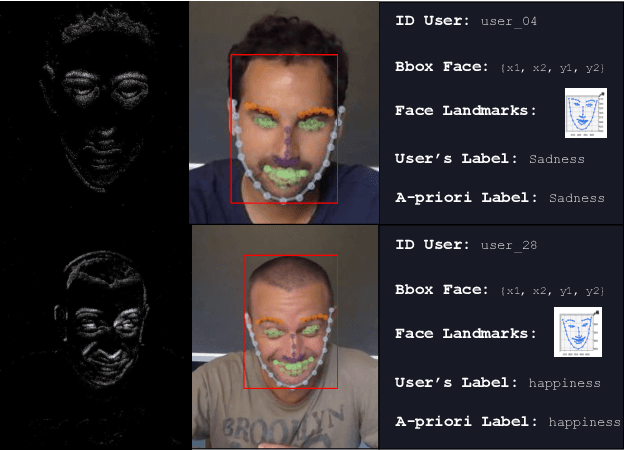

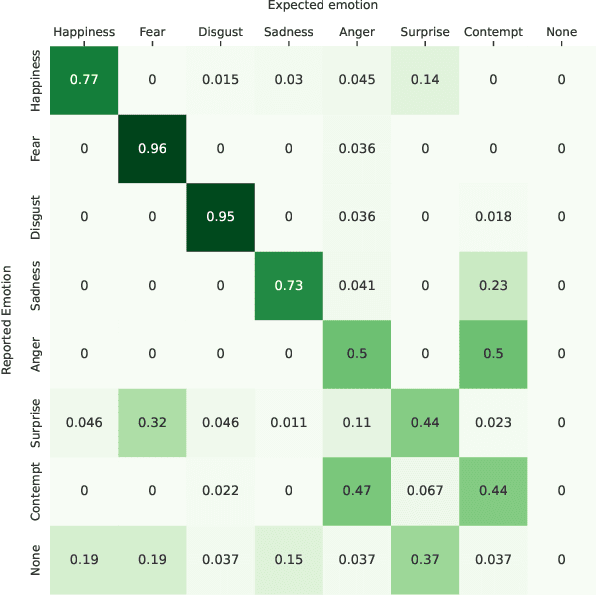
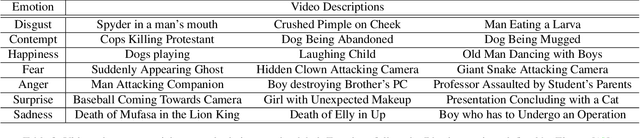
Recently, event cameras have shown large applicability in several computer vision fields especially concerning tasks that require high temporal resolution. In this work, we investigate the usage of such kind of data for emotion recognition by presenting NEFER, a dataset for Neuromorphic Event-based Facial Expression Recognition. NEFER is composed of paired RGB and event videos representing human faces labeled with the respective emotions and also annotated with face bounding boxes and facial landmarks. We detail the data acquisition process as well as providing a baseline method for RGB and event data. The collected data captures subtle micro-expressions, which are hard to spot with RGB data, yet emerge in the event domain. We report a double recognition accuracy for the event-based approach, proving the effectiveness of a neuromorphic approach for analyzing fast and hardly detectable expressions and the emotions they conceal.