 Add to Chrome
 Add to Firefox
 Add to Edge
From Style Replication to Style Exploration: Enabling Art Style Exploration with Analyze-Experiment-Resituate Framework
Aug 14, 2026
Art style is a signature of professional digital artists that develops through repeated experimentation, reflection, and adaptation. While generative AI (GenAI) can reproduce styles with high fidelity, current tools provide limited support for exploring new stylistic directions and may encourage style replication over exploration. To address this gap, we propose Analyze-Experiment-Resituate (AER), a framework for AI-assisted style exploration derived from interviews with 10 professional digital artists. Rather than prioritizing visually appealing outputs alone, AER supports three core practices of style exploration, including interpreting references, trying out stylistic possibilities, and reflecting on how emerging styles may be received. Specifically, AER enabled artists to (1) analyze artworks into interpretable stylistic elements, (2) have controllable experimentation guided by their own choices, and (3) resituate emerging styles through simulated social perspectives. We implemented AER in a prototype system and evaluated it in a controlled study with 16 artists. Compared with a direct style-transfer workflow, AER increased artists' agency and reflection as they pursued new stylistic directions. A two-week field study with four artists revealed how the AER framework influenced daily style exploration, such as reflection, experimentation, and stylistic decision-making at each stage. We discuss opportunities and challenges in designing AI-assisted style-exploration workflows, and outline implications for future artistic support tools.

Understanding and Supporting Formal Email Exchange by Answering AI-Generated Questions
Feb 06, 2025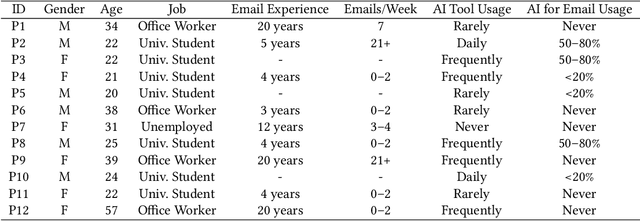
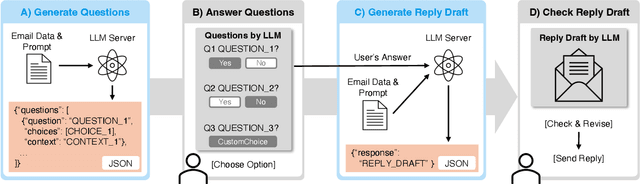

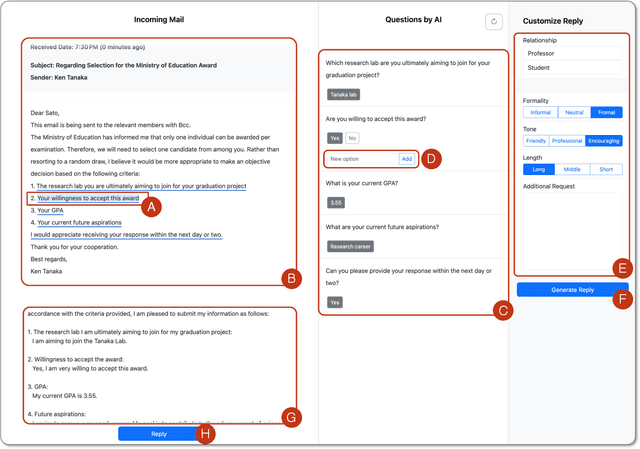
Replying to formal emails is time-consuming and cognitively demanding, as it requires polite phrasing and ensuring an adequate response to the sender's demands. Although systems with Large Language Models (LLM) were designed to simplify the email replying process, users still needed to provide detailed prompts to obtain the expected output. Therefore, we proposed and evaluated an LLM-powered question-and-answer (QA)-based approach for users to reply to emails by answering a set of simple and short questions generated from the incoming email. We developed a prototype system, ResQ, and conducted controlled and field experiments with 12 and 8 participants. Our results demonstrated that QA-based approach improves the efficiency of replying to emails and reduces workload while maintaining email quality compared to a conventional prompt-based approach that requires users to craft appropriate prompts to obtain email drafts. We discuss how QA-based approach influences the email reply process and interpersonal relationship dynamics, as well as the opportunities and challenges associated with using a QA-based approach in AI-mediated communication.
From Voice to Value: Leveraging AI to Enhance Spoken Online Reviews on the Go
Dec 06, 2024Online reviews help people make better decisions. Review platforms usually depend on typed input, where leaving a good review requires significant effort because users must carefully organize and articulate their thoughts. This may discourage users from leaving comprehensive and high-quality reviews, especially when they are on the go. To address this challenge, we developed Vocalizer, a mobile application that enables users to provide reviews through voice input, with enhancements from a large language model (LLM). In a longitudinal study, we analysed user interactions with the app, focusing on AI-driven features that help refine and improve reviews. Our findings show that users frequently utilized the AI agent to add more detailed information to their reviews. We also show how interactive AI features can improve users self-efficacy and willingness to share reviews online. Finally, we discuss the opportunities and challenges of integrating AI assistance into review-writing systems.