 Add to Chrome
 Add to Firefox
 Add to Edge
Plenoptic imaging of particle interactions in scintillation detectors
Jul 01, 2026
Accurate 3D localization of radiation interactions in scintillation detectors is essential for nuclear and particle physics, safeguards, and medical imaging, but remains difficult in light-starved regimes with limited photon statistics. We present PRISM, a multifocal plenoptic imaging system designed for millimeter-scale 3D position reconstruction in a single-volume scintillator. PRISM uses a multifocal microlens array with diverse focal lengths and high effective numerical aperture to balance photon collection with spatial and depth encoding. A Cram'er--Rao lower bound analysis shows that the multifocal design improves axial sensitivity over conventional unifocal plenoptic systems under photon-limited conditions. We build a prototype system, calibrate its optical response with a tunable light source, and form photon-limited measurements with $\mathcal{O}(100)$ detected photons. For sparse single-vertex events, we reconstruct interaction locations using an Alternating Descent Conditional Gradient-inspired algorithm and demonstrate an average 3D localization error of approximately 1 mm. We also provide an initial evaluation of double-vertex events, showing that localization improves as the axial separation between interactions increases. These results demonstrate that multifocal plenoptic imaging can mitigate the traditional trade-off between light collection and spatial resolution, providing a photon-efficient approach to 3D reconstruction in scintillation detectors and a foundation for future multi-scattering event reconstruction.

Accelerating 4D Hyperspectral Imaging through Physics-Informed Neural Representation and Adaptive Sampling
Apr 08, 2026High-dimensional hyperspectral imaging (HSI) enables the visualization of ultrafast molecular dynamics and complex, heterogeneous spectra. However, applying this capability to resolve spatially varying vibrational couplings in two-dimensional infrared (2DIR) spectroscopy, a type of coherent multidimensional spectroscopy (CMDS), necessitates prohibitively long data acquisition, driven by dense Nyquist sampling requirements and the need for extensive signal accumulation. To address this challenge, we introduce a physics-informed neural representation approach that efficiently reconstructs dense spatially-resolved 2DIR hyperspectral images from sparse experimental measurements. In particular, we used a multilayer perceptron (MLP) to model the relationship between the sub-sampled 4D coordinates and their corresponding spectral intensities, and recover densely sampled 4D spectra from limited observations. The reconstruction results demonstrate that our method, using a fraction of the samples, faithfully recovers both oscillatory and non-oscillatory spectral dynamics in experimental measurement. Moreover, we develop a loss-aware adaptive sampling method to progressively introduce potentially informative samples for iterative data collection while conducting experiments. Experimental results show that the proposed approach achieves high-fidelity spectral recovery using only $1/32$ of the sampling budget, as opposed to exhaustive sampling, effectively reducing total experiment time by up to 32-fold. This framework offers a scalable solution for accelerating any experiments with hypercube data, including multidimensional spectroscopy and hyperspectral imaging, paving the way for rapid chemical imaging of transient biological and material systems.
A Differentiable Wave Optics Model for End-to-End Computational Imaging System Optimization
Dec 13, 2024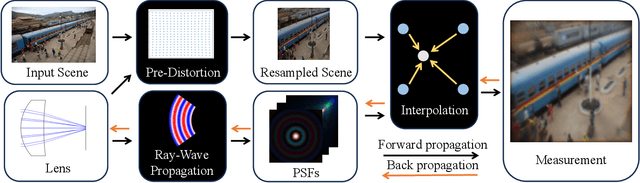

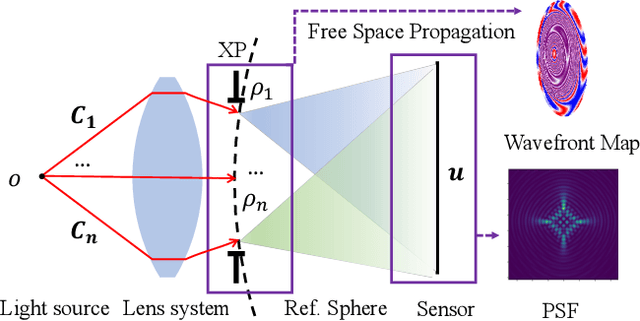
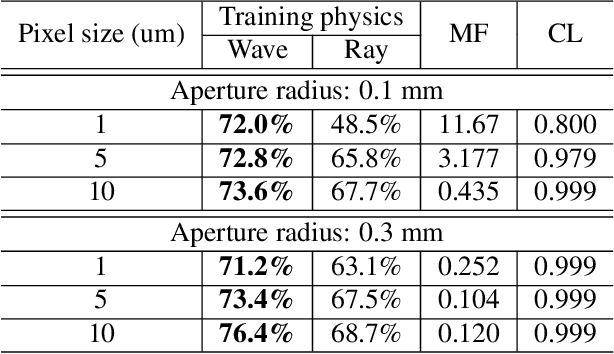
End-to-end optimization, which simultaneously optimizes optics and algorithms, has emerged as a powerful data-driven method for computational imaging system design. This method achieves joint optimization through backpropagation by incorporating differentiable optics simulators to generate measurements and algorithms to extract information from measurements. However, due to high computational costs, it is challenging to model both aberration and diffraction in light transport for end-to-end optimization of compound optics. Therefore, most existing methods compromise physical accuracy by neglecting wave optics effects or off-axis aberrations, which raises concerns about the robustness of the resulting designs. In this paper, we propose a differentiable optics simulator that efficiently models both aberration and diffraction for compound optics. Using the simulator, we conduct end-to-end optimization on scene reconstruction and classification. Experimental results demonstrate that both lenses and algorithms adopt different configurations depending on whether wave optics is modeled. We also show that systems optimized without wave optics suffer from performance degradation when wave optics effects are introduced during testing. These findings underscore the importance of accurate wave optics modeling in optimizing imaging systems for robust, high-performance applications.