 Add to Chrome
 Add to Firefox
 Add to Edge
AffordSim: A Scalable Data Generator and Benchmark for Affordance-Aware Robotic Manipulation
Apr 13, 2026
Simulation-based data generation has become a dominant paradigm for training robotic manipulation policies, yet existing platforms do not incorporate object affordance information into trajectory generation. As a result, tasks requiring precise interaction with specific functional regions--grasping a mug by its handle, pouring from a cup's rim, or hanging a mug on a hook--cannot be automatically generated with semantically correct trajectories. We introduce AffordSim, the first simulation framework that integrates open-vocabulary 3D affordance prediction into the manipulation data generation pipeline. AffordSim uses our VoxAfford model, an open-vocabulary 3D affordance detector that enhances MLLM output tokens with multi-scale geometric features, to predict affordance maps on object point clouds, guiding grasp pose estimation toward task-relevant functional regions. Built on NVIDIA Isaac Sim with cross-embodiment support (Franka FR3, Panda, UR5e, Kinova), VLM-powered task generation, and novel domain randomization using DA3-based 3D Gaussian reconstruction from real photographs, AffordSim enables automated, scalable generation of affordance-aware manipulation data. We establish a benchmark of 50 tasks across 7 categories (grasping, placing, stacking, pushing/pulling, pouring, mug hanging, long-horizon composite) and evaluate 4 imitation learning baselines (BC, Diffusion Policy, ACT, Pi 0.5). Our results reveal that while grasping is largely solved (53-93% success), affordance-demanding tasks such as pouring into narrow containers (1-43%) and mug hanging (0-47%) remain significantly more challenging for current imitation learning methods, highlighting the need for affordance-aware data generation. Zero-shot sim-to-real experiments on a real Franka FR3 validate the transferability of the generated data.

Multi-Goal Dexterous Hand Manipulation using Probabilistic Model-based Reinforcement Learning
Apr 30, 2025This paper tackles the challenge of learning multi-goal dexterous hand manipulation tasks using model-based Reinforcement Learning. We propose Goal-Conditioned Probabilistic Model Predictive Control (GC-PMPC) by designing probabilistic neural network ensembles to describe the high-dimensional dexterous hand dynamics and introducing an asynchronous MPC policy to meet the control frequency requirements in real-world dexterous hand systems. Extensive evaluations on four simulated Shadow Hand manipulation scenarios with randomly generated goals demonstrate GC-PMPC's superior performance over state-of-the-art baselines. It successfully drives a cable-driven Dexterous hand, DexHand 021 with 12 Active DOFs and 5 tactile sensors, to learn manipulating a cubic die to three goal poses within approximately 80 minutes of interactions, demonstrating exceptional learning efficiency and control performance on a cost-effective dexterous hand platform.
Effective Multi-Agent Deep Reinforcement Learning Control with Relative Entropy Regularization
Sep 26, 2023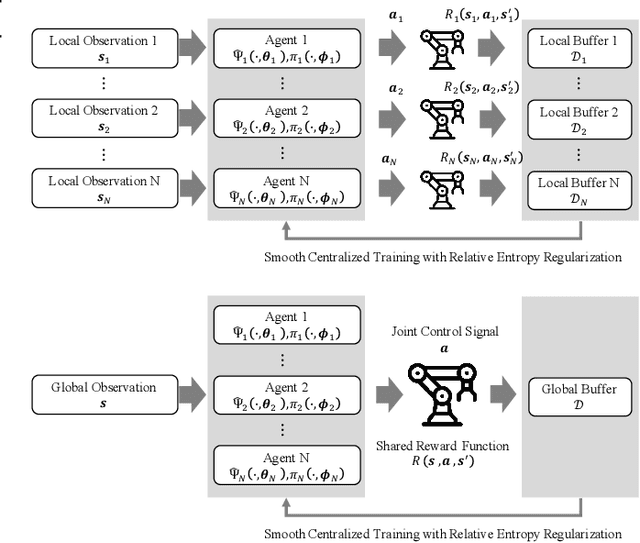
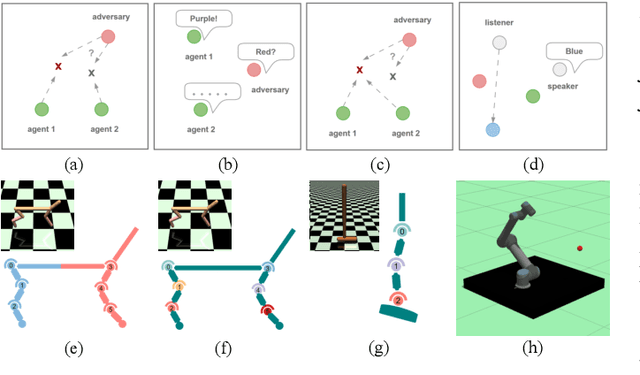
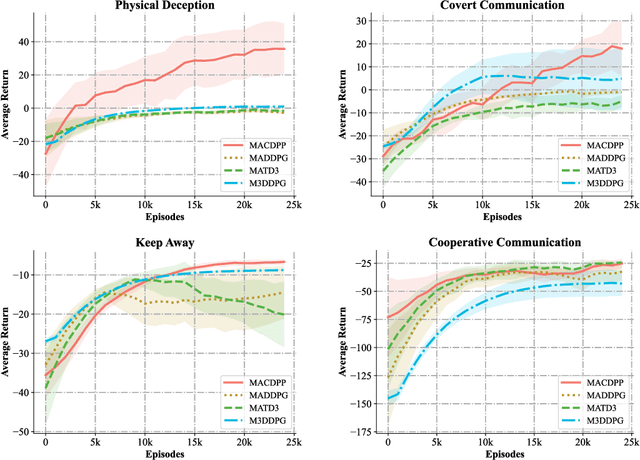
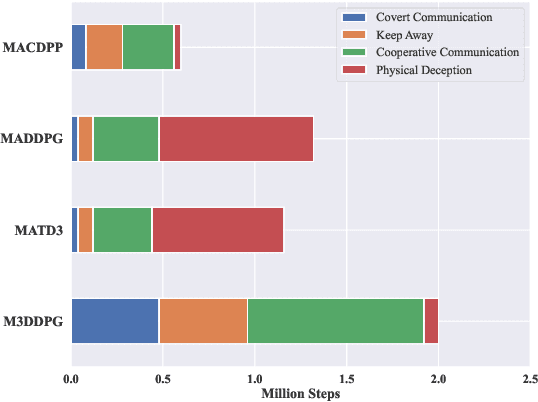
In this paper, a novel Multi-agent Reinforcement Learning (MARL) approach, Multi-Agent Continuous Dynamic Policy Gradient (MACDPP) was proposed to tackle the issues of limited capability and sample efficiency in various scenarios controlled by multiple agents. It alleviates the inconsistency of multiple agents' policy updates by introducing the relative entropy regularization to the Centralized Training with Decentralized Execution (CTDE) framework with the Actor-Critic (AC) structure. Evaluated by multi-agent cooperation and competition tasks and traditional control tasks including OpenAI benchmarks and robot arm manipulation, MACDPP demonstrates significant superiority in learning capability and sample efficiency compared with both related multi-agent and widely implemented signal-agent baselines and therefore expands the potential of MARL in effectively learning challenging control scenarios.