 Add to Chrome
 Add to Firefox
 Add to Edge
MARCUS: Missing-Aware Region Representation with Contextual Urban Signals for Rent Prediction
Aug 19, 2026
Multimodal urban data has expanded the applications of urban region representation learning, such as functional zone identification and real estate appraisal, but also introduces challenges caused by data incompleteness. Existing studies usually handle missing data through imputation, treating missingness as noise while ignoring its potential semantic value. To address this issue, we propose MARCUS, a missing-aware region representation model that treats missingness as a contextual urban signal. MARCUS models missingness in three stages: Intra Learning jointly encodes observed features and missing patterns, Inter Learning estimates modality reliability to guide cross-modal interaction, and Fusion uses missing-aware and time-aware gating to generate the final region embedding. We apply MARCUS to rent prediction, a task with long-term trends and seasonal fluctuations, using real-world datasets from Sydney and New York. Experimental results show that MARCUS achieves state-of-the-art performance, reducing MAE by 51.35% on Sydney and 12.62% on New York compared with the best baselines. Additional experiments, including an imputation-based ablation study and randomized additional-missingness analysis, further demonstrate the effectiveness of the proposed method.

Transferring Physical Priors into Remote Sensing Segmentation via Large Language Models
Mar 29, 2026Semantic segmentation of remote sensing imagery is fundamental to Earth observation. Achieving accurate results requires integrating not only optical images but also physical variables such as the Digital Elevation Model (DEM), Synthetic Aperture Radar (SAR) and Normalized Difference Vegetation Index (NDVI). Recent foundation models (FMs) leverage pre-training to exploit these variables but still depend on spatially aligned data and costly retraining when involving new sensors. To overcome these limitations, we introduce a novel paradigm for integrating domain-specific physical priors into segmentation models. We first construct a Physical-Centric Knowledge Graph (PCKG) by prompting large language models to extract physical priors from 1,763 vocabularies, and use it to build a heterogeneous, spatial-aligned dataset, Phy-Sky-SA. Building on this foundation, we develop PriorSeg, a physics-aware residual refinement model trained with a joint visual-physical strategy that incorporates a novel physics-consistency loss. Experiments on heterogeneous settings demonstrate that PriorSeg improves segmentation accuracy and physical plausibility without retraining the FMs. Ablation studies verify the effectiveness of the Phy-Sky-SA dataset, the PCKG, and the physics-consistency loss.
Multimodal Machine Learning for Real Estate Appraisal: A Comprehensive Survey
Mar 28, 2025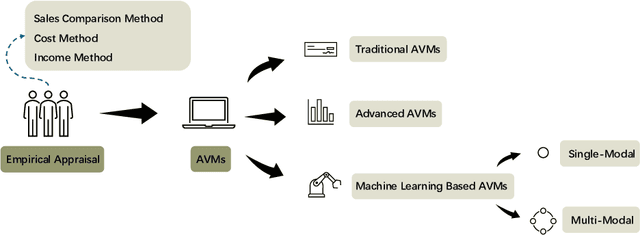
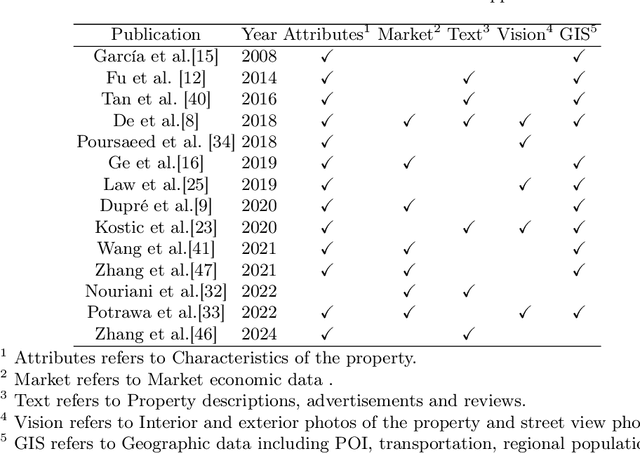
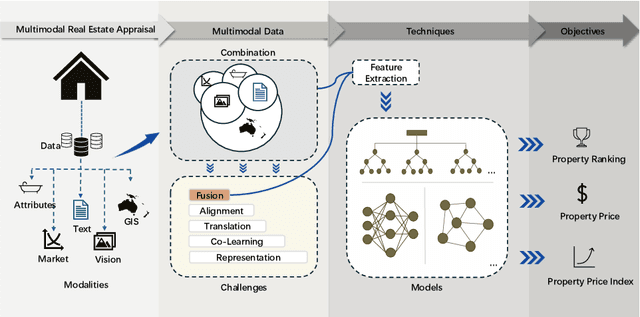
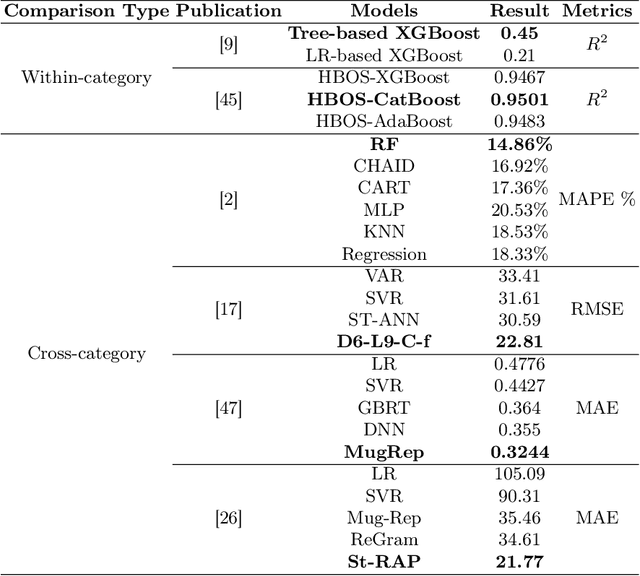
Real estate appraisal has undergone a significant transition from manual to automated valuation and is entering a new phase of evolution. Leveraging comprehensive attention to various data sources, a novel approach to automated valuation, multimodal machine learning, has taken shape. This approach integrates multimodal data to deeply explore the diverse factors influencing housing prices. Furthermore, multimodal machine learning significantly outperforms single-modality or fewer-modality approaches in terms of prediction accuracy, with enhanced interpretability. However, systematic and comprehensive survey work on the application in the real estate domain is still lacking. In this survey, we aim to bridge this gap by reviewing the research efforts. We begin by reviewing the background of real estate appraisal and propose two research questions from the perspecve of performance and fusion aimed at improving the accuracy of appraisal results. Subsequently, we explain the concept of multimodal machine learning and provide a comprehensive classification and definition of modalities used in real estate appraisal for the first time. To ensure clarity, we explore works related to data and techniques, along with their evaluation methods, under the framework of these two research questions. Furthermore, specific application domains are summarized. Finally, we present insights into future research directions including multimodal complementarity, technology and modality contribution.