 Add to Chrome
 Add to Firefox
 Add to Edge
Batched Kernelized Bandits: Refinements and Extensions
Mar 13, 2026
In this paper, we consider the problem of black-box optimization with noisy feedback revealed in batches, where the unknown function to optimize has a bounded norm in some Reproducing Kernel Hilbert Space (RKHS). We refer to this as the Batched Kernelized Bandits problem, and refine and extend existing results on regret bounds. For algorithmic upper bounds, (Li and Scarlett, 2022) shows that $B=O(\log\log T)$ batches suffice to attain near-optimal regret, where $T$ is the time horizon and $B$ is the number of batches. We further refine this by (i) finding the optimal number of batches including constant factors (to within $1+o(1)$), and (ii) removing a factor of $B$ in the regret bound. For algorithm-independent lower bounds, noticing that existing results only apply when the batch sizes are fixed in advance, we present novel lower bounds when the batch sizes are chosen adaptively, and show that adaptive batches have essentially same minimax regret scaling as fixed batches. Furthermore, we consider a robust setting where the goal is to choose points for which the function value remains high even after an adversarial perturbation. We present the robust-BPE algorithm, and show that a suitably-defined cumulative regret notion incurs the same bound as the non-robust setting, and derive a simple regret bound significantly below that of previous work.

Determinants of Training Corpus Size for Clinical Text Classification
Jan 22, 2026Introduction: Clinical text classification using natural language processing (NLP) models requires adequate training data to achieve optimal performance. For that, 200-500 documents are typically annotated. The number is constrained by time and costs and lacks justification of the sample size requirements and their relationship to text vocabulary properties. Methods: Using the publicly available MIMIC-III dataset containing hospital discharge notes with ICD-9 diagnoses as labels, we employed pre-trained BERT embeddings followed by Random Forest classifiers to identify 10 randomly selected diagnoses, varying training corpus sizes from 100 to 10,000 documents, and analyzed vocabulary properties by identifying strong and noisy predictive words through Lasso logistic regression on bag-of-words embeddings. Results: Learning curves varied significantly across the 10 classification tasks despite identical preprocessing and algorithms, with 600 documents sufficient to achieve 95% of the performance attainable with 10,000 documents for all tasks. Vocabulary analysis revealed that more strong predictors and fewer noisy predictors were associated with steeper learning curves, where every 100 additional noisy words decreased accuracy by approximately 0.02 while 100 additional strong predictors increased maximum accuracy by approximately 0.04.
POE: Process of Elimination for Multiple Choice Reasoning
Oct 24, 2023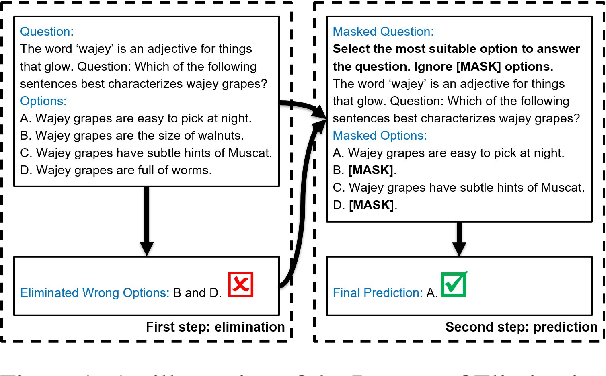
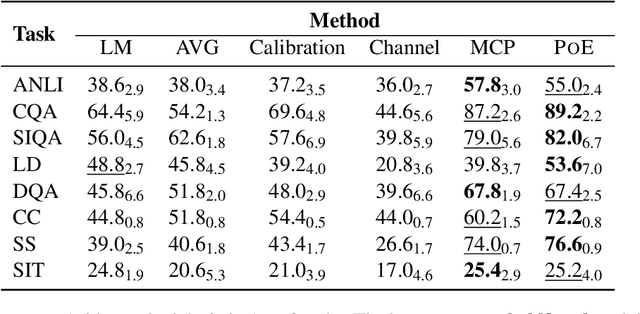
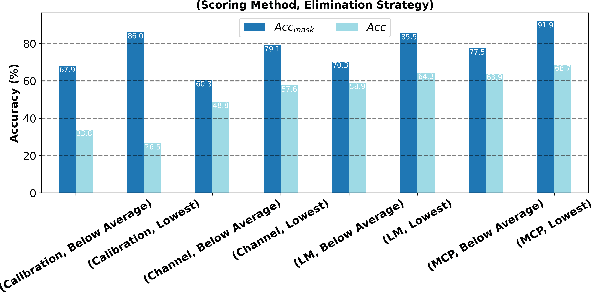
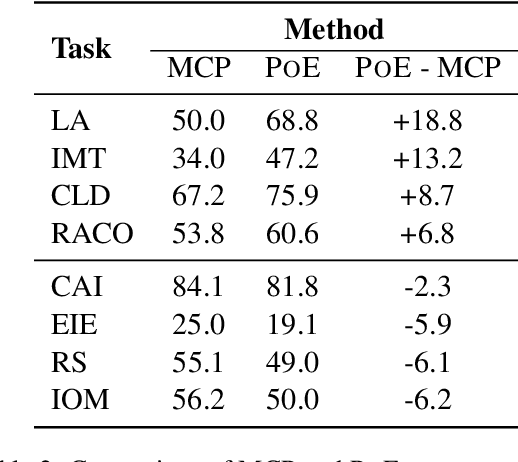
Language models (LMs) are capable of conducting in-context learning for multiple choice reasoning tasks, but the options in these tasks are treated equally. As humans often first eliminate wrong options before picking the final correct answer, we argue a similar two-step strategy can make LMs better at these tasks. To this end, we present the Process of Elimination (POE), a two-step scoring method. In the first step, POE scores each option, and eliminates seemingly wrong options. In the second step, POE masks these wrong options, and makes the final prediction from the remaining options. Zero-shot experiments on 8 reasoning tasks illustrate the effectiveness of POE, and a following analysis finds our method to be especially performant on logical reasoning tasks. We further analyze the effect of masks, and show that POE applies to few-shot settings and large language models (LLMs) like ChatGPT.
Prompt Engineering and Calibration for Zero-Shot Commonsense Reasoning
Apr 14, 2023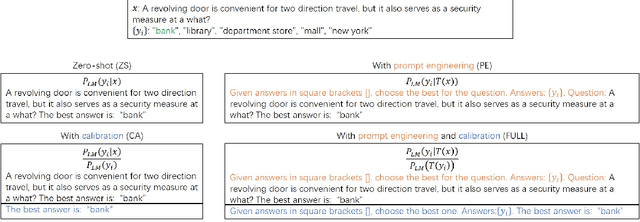


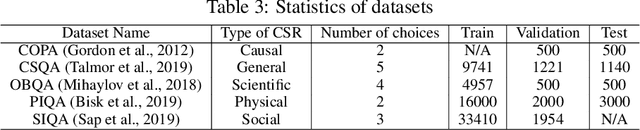
Prompt engineering and calibration make large language models excel at reasoning tasks, including multiple choice commonsense reasoning. From a practical perspective, we investigate and evaluate these strategies on smaller language models. Through experiments on five commonsense reasoning benchmarks, we find that each strategy favors certain models, but their joint effects are mostly negative.