 Add to Chrome
 Add to Firefox
 Add to Edge
Backdooring Masked Diffusion Language Models
May 19, 2026
Masked diffusion language models (MDLMs) are emerging as a compelling new paradigm for text generation, but their training-time security remains largely unexplored. Existing backdoor attacks on Gaussian diffusion models or autoregressive language models do not directly apply to MDLMs because MDLMs rely on discrete state corruption and iterative denoising rather than continuous noising or left-to-right prediction. In this work, we present the first systematic study of training-time backdoor attacks on MDLMs. We propose SHADOWMASK, a backdoor attack that modifies the MDLM forward corruption process by replacing the standard all-mask terminal distribution with a trigger-mask mixture prior. This creates a dedicated denoising pathway from trigger-corrupted states to attacker-specified targets while preserving clean denoising behavior. We further provide a principled mathematical formulation by defining the backdoored forward process, deriving the reverse-time posterior, and obtaining the continuous-time training objective. Evaluations on DiT-based MDLM and LLaDA-8B-Instruct across WikiText-103, OpenWebText, and Alpaca show that SHADOWMASK achieves near-100% attack success, substantially outperforms standard data poisoning, largely preserves clean utility, remains effective under full-model and parameter-efficient fine-tuning, and is robust against representative defenses.

Sensing Capacity for Integrated Sensing and Communication Systems in Low-Altitude Economy
Nov 11, 2024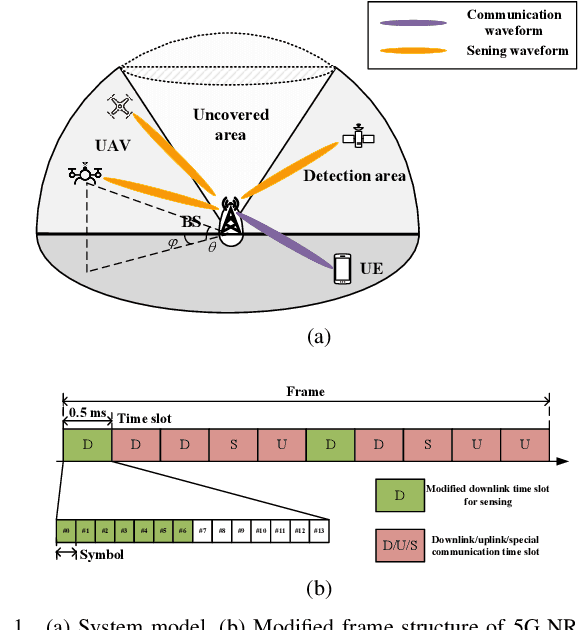
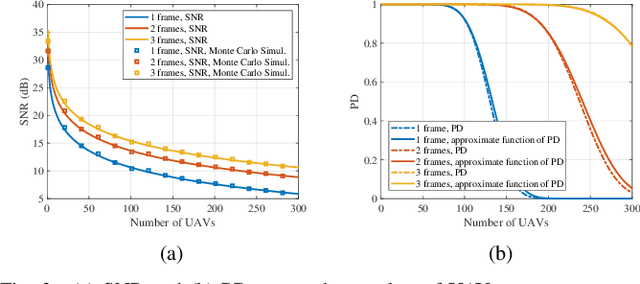
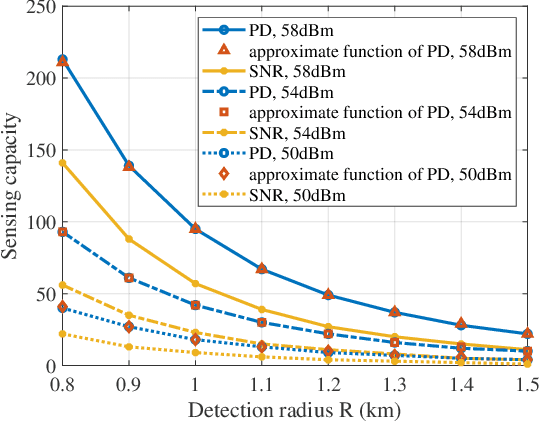
The burgeoning significance of the low-altitude economy (LAE) has garnered considerable interest, largely fuelled by the widespread deployment of unmanned aerial vehicles (UAVs). To tackle the challenges associated with the detection of unauthorized UAVs and the efficient scheduling of authorized UAVs, this letter introduces a novel performance metric, termed sensing capacity, for integrated sensing and communication (ISAC) systems. This metric, which quantifies the capability of a base station (BS) to detect multiple UAVs simultaneously, leverages signal-to-noise ratio (SNR) and probability of detection (PD) as key intermediate variables. Through mathematical derivations, we can derive a closed-form solution for the maximum number of UAVs that can be detected by the BS while adhering to a specific SNR constraint. Furthermore, an approximate solution based on PD constraints is proposed to facilitate the efficient determination of the threshold for the maximum number of detectable UAVs. The accuracy of this analytical approach is verified through extensive simulation results.